
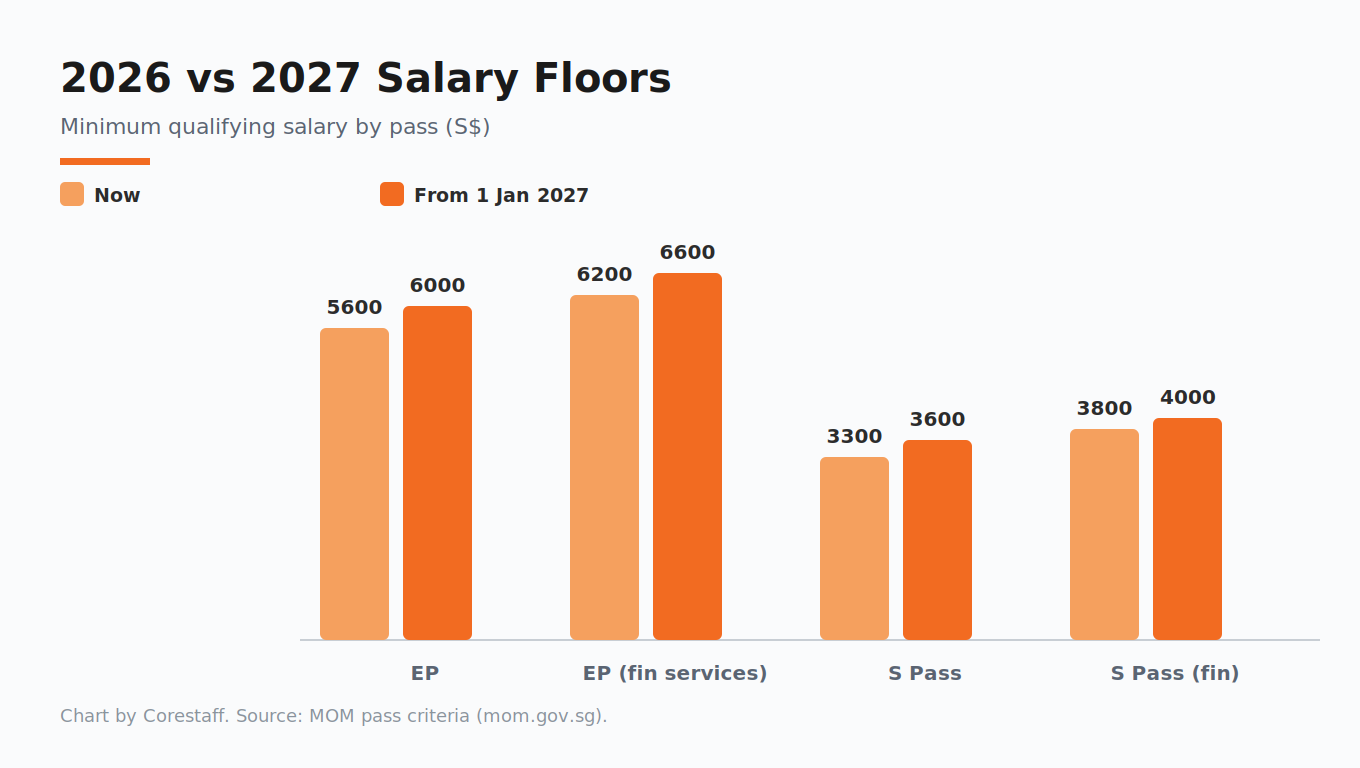
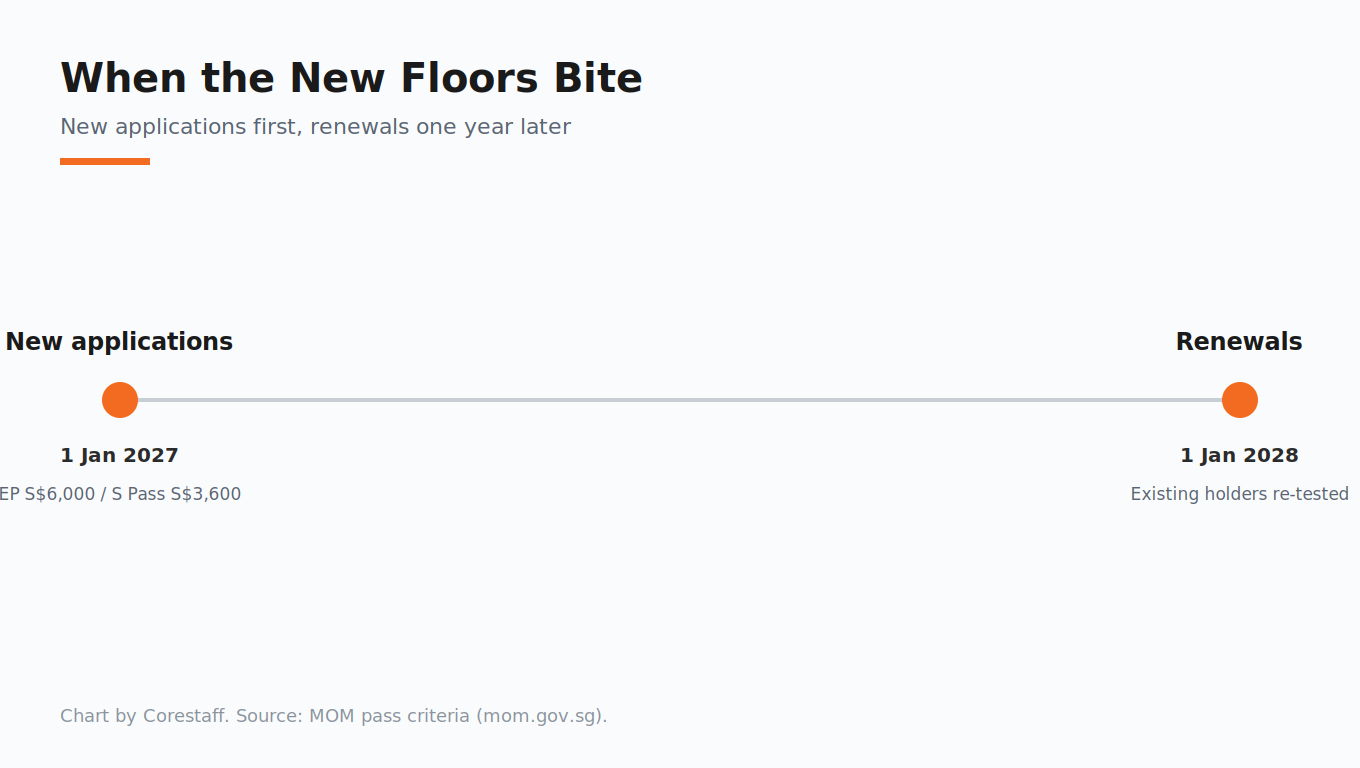
From 1 January 2027 the Employment Pass floor moves from S$5,600 to S$6,000 a month, and the S Pass floor moves from S$3,300 to S$3,600. New applications are affected first, and renewals from 1 January 2028. That gives employers one full budget cycle to prepare, and most of them will need it, because replacing or re-banding a long-serving pass holder mid-project is far more expensive than a planned adjustment.

This guide explains what changes, when it bites, and how to run a one-pass exposure review over your existing roster. If you want the underlying cost model first, start with our 2026 work pass cost guide. Corestaff’s hiring team runs this exposure review with employers every quarter, and its sector-specialist recruiters work from the same floors when they shortlist.
What changes, and when

| Pass | Floor now | Floor from 1 Jan 2027 | Applies to |
|---|---|---|---|
| Employment Pass | S$5,600 | S$6,000 | New applications 2027, renewals 2028 |
| Employment Pass (financial services) | S$6,200 | S$6,600 | New applications 2027, renewals 2028 |
| S Pass | S$3,300 | S$3,600 | New applications 2027, renewals 2028 |
| S Pass (financial services) | S$3,800 | S$4,000 | New applications 2027, renewals 2028 |
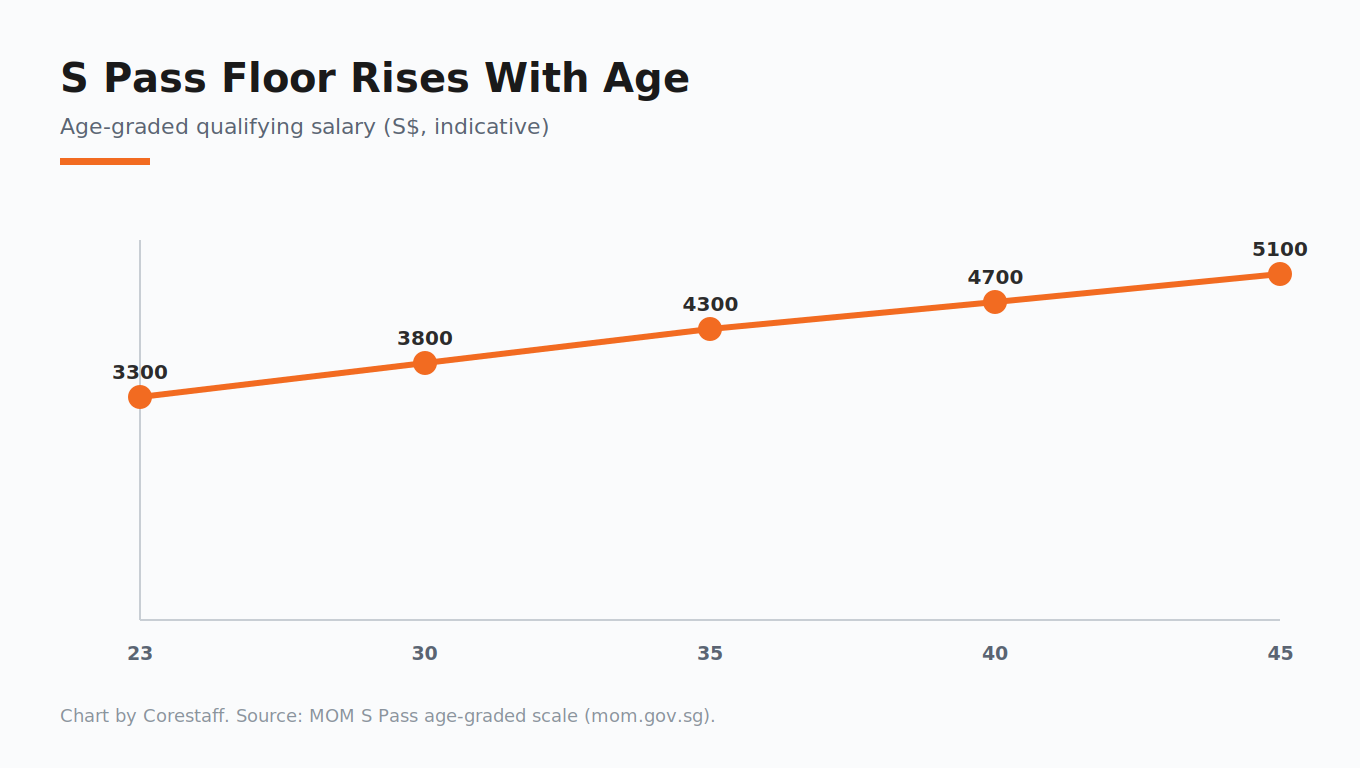
The S Pass also carries an age-graded scale, so the required salary rises with the age of the candidate, topping out around S$5,100 for a worker aged 45 and above. An employer who only checks the base floor will still fail the age-adjusted test, and that failure arrives at renewal, when the candidate has the most institutional knowledge and the least patience for a pay cut.
The renewal cliff matters more than the new-hire gate
New-application changes are visible because you feel them the moment you hire. Renewal changes are invisible until the renewal is due. If a quarter of your S Pass holders sit between S$3,300 and S$3,600 today, you are carrying a concentration of exposure that resolves itself on the 2028 calendar whether or not you have planned for it. The cost of that exposure is not the salary increase alone; it is the recruitment fee, the onboarding time and the productivity dip that follow if the holder cannot be re-banded and leaves.
Who is most exposed
- Employers with a recent hiring surge. Their roster skews toward salaries set under the old floors, so more holders sit in the gap.
- Financial services employers. Both the EP and S Pass floors step up again in that sector, a double move.
- Employers holding older S Pass staff. The age-graded scale pushes the required salary above the base floor, and long-serving staff are exactly the ones who age into the top of the scale.
- Employers mid-project in construction and marine. A renewal that fails during a peak phase is a schedule risk, not just a cost.
How to run a one-pass exposure review
You do not need a system project. You need a list of pass holders with their current salary, pass type, sector and renewal date, sorted against the 2027 floors. That produces three groups: those already clear, those that need a salary adjustment before renewal, and those where an adjustment is not commercially sensible and a transition plan is the better answer.
The third group is the one most employers avoid, and it is usually the most valuable. A holder whose market rate genuinely does not justify S$6,000 is better replaced in an orderly way, eighteen months out, than re-banded in a hurry or lost at renewal with no successor in training.
A worked exposure example
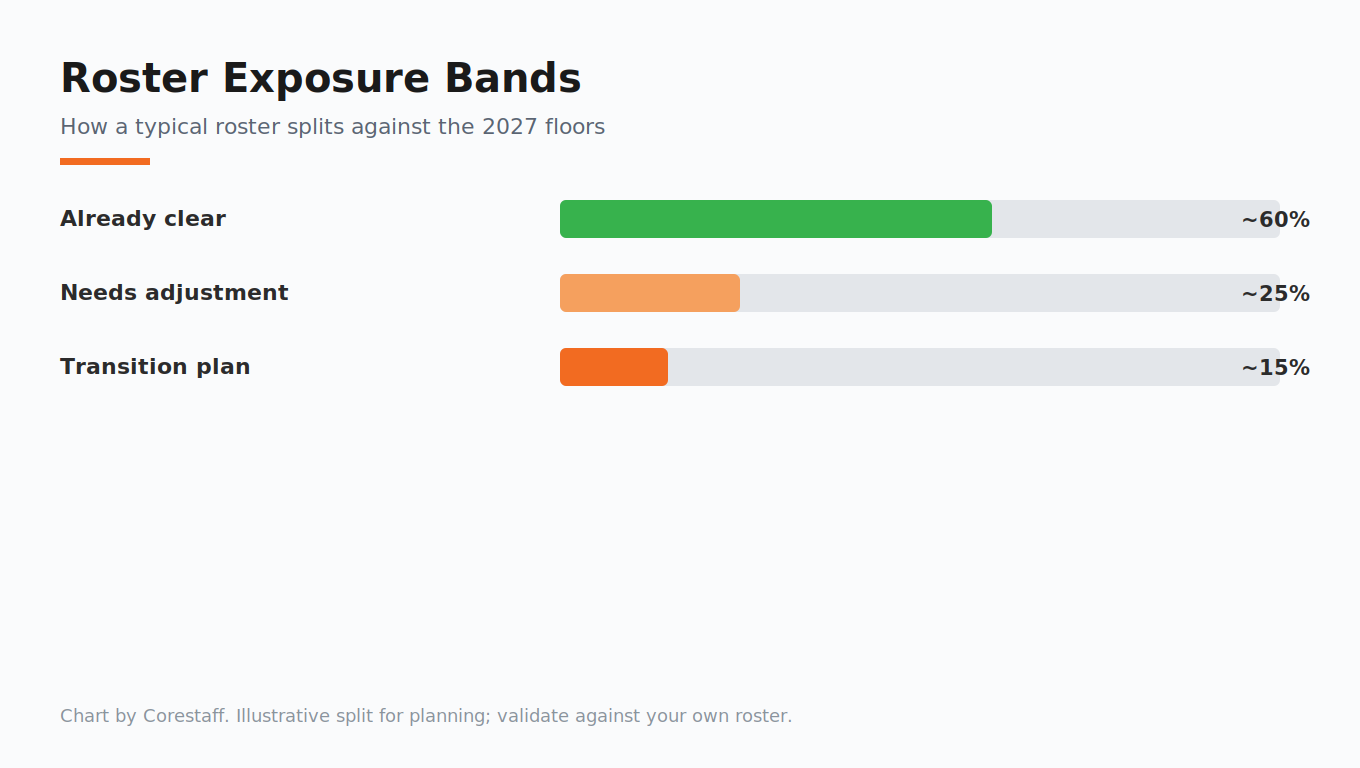
An employer with 60 S Pass holders across Services might find 22 sitting between S$3,300 and S$3,600. If 9 of them need re-banding to stay, the annual salary cost is roughly S$32,000 to S$40,000 before levy. If 4 of the remaining 13 cannot be re-banded and leave instead, the replacement cost, using a typical agency fee of one to two months’ salary, plus lost productivity, easily exceeds the re-banding bill. Splitting the roster into clear, adjust and transition turns an abstract rule change into a funded line item.
Send the roster, get the exposed list
The 2027 threshold exposure audit takes your current pass-holder list and returns every holder below the new floors, grouped by renewal date and by the size of the gap.
Frequently asked questions
When do the new floors take effect?
From 1 January 2027 for new applications, and from 1 January 2028 for renewals.
Does the S Pass floor depend on age?
Yes. The S Pass uses an age-graded scale, so the required salary rises with the age of the candidate, topping out around S$5,100 at age 45 and above.
Are financial services thresholds different?
Yes. Financial services carries a higher EP and a higher S Pass floor than other sectors, and both step up again in 2027.
Will renewals be tested against the new floors automatically?
Yes. From 1 January 2028 a renewal is assessed against the new floor and the age-graded scale, so a holder who clears today may not clear at renewal.
Related reading
Talk to Corestaff about this
Corestaff Pte Ltd is a Singapore employment agency, a trusted hiring partner since 2015, holding Employment Agency Licence 18C9027 under UEN 201633744E. If you want this article applied to your own workforce, our consultants will model it with you.
- Call: +65 6288 6866
- Email: recruit@corestaff.com.sg
- Visit: 175A Bencoolen Street, #11-05 Burlington Square, Singapore 189650
- Send a brief: Contact Corestaff · corestaff.com.sg