
Direct Answer
Singapore’s 2026 construction demand of SGD 47 to 53 billion keeps the labour market tight. With construction DRC at 83.3% and a levy structure that rewards higher-skilled workers, cost-smart hiring in 2026 comes down to skill-tier discipline, not chasing the cheapest headcount.
The 2026 Construction Demand Picture
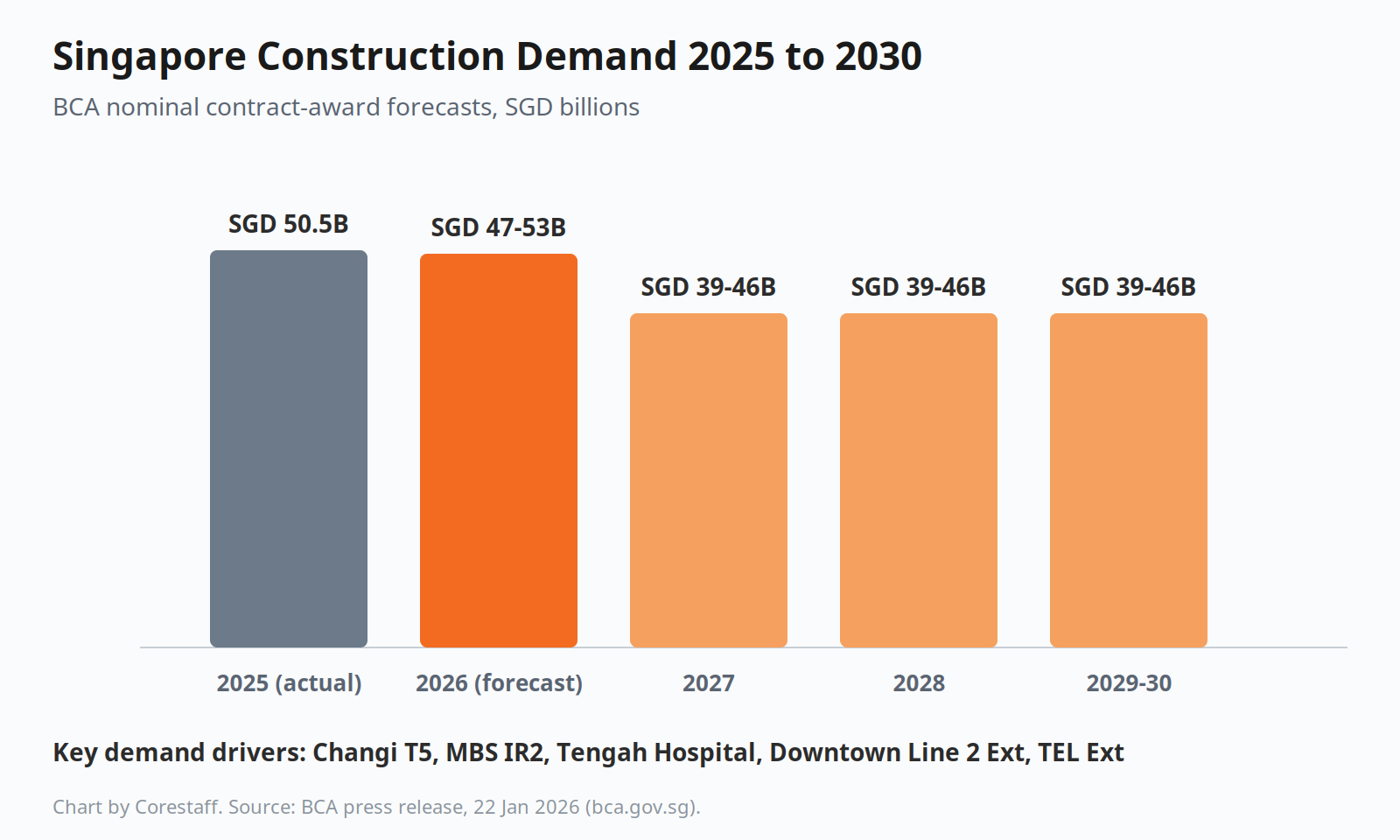
BCA forecasts total 2026 construction demand at SGD 47 to 53 billion, similar to 2025’s preliminary actual of SGD 50.5 billion. Medium-term demand for 2027 to 2030 is projected at SGD 39 to 46 billion per year. Key demand drivers include Changi Terminal 5, the Marina Bay Sands IR2 expansion, the new Tengah General & Community Hospital, and the Downtown and Thomson-East Coast Line extensions.
This is a busy market for main contractors and skilled trades. Any main contractor treating 2026 as a slow year is misreading the pipeline.
MOM Levy and Quota Basics
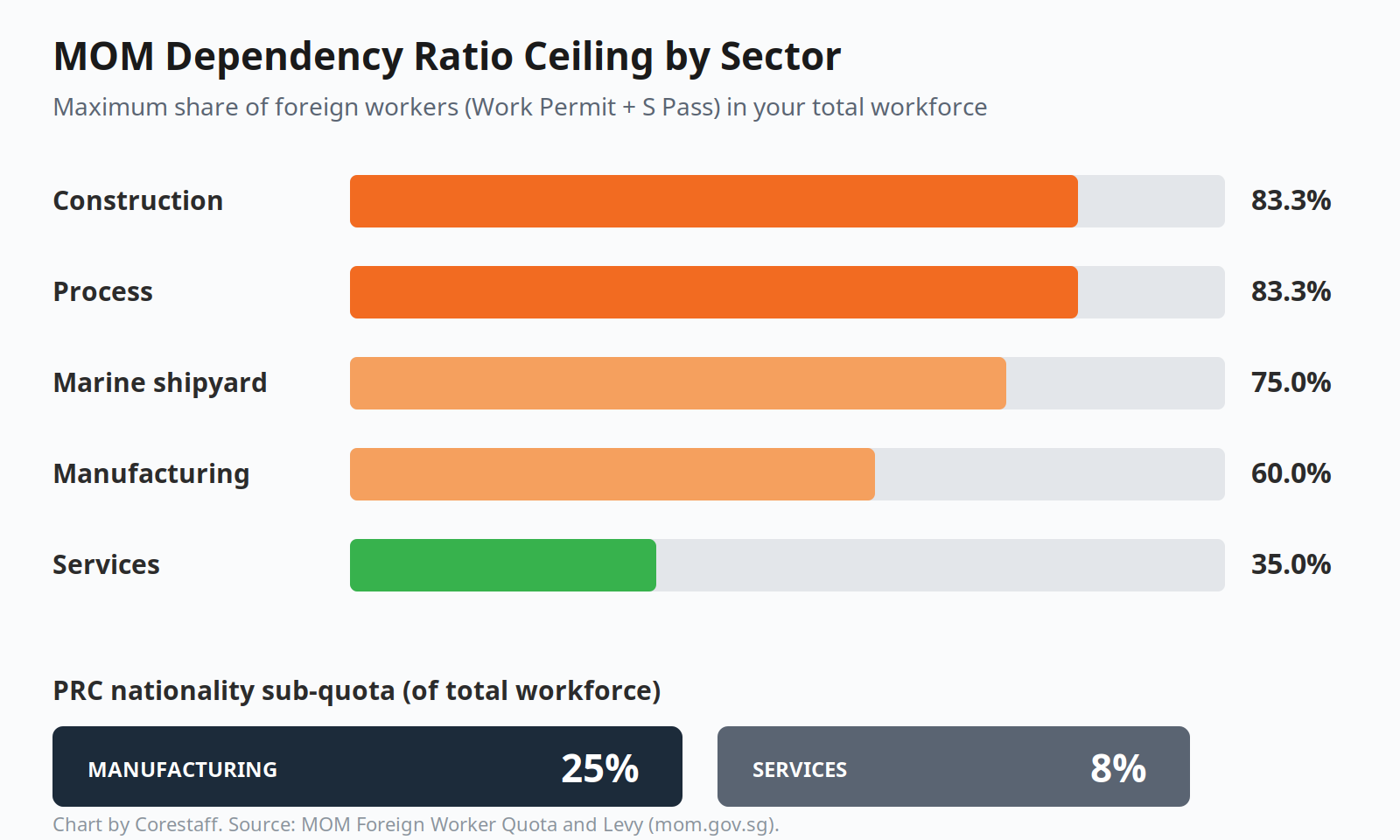
Construction employers work with the highest DRC in Singapore, which is a deliberate policy given the sector’s manpower needs:
- Construction DRC 83.3% per MOM foreign worker quota.
- Construction WPHs without required certification attract a levy of SGD 900 per month regardless of skill tier per MOM Construction sector Work Permit requirements.
- Local Qualifying Salary: locals below SGD 900 do not count; SGD 900 to under SGD 1,800 counts as 0.5; SGD 1,800+ counts as 1.0. This affects your quota base calculation.
The Higher-Skilled Worker Strategy
Upgrading a construction Work Permit holder to higher-skilled status reduces your monthly levy per MOM. The exact rate depends on skill certifications, but the pattern is consistent: a higher-skilled worker earns you a lower levy line every month for as long as they hold the certification.
This flips the naive “cheapest headcount” strategy on its head. Over a 24-month engagement, the total cost of a higher-skilled worker is often lower than a basic-skilled worker once you monthly-average the levy differential.
Not sure how to structure your levy tier mix?
We help construction employers model the levy differential across skill tiers before you finalise the ramp. It usually pays back within 6 months.
Sourcing Channels That Work in 2026
- Existing worker upgrade: the fastest way to reduce levy cost is to certify your existing basic-skilled workforce.
- Source-country recruitment for approved source countries under the construction sector rules.
- Local sub-contractor partnerships for scope Corestaff cannot cover directly.
- Corestaff mid-tier hires for BIM co-ordinators, M&E supervisors, and site engineers where local sourcing is disproportionately effective.
Retention on Active Sites
Retention on Singapore construction sites is a management discipline. Key predictors are on-time salary payment, dormitory quality, and site-safety culture. The BE CARE Charter adopted by 47 firms in Nov 2025 is a useful reference framework; project delivery outcomes improve when charter behaviours are enforced on site.
Related reading: Q4 2026 Singapore construction hiring forecast, Corestaff construction recruitment.
BCA Productivity Programmes to Layer With Hiring
Per BCA, the Productivity Solutions Grant (PSG) has supported more than 1,100 Built Environment firms since 2020. From 1 April 2026, the enhanced PSG offers:
- Advanced equipment support including robotic and automation solutions that can achieve up to 50% manpower savings per construction trade activity.
- Pre-approved digital solutions for digital contract management, coordinated regulatory approvals, and productivity monitoring.
- Raised grant caps for longer-term productivity investments.
- Repeat access for firms that benefited from previous PSG tranches, subject to no double-funding of the same solution.
Layer the productivity grant against hiring: fewer basic-skilled operatives, more higher-skilled operators of the funded equipment. Total workforce cost falls; output rises.
The BE CARE Charter and Its Retention Impact
Per BCA, 47 progressive Built Environment firms had committed to the Built Environment Culture for Appreciation, Respect and Empathy (BE CARE) Charter by November 2025. Signatories commit to specified behaviours: fair contract terms, respectful communication with subcontractors and workers, punctual payment, and a shared safety culture.
The BE CARE Charter is voluntary, but it is a useful retention lever: workers cite these behaviours in exit interviews far more often than pay when they leave. GuocoLand’s Springleaf Residence project was cited by BCA as an example of a firm adopting the charter with measurable improvements in project delivery.
Collaborative Contracting as a Hiring Multiplier
Per BCA, more than 20 collaborative-contracting pilot projects are ongoing or upcoming across public and private sectors, using either the Option Module clauses under the Public Sector Standard Conditions of Contract (PSSCOC) or the internationally recognised NEC4 collaborative contract form.
Why this matters for hiring: collaborative contracts share cost savings and overruns between parties, which reshapes the incentives around workforce productivity. Contractors on collaborative contracts have measurably higher demand for BIM and M&E engineering talent because the contract rewards early integrated design over late variation orders.
How Corestaff Runs This Category of Search
Every Corestaff mandate in Singapore follows the same underlying process discipline, adapted to the role:
- Discovery call (day 0 to 1). A 30-minute call to lock scope, must-haves, salary band, and MOM pass eligibility. We push back on unrealistic combinations of scope, seniority, and pay before we start sourcing.
- Compliance check (day 1 to 2). We verify DRC headroom, appropriate pass type (EP, S Pass, or Work Permit), and any sector-specific requirements.
- Sourcing (day 2 to 10). Active outreach across our network plus MyCareersFuture posting where the Fair Consideration Framework requires it for new EP roles. Structured screens against must-haves.
- Shortlist (day 10 to 14). 3 to 5 candidates presented with a written summary matched to your must-haves, plus salary expectation, notice period, and any pass-eligibility flags.
- Client interviews (day 14 to 25). We coordinate the panel, collect structured feedback, and keep candidates warm through the cycle. Two rounds maximum for most roles; three for senior mandates.
- Offer and close (day 25 to 35). We handle counter-offer defence, notice-period navigation, and start-date logistics. Guarantee clock starts on day one.
Where a mandate needs to run confidentially, we adapt the sourcing (outbound only) and disclosure discipline (client identity gated behind NDA) without changing the process backbone.
Why Every Fact in This Article Is Sourced to a Singapore Government Page
Recruitment content on the internet is full of confident-sounding numbers with no traceable origin. Salary figures, quota rules, pass thresholds, sector growth: all reported, few verifiable. Corestaff’s editorial rule is that any load-bearing fact must trace to a Singapore government page (MOM, EDB, MAS, MTI, IMDA, BCA, CPF Board) with an inline citation link. Where a claim cannot be sourced to a .gov.sg page, we drop the claim rather than dress it up as an estimate. This is more work; it is also why Corestaff’s content survives fact-checking by hiring managers, CFOs, and audit teams. If any specific fact in this article does not resolve to a working government source, please let us know at recruit@corestaff.com.sg and we will fix it.
Frequently Asked Questions
What is the construction DRC in Singapore?
How much is the higher-skilled worker levy for construction?
Does BCA construction demand actually flow through to my project pipeline?
Can Corestaff help with dormitory-linked recruitment compliance?
Conclusion: What to Do Next
The employers who structure their skill-tier mix deliberately in 2026 will pay materially less levy per productive man-day than employers who default to basic-skilled headcount.
Hire construction skill tiers strategically, not tactically
Corestaff runs recruitment sprints for Singapore employers across executive search, professional and mid-market hiring, and skilled-trade sourcing. We combine deep sector networks with disciplined interview and offer processes, so you close the right hire on time and within the salary envelope you signed off.
Book a Free Scoping Call →
Learn about Construction Recruitment
Phone: +65 6288 6866 ·
Email: recruit@corestaff.com.sg
Address: 175A Bencoolen Street #11-05 Burlington Square, Singapore 189650
Web: www.corestaff.com.sg