

Hiring senior leadership has never been more challenging in Singapore. The demand for experienced C-level executives far exceeds supply, and companies are competing harder than ever to attract top leadership talent.
If you need to fill a CEO, CFO, COO, or other board-level position, you cannot afford to get it wrong. The wrong executive hire can cost millions in lost opportunities, damaged culture, and wasted resources.
This guide shows you how to navigate Singapore’s executive search landscape in 2026, from understanding when to use professional headhunting services from a leading recruitment agency in Singapore to managing confidential recruitment processes and avoiding costly hiring mistakes.
The Executive Hiring Challenge in Singapore 2026
Singapore’s executive talent market is under pressure. Several factors are making C-level recruitment increasingly difficult:
Limited local talent pool: Singapore has a small population. The number of executives with 15+ years of experience and proven leadership in Southeast Asian markets is limited.
Global competition: Singapore competes with Hong Kong, Dubai, and other regional hubs for the same pool of senior leaders.
High salary expectations: C-level candidates expect competitive packages that match or exceed regional standards. According to 2026 benchmarks, CEOs in Singapore command salaries ranging from SGD 250,000 to over SGD 1 million annually, depending on company size and industry.
Confidentiality requirements: Many executive searches must be conducted discreetly. Companies replacing current leadership or pursuing strategic pivots cannot afford public speculation.
Longer hiring timelines: Executive recruitment typically takes 3 to 6 months from search initiation to onboarding. Rushed decisions often lead to poor cultural fit.
These challenges make executive search a specialized discipline requiring different strategies, tools, and expertise compared to standard recruitment.

When to Use Executive Search vs Traditional Recruitment
Not every senior hire requires executive search services. Understanding when to invest in headhunting versus using traditional recruitment methods saves time and money.
Use Executive Search When:
1. The role is at C-level or board level
CEO, CFO, COO, CMO, CTO, and board positions benefit from retained executive search. These roles require deep market research and discrete approaches to passive candidates.
2. Confidentiality is essential
If you are replacing an existing executive or planning a strategic change that requires secrecy, executive search firms can conduct confidential searches without alerting the market.
3. The candidate pool is limited
For highly specialized leadership roles (e.g., Chief Data Officer with Southeast Asian fintech experience), headhunters can identify and approach candidates who are not actively looking for new positions.
4. Speed and quality matter equally
Executive search firms dedicate significant resources to mapping the market, assessing leadership competencies, and conducting thorough reference checks.
Use Traditional Recruitment When:
- The role is senior but not C-level (e.g., department head, senior manager)
- You have strong internal talent pipelines
- The position can be advertised publicly without strategic risk
- Your budget is limited
For most C-level hires, executive search delivers better results. The investment typically pays for itself through reduced turnover and faster time-to-impact.
The Executive Search Process: Research, Approach, Assessment, Onboarding
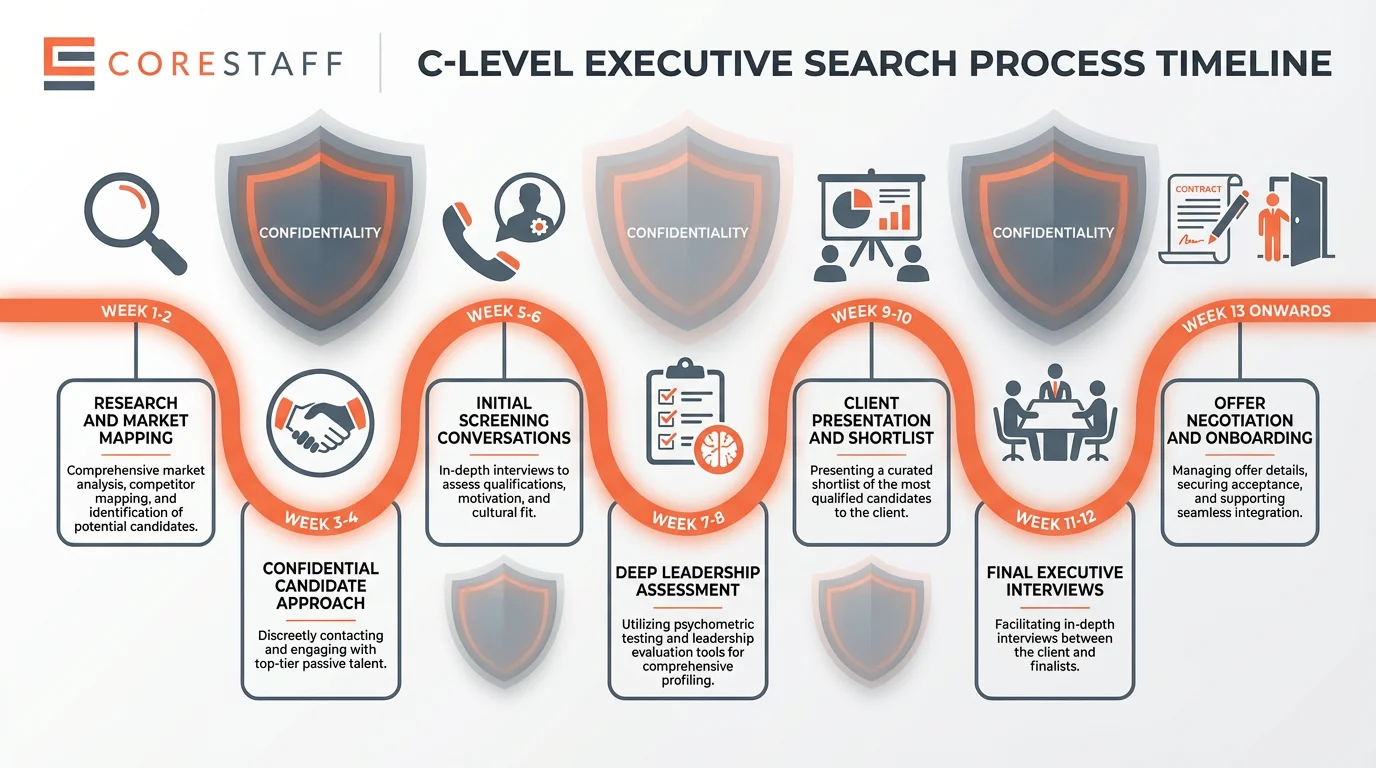
Executive search follows a structured methodology. Understanding each phase helps you set realistic timelines and expectations.
Phase 1: Research and Market Mapping (Weeks 1-3)
The search begins with deep market research:
- Define the leadership profile (skills, experience, cultural fit)
- Map the competitive landscape
- Identify target companies and potential candidates
- Develop an approach strategy
At this stage, the search firm works closely with your board or leadership team to understand your strategic goals, company culture, and specific requirements for the role.
Phase 2: Confidential Approach (Weeks 4-7)
Once target candidates are identified, the headhunter makes discreet contact:
- Reach out to passive candidates (those not actively job hunting)
- Present the opportunity in confidence
- Gauge interest and availability
- Conduct preliminary screening
Many top executives are not browsing job boards. They must be approached directly and convinced that the opportunity aligns with their career goals.
Phase 3: Assessment and Interviews (Weeks 8-11)
Candidates who express interest move into formal assessment:
- In-depth interviews with the search firm
- Psychometric and leadership assessments
- Presentation of shortlisted candidates (typically 3-5 candidates)
- Client interviews (multiple rounds)
- Reference checks and background verification
This phase is critical. Executive search firms present only the most qualified candidates, saving your leadership team significant time.
Phase 4: Offer, Negotiation, and Onboarding (Weeks 12-13+)
Once a candidate is selected:
- Negotiate offer package (salary, equity, benefits, relocation)
- Draft employment contracts
- Manage resignation and notice period
- Plan onboarding and integration
Executive onboarding is often overlooked but essential. New C-level hires need a structured first 90 days to understand the business, build relationships, and deliver early wins.
Confidentiality in Executive Search: Why It Matters
Confidentiality is one of the most important aspects of executive recruitment. Here is why:
Protecting current leadership: If you are replacing an underperforming executive, public knowledge can damage morale and create uncertainty.
Maintaining competitive advantage: Strategic hires (e.g., a new CTO to lead digital transformation) can signal your intentions to competitors.
Respecting candidate privacy: Senior executives have reputations to protect. They will not engage with opportunities that are publicly advertised.
Professional executive search firms have strict confidentiality protocols:
- Non-disclosure agreements with all parties
- Discreet communication channels
- Blind advertisements (if any public advertising is used)
- Careful management of information flow
If confidentiality is compromised, you risk losing top candidates and damaging your company’s reputation.
C-Level Salary Benchmarks 2026: What to Expect

Salary expectations for C-level executives in Singapore vary significantly by industry, company size, and role complexity. Here are typical ranges for 2026:
CEO (Chief Executive Officer):
- Small companies (under 100 employees): SGD 200,000 – SGD 400,000
- Mid-sized companies (100-500 employees): SGD 400,000 – SGD 800,000
- Large companies (500+ employees): SGD 800,000 – SGD 2,000,000+
CFO (Chief Financial Officer):
- Small companies: SGD 150,000 – SGD 300,000
- Mid-sized companies: SGD 300,000 – SGD 600,000
- Large companies: SGD 600,000 – SGD 1,200,000+
COO (Chief Operating Officer):
- Small companies: SGD 150,000 – SGD 350,000
- Mid-sized companies: SGD 350,000 – SGD 700,000
- Large companies: SGD 700,000 – SGD 1,500,000+
CTO/CIO (Chief Technology/Information Officer):
- Small companies: SGD 180,000 – SGD 350,000
- Mid-sized companies: SGD 350,000 – SGD 700,000
- Large companies: SGD 700,000 – SGD 1,500,000+
CMO (Chief Marketing Officer):
- Small companies: SGD 150,000 – SGD 300,000
- Mid-sized companies: SGD 300,000 – SGD 600,000
- Large companies: SGD 600,000 – SGD 1,200,000+
These figures typically include base salary and annual bonuses. Many C-level packages also include equity, long-term incentives, and additional benefits such as car allowances and club memberships.
When setting compensation, consider:
- Industry standards (technology and finance typically pay more)
- Candidate experience and track record
- Company stage (startups may offer more equity, less cash)
- Regional benchmarks (Singapore competes with Hong Kong, Shanghai, and Sydney)
Red Flags in Executive Hiring: What to Watch For
Even experienced boards can make costly mistakes in executive recruitment. Here are warning signs to watch for:
1. Frequent job changes: If a candidate has held 4-5 C-level roles in the past 10 years, dig deeper. Understand why they left each position. Frequent moves may indicate performance issues or poor cultural fit.
2. Lack of measurable results: Strong executives can articulate their impact with concrete examples: revenue growth, cost savings, market expansion, or successful M&A transactions. Be cautious of vague claims.
3. Poor references: Always conduct thorough reference checks. Speak to former board members, direct reports, and peers. If a candidate is reluctant to provide references, consider it a red flag.
4. Cultural mismatch: Skills and experience matter, but cultural fit is equally important. An executive who thrived in a hierarchical corporate environment may struggle in a fast-moving startup.
5. Overemphasis on title: Some candidates prioritize title over impact. If a candidate is more concerned with their business card than the company’s strategic challenges, proceed with caution.
6. Lack of curiosity: During interviews, strong executives ask insightful questions about your business, competitive positioning, and growth plans. If a candidate shows little interest in understanding your company, it may indicate low engagement.
Success Metrics for Executive Hires
How do you measure whether an executive hire was successful? Here are key indicators to track:
Time to impact: Strong executives deliver measurable results within the first 6-12 months. Define clear goals during onboarding and track progress.
Team performance: Effective leaders build strong teams. Monitor employee engagement, retention, and performance within the executive’s division.
Strategic execution: Executives should drive strategic initiatives. Track whether they meet key milestones and achieve business objectives.
Cultural contribution: Great executives reinforce company culture. Assess whether they embody your values and inspire others.
Retention: If an executive leaves within the first two years, the hire was likely unsuccessful. Aim for multi-year tenure.
Establish these metrics upfront and review them regularly with your board or leadership team.
Why Work with Corestaff for Executive Search
Corestaff understands the unique challenges of executive recruitment in Singapore. We bring deep market knowledge, extensive networks, and a proven track record in placing C-level leaders across industries.
What sets us apart:
- Confidential search processes: We protect your strategic interests and candidate privacy
- Extensive executive networks: We have access to passive candidates who are not on job boards
- Thorough assessment: Our rigorous evaluation process ensures you meet only the most qualified candidates
- Strategic advisory: We act as trusted advisors throughout the search, offering insights on market trends, compensation, and candidate quality
- Post-placement support: We stay involved after the hire to ensure successful onboarding and integration
Whether you need a CEO to lead your next growth phase or a CFO to prepare for an IPO, Corestaff can help you find the right leader.
Contact Corestaff for Confidential Executive Search Services
Ready to hire your next C-level leader? Corestaff’s executive search team is here to help. We manage the entire process with discretion, professionalism, and a commitment to finding the perfect match for your organisation.
Get in touch:
- Phone: +65 6288 6866
- Email: recruit@corestaff.com.sg
- Website: www.corestaff.com.sg
- Address: 175A Bencoolen Street, #11-05 Burlington Square, Singapore 189650
Contact us today to discuss your executive search needs.