
Recruitment is one of the most critical functions in any growing company. But should you build an internal talent acquisition team or outsource the entire process to a specialist provider?
This is not a simple question. The answer depends on your hiring volume, growth trajectory, budget, and internal capabilities. Both models have distinct advantages and challenges.
This guide provides a comprehensive cost-benefit analysis of Recruitment Process Outsourcing (RPO) versus in-house hiring for Singapore companies. You will learn when to choose each model, how to calculate true costs, and what ROI to expect from professional recruitment agency services in Singapore.
What is RPO? Understanding Recruitment Process Outsourcing
Recruitment Process Outsourcing (RPO) means partnering with an external provider to manage some or all of your recruitment activities.
Unlike traditional recruitment agencies (which fill individual roles on a transactional basis), RPO providers integrate into your organisation. They act as an extension of your HR team, managing end-to-end recruitment processes, employer branding, and candidate experience.
Types of RPO Models
RPO is not one-size-fits-all. There are three main models:
1. Full RPO:
The provider manages all recruitment activities across your entire organisation. This includes sourcing, screening, interviewing, offer management, and onboarding. Your internal HR team focuses on strategic initiatives rather than day-to-day hiring.
Best for: Large organisations with high-volume hiring needs (100+ hires per year) or companies experiencing rapid growth.
2. Partial RPO:
The provider handles recruitment for specific departments, locations, or job types. For example, you might outsource IT recruitment while managing other functions in-house.
Best for: Companies with uneven hiring needs or specialized recruitment challenges in certain areas.
3. Project-Based RPO:
The provider manages recruitment for a defined project or time period. For example, hiring 50 manufacturing workers for a new facility over six months.
Best for: Companies with temporary hiring surges, seasonal peaks, or one-time projects.
What RPO Providers Do
A typical RPO engagement includes:
- Workforce planning and talent mapping
- Employer branding and candidate attraction strategies
- Job posting and advertising
- Candidate sourcing (active and passive)
- Screening and initial interviews
- Interview coordination and scheduling
- Reference checks and background verification
- Offer negotiation and management
- Onboarding support
- Recruitment analytics and reporting
The level of service depends on the contract. Some RPO providers also manage recruitment technology (applicant tracking systems, assessment tools, etc.).
In-House Recruitment: Building Your Own Talent Acquisition Team
In-house recruitment means hiring dedicated recruiters and talent acquisition specialists who work exclusively for your company.
What In-House Teams Do
Internal recruitment teams typically handle:
- Job requisition management
- Sourcing candidates through job boards, social media, and referrals
- Screening resumes and conducting interviews
- Managing candidate relationships
- Coordinating with hiring managers
- Employer branding and recruitment marketing
- Recruitment data and analytics
- Managing recruitment tools and technology
When In-House Recruitment Works Well
In-house teams excel when:
- Hiring volume is steady and predictable
- Your company has a strong employer brand
- You have the budget to invest in recruitment technology
- Internal recruiters can develop deep industry expertise
- You prioritize cultural fit and long-term relationship building
However, building and maintaining an effective in-house team requires significant investment.
Cost Comparison Breakdown: RPO vs In-House
Let’s compare the true costs of RPO versus in-house recruitment. We will use a mid-sized Singapore company hiring 60 positions per year as our example.
In-House Recruitment Costs
Salaries:
- 2 full-time recruiters at SGD 4,500/month each = SGD 108,000/year
- 1 talent acquisition manager at SGD 6,500/month = SGD 78,000/year
- Total salary costs: SGD 186,000/year
Technology and Tools:
- Applicant tracking system (ATS): SGD 12,000/year
- Job board subscriptions (JobStreet, LinkedIn Recruiter, etc.): SGD 18,000/year
- Assessment tools: SGD 6,000/year
- Total technology costs: SGD 36,000/year
Advertising and Marketing:
- Job postings and sponsored ads: SGD 24,000/year
- Employer branding campaigns: SGD 12,000/year
- Total marketing costs: SGD 36,000/year
Other Costs:
- Training and professional development: SGD 6,000/year
- Recruitment events and networking: SGD 4,000/year
- Total other costs: SGD 10,000/year
Total In-House Cost: SGD 268,000/year
Cost per hire: SGD 4,467 (based on 60 hires)
RPO Costs
RPO pricing varies by provider and service level. Here is a typical structure for our example company:
Model 1: Fixed monthly fee
- Monthly retainer: SGD 15,000
- Total annual cost: SGD 180,000
Model 2: Cost per hire
- Fee per hire: SGD 3,500
- Total annual cost: SGD 210,000 (based on 60 hires)
Model 3: Hybrid (retainer + per hire)
- Monthly retainer: SGD 8,000 (SGD 96,000/year)
- Cost per hire: SGD 1,800
- Total annual cost: SGD 204,000 (based on 60 hires)
Cost per hire: SGD 3,000 – SGD 3,500
Direct Cost Savings with RPO
In this example, RPO saves approximately SGD 58,000 to SGD 88,000 per year compared to in-house recruitment.
But direct costs are only part of the picture. You also need to consider hidden costs and value-added benefits.
Hidden Costs of In-House Recruitment
In-house recruitment involves several hidden costs that are often overlooked:
1. Productivity loss during hiring lags: When recruiters leave or go on extended leave, hiring slows down. This can delay projects and revenue growth.
2. Training time for new recruiters: It takes 3-6 months for new recruiters to become fully productive. During this ramp-up period, hiring efficiency drops.
3. Technology maintenance: ATS and recruitment tools require ongoing updates, troubleshooting, and vendor management.
4. Scalability challenges: If you need to hire 100 people in one quarter (e.g., for a new factory or office), your in-house team may not have capacity. You will need to engage agencies anyway, duplicating costs.
5. Market knowledge gaps: In-house recruiters may lack deep expertise in niche areas (e.g., executive search, foreign worker compliance, specialized technical roles).
These hidden costs can add 10-20% to your total recruitment expenditure.
Benefits of RPO: Beyond Cost Savings
RPO offers several strategic advantages that go beyond direct cost savings through recruitment process outsourcing services:
1. Faster Time-to-Hire
RPO providers have dedicated teams, advanced sourcing tools, and extensive candidate networks. This reduces time-to-hire by 20-40% on average.
Example: If your average time-to-hire is 45 days in-house, RPO can reduce it to 30 days. For critical roles, this speed can save significant opportunity costs.
2. Higher Quality of Hire
RPO providers specialize in recruitment. They use data-driven assessment tools, structured interviews, and rigorous screening processes. This results in better candidate quality and lower turnover.
Metric to track: Measure quality of hire through 90-day retention, hiring manager satisfaction scores, and new hire performance ratings.
3. Scalability and Flexibility
RPO providers can quickly scale up or down based on your hiring needs. If you need to hire 20 workers in one month and 5 the next, RPO adapts seamlessly. In-house teams struggle with this variability.
4. Access to Recruitment Expertise
RPO providers bring deep market knowledge, compliance expertise (especially important for foreign worker recruitment in Singapore), and best-practice processes. Your organisation benefits from this expertise without hiring specialists full-time.
5. Better Recruitment Metrics and Analytics
Top RPO providers deliver detailed reporting on time-to-hire, cost-per-hire, source effectiveness, candidate experience, and diversity metrics. This data helps you make better strategic decisions.
6. Focus on Core Business
By outsourcing recruitment, your HR team can focus on strategic priorities such as employee development, retention, culture building, and performance management.
When to Choose RPO vs In-House Hiring
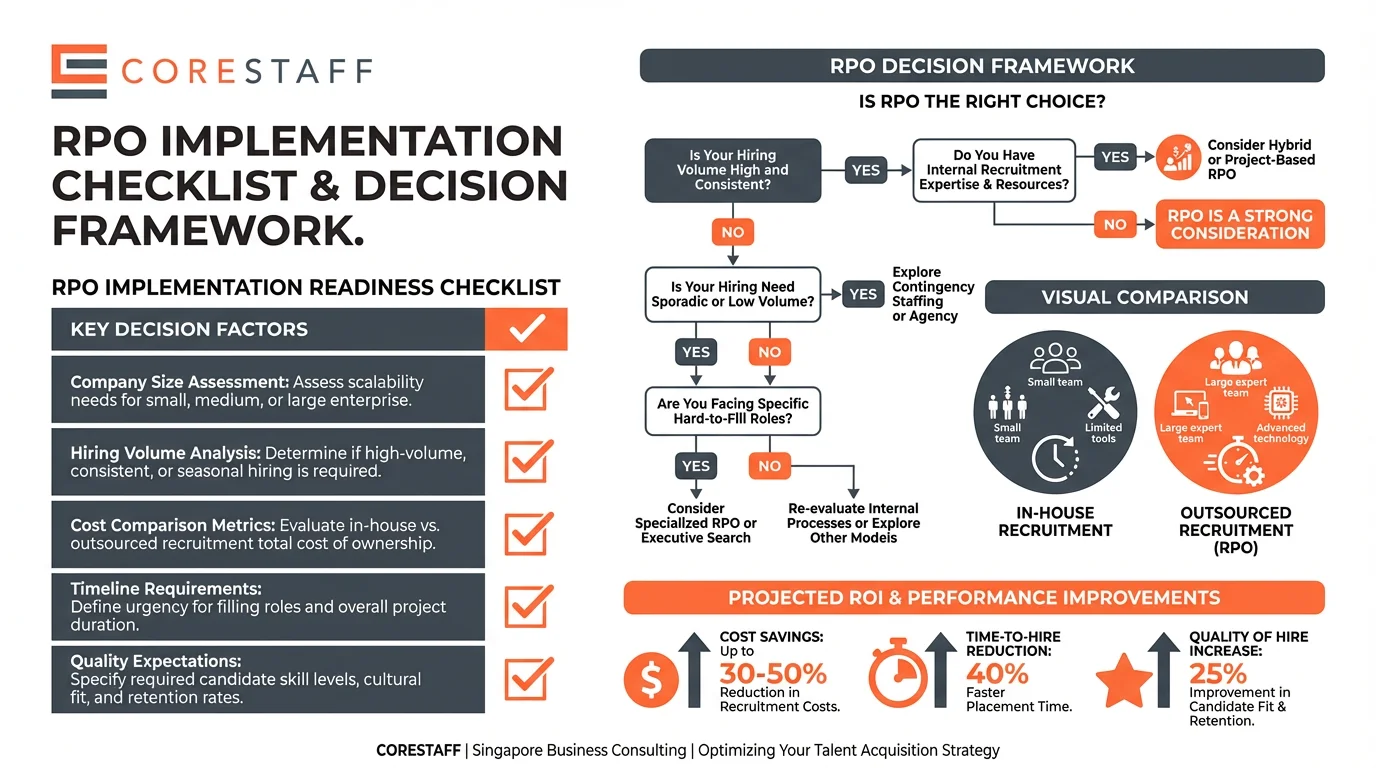
So when should you choose each model? Here is a decision framework:
Choose RPO When:
You have high-volume hiring needs (50+ hires per year): RPO delivers cost savings and efficiency at scale.
Your hiring volume fluctuates significantly: Seasonal businesses, project-based companies, or those in growth phases benefit from RPO flexibility.
You lack in-house recruitment expertise: If your HR team is small or lacks specialized recruitment skills, RPO fills the gap.
Speed is critical: If time-to-hire directly impacts revenue or customer satisfaction, RPO accelerates hiring.
You want to reduce recruitment costs: RPO typically costs 20-30% less than in-house recruitment when all factors are included.
Compliance is complex: Foreign worker recruitment, multi-country hiring, and regulatory compliance are easier with RPO providers who specialize in these areas.
Choose In-House Recruitment When:
You have low hiring volume (under 20 hires per year): The fixed costs of in-house recruitment may be justified if hiring needs are minimal.
Cultural fit is paramount: Some companies believe internal recruiters develop deeper understanding of culture and values. However, good RPO providers can also be trained on your culture.
You have the budget for a strong internal team: If you can afford experienced recruiters, recruitment technology, and ongoing training, in-house recruitment can work well.
Your employer brand is highly specialized: If your company requires very niche talent that is hard to source externally, in-house recruiters may develop better networks over time.
RPO Challenges and How to Address Them
RPO is not without challenges. Here are common concerns and how to mitigate them:
1. Loss of Control
Concern: Some companies fear losing control over recruitment decisions.
Solution: Choose an RPO provider that operates transparently. Establish clear governance structures, regular reporting, and joint decision-making processes.
2. Cultural Misalignment
Concern: External recruiters may not understand your company culture.
Solution: Invest time in onboarding the RPO team. Share your values, mission, and cultural expectations. Treat them as an extension of your team, not a vendor.
3. Integration with Internal Teams
Concern: RPO providers may not integrate smoothly with hiring managers and HR.
Solution: Define clear roles and responsibilities. Use collaborative tools (shared ATS, communication platforms) and schedule regular check-ins.
4. Quality Variability
Concern: Not all RPO providers deliver consistent quality.
Solution: Conduct thorough due diligence. Request case studies, speak to references, and pilot the engagement with a small scope before scaling up.
Singapore RPO Market Landscape
Singapore’s RPO market is growing rapidly. Several factors are driving adoption:
Talent shortages: Singapore faces skill gaps in technology, healthcare, engineering, and logistics. RPO providers help companies access wider talent pools.
Foreign worker complexity: Managing work permits, S Passes, and Employment Passes requires expertise in compliance. RPO providers streamline this process.
Cost pressure: Companies are under pressure to reduce costs while maintaining quality. RPO offers a compelling value proposition.
Digital transformation: Advanced RPO providers use AI-powered sourcing, video interviewing, and predictive analytics. These tools improve efficiency and candidate experience.
Local and regional RPO providers: Corestaff offers RPO services tailored to Singapore’s unique market. We understand local compliance requirements, salary benchmarks, and talent availability.
RPO Implementation Checklist
If you decide to pursue RPO, follow this implementation checklist:
Step 1: Define Your Requirements (Weeks 1-2)
- Identify which roles or departments to include in RPO scope
- Determine hiring volume and timelines
- Set clear goals (cost savings, time-to-hire, quality of hire)
- Assign internal stakeholders and decision-makers
Step 2: Select the Right RPO Provider (Weeks 3-6)
- Research providers with Singapore expertise
- Request proposals from 3-5 providers
- Evaluate based on: experience, technology, pricing, cultural fit, and references
- Conduct interviews and ask detailed questions about processes, SLAs, and reporting
Step 3: Pilot the Engagement (Months 1-3)
- Start with a small scope (e.g., one department or project)
- Monitor performance closely
- Gather feedback from hiring managers and candidates
- Adjust processes as needed
Step 4: Scale and Optimize (Months 4-6)
- Expand the engagement to additional roles or departments
- Implement continuous improvement processes
- Review metrics regularly (time-to-hire, cost-per-hire, quality of hire)
- Build long-term partnership with the provider
Step 5: Measure ROI (Ongoing)
Track these metrics to measure RPO ROI:
- Cost per hire: Compare RPO cost to in-house cost
- Time-to-hire: Measure reduction in hiring timelines
- Quality of hire: Track 90-day retention, performance ratings, and hiring manager satisfaction
- Hiring manager satisfaction: Conduct regular surveys
- Candidate experience: Measure candidate satisfaction scores
ROI Calculator: RPO vs In-House
Here is a simple ROI calculator to help you decide:
Inputs:
- Annual hiring volume: 60 positions
- Average time-to-hire (in-house): 45 days
- Average time-to-hire (RPO): 30 days
- Average salary of hired roles: SGD 5,000/month
- In-house recruitment cost: SGD 268,000/year
- RPO cost: SGD 204,000/year
Calculations:
Direct cost savings:
SGD 268,000 – SGD 204,000 = SGD 64,000/year
Opportunity cost savings (faster hiring):
15 days faster hiring x 60 positions = 900 days saved
900 days / 30 days per month = 30 months of productivity gained
30 months x SGD 5,000 = SGD 150,000 in recovered productivity
Total ROI:
SGD 64,000 + SGD 150,000 = SGD 214,000/year
ROI percentage:
(SGD 214,000 / SGD 204,000) x 100 = 105% return on investment
This is a simplified model, but it illustrates the substantial ROI that RPO can deliver.
Why Work with Corestaff for RPO Services
Corestaff provides flexible, cost-effective RPO solutions for Singapore companies. Whether you need full-service recruitment outsourcing or project-based support, we have the expertise to deliver results.
What we offer:
- Tailored RPO models: Full, partial, or project-based RPO to match your needs
- Deep Singapore market knowledge: We understand local talent availability, salary benchmarks, and compliance requirements
- Advanced recruitment technology: We use AI-powered sourcing, video interviewing, and analytics to improve efficiency
- Proven track record: We have helped companies across manufacturing, logistics, IT, and healthcare scale their hiring
- Transparent reporting: You receive detailed metrics and regular updates on recruitment performance
Whether you are building a new team, scaling rapidly, or looking to reduce recruitment costs, Corestaff can help.
Contact Corestaff for RPO Consultation
Ready to explore RPO for your organisation? Corestaff’s team is here to help. We will conduct a thorough assessment of your recruitment needs and recommend the best solution.
Get in touch:
- Phone: +65 6288 6866
- Email: recruit@corestaff.com.sg
- Website: www.corestaff.com.sg
- Address: 175A Bencoolen Street, #11-05 Burlington Square, Singapore 189650
Contact us today to discuss your recruitment outsourcing needs.