
Singapore’s manufacturing sector is undergoing a profound transformation as Industry 4.0 technologies reshape production floors nationwide. From precision engineering workshops in Tuas to pharmaceutical plants in Jurong, manufacturers face an unprecedented challenge: finding skilled talent who can bridge traditional manufacturing expertise with cutting-edge digital capabilities.

Singapore’s Manufacturing Landscape 2026
Key Manufacturing Sectors
Singapore’s manufacturing economy spans diverse high-value sectors, each with distinct talent requirements:
Electronics Manufacturing
- Contribution: $87 billion in output (2025)
- Key players: Semiconductor fabrication, consumer electronics, industrial electronics
- Talent focus: Process engineers, automation specialists, quality assurance technicians
- Growth driver: Global chip demand and 5G infrastructure expansion
Precision Engineering
- Contribution: $34 billion in output
- Key subsectors: Aerospace components, machinery and systems, precision modules
- Talent focus: CNC programmers, tooling engineers, metrology specialists
- Challenge: Ageing workforce with specialized skills (average age: 47 years)
Biomedical Manufacturing
- Contribution: $29 billion in output
- Key areas: Pharmaceuticals, biologics, medical devices
- Talent focus: Validation engineers, cleanroom technicians, regulatory affairs specialists
- Regulatory requirement: GMP (Good Manufacturing Practice) certification essential
Chemicals Sector
- Contribution: $42 billion in output
- Key focus: Specialty chemicals, petrochemicals, sustainable chemistry
- Talent focus: Process safety engineers, chemical operators, sustainability specialists
- Emerging trend: Green chemistry expertise increasingly critical
Industry 4.0 Transformation Impact
The manufacturing transformation extends beyond traditional automation:
| Technology | Adoption Rate | Talent Gap |
|---|---|---|
| Smart sensors & IoT | 76% of manufacturers | IoT integration specialists |
| Robotics & automation | 68% of manufacturers | Robotics programmers |
| AI & machine learning | 45% of manufacturers | Data scientists for manufacturing |
| Additive manufacturing | 38% of manufacturers | 3D printing engineers |
| Digital twin technology | 31% of manufacturers | Simulation engineers |
Critical Manufacturing Roles 2026
Production & Operations Roles
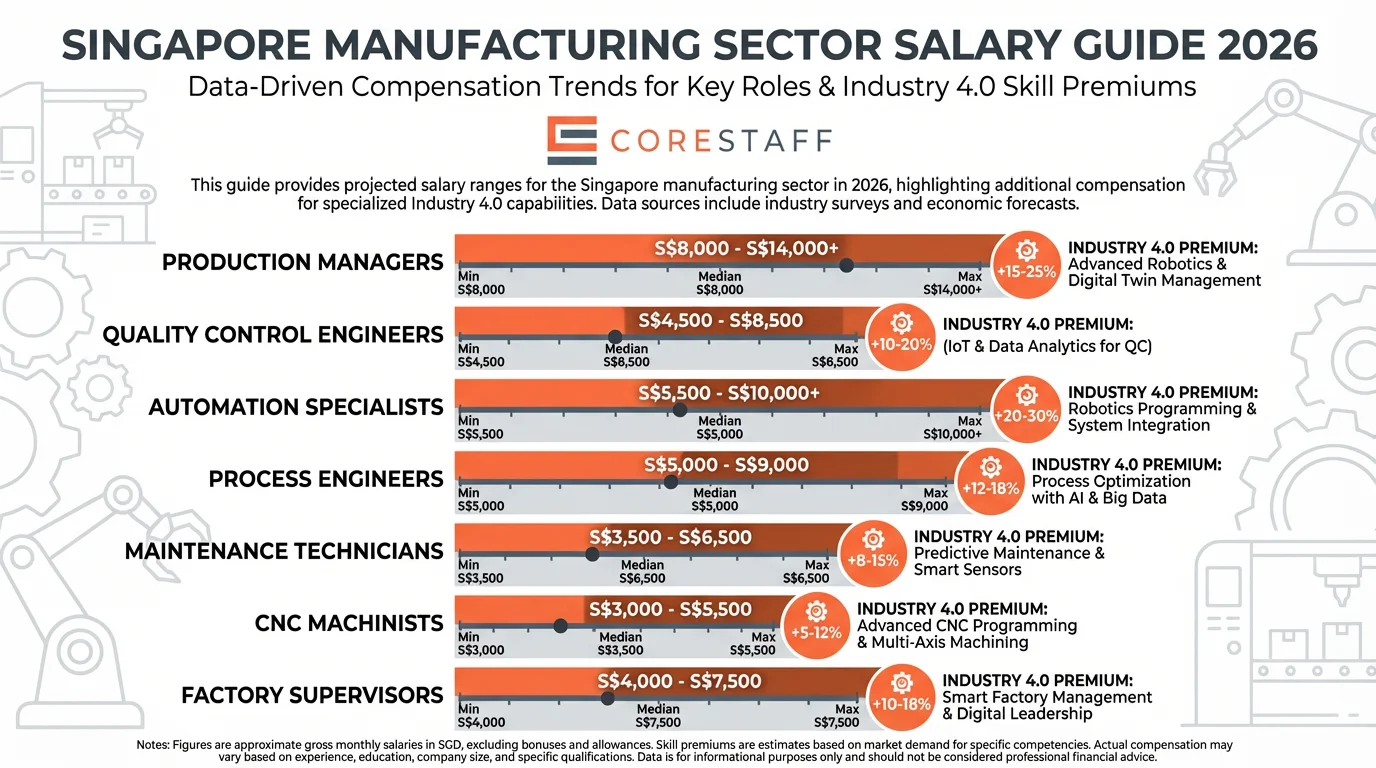
Production Manager
- Salary range: SGD 6,000 – 12,000/month
- Key requirements: Lean manufacturing certification, 5+ years production experience, team leadership
- Time to hire: 45-60 days (highly competitive)
- Critical skills: OEE optimization, workforce planning, continuous improvement
Manufacturing Engineer
- Salary range: SGD 4,500 – 8,500/month
- Key requirements: Engineering degree, CAD/CAM proficiency, process improvement experience
- Time to hire: 30-45 days
- Critical skills: Process optimization, equipment validation, cost reduction
Quality Assurance Engineer
- Salary range: SGD 4,000 – 7,500/month
- Key requirements: ISO 9001/GMP knowledge, statistical process control, audit experience
- Time to hire: 30-40 days
- Sector note: Biomedical roles require additional regulatory certifications
Industry 4.0 Specialist Roles
Automation Engineer
- Salary range: SGD 5,500 – 10,000/month
- Key requirements: PLC programming (Siemens, Allen Bradley), SCADA systems, robotics integration
- Time to hire: 60-90 days (severe shortage)
- Hot skill: Collaborative robot (cobot) programming
Industrial IoT Specialist
- Salary range: SGD 6,000 – 11,000/month
- Key requirements: Sensor networks, edge computing, data analytics, cybersecurity basics
- Time to hire: 70-100 days (emerging role, limited talent pool)
- Growth trend: Demand increased 240% year-on-year
Data Analyst (Manufacturing)
- Salary range: SGD 5,000 – 9,000/month
- Key requirements: SQL, Python/R, manufacturing domain knowledge, dashboard development
- Time to hire: 40-60 days
- Focus areas: Predictive maintenance, yield optimization, supply chain analytics
Skilled Production Roles
CNC Machinist/Programmer
- Salary range: SGD 2,800 – 5,500/month
- Key requirements: Multi-axis CNC experience, GD&T reading, precision measurement
- Time to hire: 50-70 days
- Challenge: Experienced machinists increasingly rare (ageing demographic)
Production Technician
- Salary range: SGD 2,200 – 4,000/month
- Key requirements: Technical diploma/ITE certification, equipment operation, basic troubleshooting
- Time to hire: 20-30 days
- Volume role: Highest hiring volume across manufacturing sectors
Manufacturing Salary Benchmarks 2026
Comprehensive Salary Guide by Role Level
| Role Category | Entry Level | Mid Level | Senior Level |
|---|---|---|---|
| Production Management | SGD 4,500 – 6,000 | SGD 6,000 – 9,000 | SGD 9,000 – 15,000 |
| Engineering | SGD 3,800 – 5,000 | SGD 5,000 – 8,000 | SGD 8,000 – 12,000 |
| Automation/Industry 4.0 | SGD 4,200 – 6,000 | SGD 6,000 – 10,000 | SGD 10,000 – 16,000 |
| Quality Assurance | SGD 3,200 – 4,500 | SGD 4,500 – 7,000 | SGD 7,000 – 11,000 |
| Skilled Production | SGD 2,200 – 3,000 | SGD 3,000 – 4,500 | SGD 4,500 – 6,500 |
Sector-Specific Salary Premiums
Different manufacturing subsectors command varying salary levels:
- Biomedical/Pharmaceutical: +15-25% premium (regulatory complexity and compliance requirements)
- Semiconductor/Electronics: +10-20% premium (technical sophistication and precision requirements)
- Aerospace: +12-18% premium (safety-critical operations and specialized certifications)
- Precision Engineering: Market rate baseline
- General Manufacturing: -5 to -10% compared to high-tech sectors
Additional Compensation Components
Competitive manufacturing packages extend beyond base salary:
- Variable bonus: 1-3 months (performance-based, typically tied to production targets)
- Shift allowance: SGD 300-800/month (for roles requiring night/weekend shifts)
- Transport allowance: SGD 150-300/month (especially for industrial estate locations)
- Professional development: SGD 2,000-5,000/year (certifications, training, conferences)
- Retention bonus: 1-2 months (common for critical technical roles)
Manufacturing Recruitment Challenges 2026
1. Skills Mismatch and Digital Divide
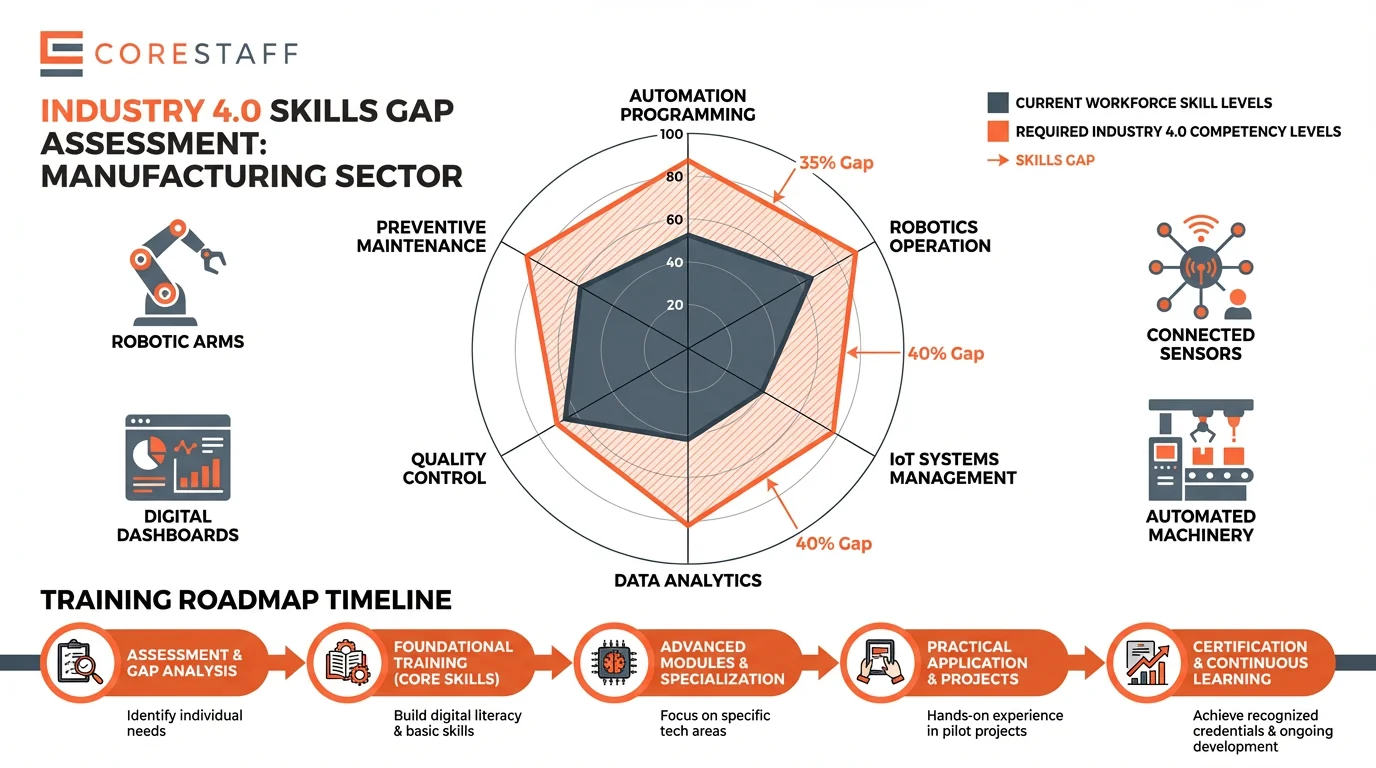
The transition to Industry 4.0 has created a significant skills gap:
- Traditional vs digital: 62% of production workers lack basic digital literacy for smart manufacturing systems
- Ageing workforce: 45% of precision engineering workforce over 50 years old, with retirement wave approaching
- Knowledge transfer gap: Limited structured programs to transfer specialized skills from senior to junior staff
- Retraining challenge: Average 6-12 months required to upskill traditional workers for Industry 4.0 roles
2. Competition for Technical Talent
Manufacturing faces stiff competition from other sectors:
- Tech sector competition: IT companies offer 20-30% higher salaries for software engineers and data analysts
- Hybrid roles challenge: Automation engineers can work in multiple industries, creating bidding wars
- Regional competition: Neighboring countries actively recruiting Singapore-trained manufacturing professionals
- Industry perception: Manufacturing struggles with outdated “dirty and dangerous” perception among young talent
3. Location Constraints
Manufacturing facilities face geographical hiring challenges:
- Industrial estate locations: Tuas, Jurong, and Woodlands facilities require 45-90 minute commutes for many workers
- Limited public transport: Off-peak shift timing (night shifts, weekend operations) often lack adequate public transport
- Remote work impossible: Unlike office roles, production positions require physical presence
- Housing considerations: Foreign talent placement complicated by dormitory locations and regulations
4. Regulatory and Foreign Worker Policy Constraints
Dependency ratio ceiling (DRC) and levies impact hiring strategy:
- Manufacturing DRC: Maximum 60% foreign workers (general manufacturing); 87.5% (process sector)
- S Pass quota: Maximum 20% of total workforce on S Pass
- Levy costs: Work Permit levies range from SGD 300-950/month depending on sector
- Fair Consideration Framework (FCF): 14-day job advertisement period before foreign hire application
Effective Manufacturing Recruitment Strategies
Strategy 1: Skills-Based Hiring Over Credential-Based
Focus on demonstrable competencies rather than traditional qualifications:
- Practical assessments: Conduct hands-on technical tests (machining tests, PLC programming challenges, quality inspection exercises)
- Competency frameworks: Define clear skill requirements for each role (equipment operation, software proficiency, troubleshooting abilities)
- Alternative pathways: Consider ITE diploma holders, mid-career switchers, and military veterans with technical backgrounds
- Portfolio evaluation: For engineering roles, review past projects and problem-solving approaches
Case example: A semiconductor manufacturer in Tampines reduced time-to-hire by 35% by implementing skills-based assessments, discovering strong candidates without traditional engineering degrees who excelled in technical tests.
Strategy 2: Structured Training and Upskilling Programs
Build your own talent pipeline through systematic development:
- Graduate training programs: 6-12 month structured programs for fresh ITE/polytechnic graduates (SGD 2,500-3,500 starting salary with progression path)
- Apprenticeship models: Partner with educational institutions for work-study arrangements (SkillsFuture Work-Study programs available)
- Internal upskilling: Systematic training for existing production staff to take on higher-value roles (ROI: typically 12-18 months)
- Certification support: Fund relevant certifications (CNC programming, Six Sigma, robotics) with retention clauses
Strategy 3: Strategic Foreign Worker Management
Optimize foreign worker strategy within regulatory constraints:
- Tiered workforce model: Use S Pass for specialized roles (automation technicians, quality engineers) and Work Permit for production operators
- Source country strategy: Malaysia, China, and India provide largest pools for technical roles; Bangladesh and Myanmar for production operators
- Retention focus: Invest in foreign worker satisfaction (good accommodation, clear progression paths, regular home leave) to reduce replacement costs
- EP strategy for critical roles: Secure Employment Pass holders for senior engineers and managers (no quota restrictions)
Strategy 4: Partnership with Specialist Manufacturing Recruitment Agencies
Leverage recruitment expertise for hard-to-fill positions:
- Technical expertise: Agencies specializing in manufacturing understand technical requirements and can pre-screen effectively
- Network access: Established agencies maintain databases of passive candidates not actively job-seeking
- Time savings: Reduce hiring manager time spent on initial screening (average 15-20 hours per technical hire)
- Market intelligence: Agencies provide salary benchmarking and insights on talent availability
Strategy 5: Employer Branding for Manufacturing
Combat negative perceptions and attract quality talent:
- Showcase technology: Highlight smart manufacturing, robotics, and innovation in recruitment materials
- Career progression stories: Feature employee testimonials showing advancement from technician to engineer roles
- Facility tours: Offer candidates tours of modern, clean, high-tech production environments
- Benefits emphasis: Clearly communicate total compensation package (base + bonus + benefits + training)
- Industry 4.0 positioning: Frame manufacturing as a technology career, not just production work
Optimized Manufacturing Hiring Process
Phase 1: Job Definition and Sourcing (Week 1)
- Define role requirements with production/engineering managers
- Create detailed job description highlighting technology and growth opportunities
- Post on MyCareersFuture, industry job boards, and LinkedIn
- Engage manufacturing recruitment specialist (Corestaff) for passive candidate sourcing
- Activate employee referral program (typical SGD 500-2,000 referral bonus)
Phase 2: Screening and Technical Assessment (Week 2-3)
- Resume screening focusing on relevant technical experience and certifications
- Phone screening to assess basic qualifications and salary expectations
- Technical assessment (online test or practical exercise depending on role)
- For engineering roles: technical case study or problem-solving exercise
- Shortlist 3-5 candidates for face-to-face interviews
Phase 3: Interviews and Practical Evaluation (Week 3-4)
- First interview with hiring manager and department head (technical competencies, cultural fit)
- Facility tour and practical demonstration (operating equipment, reading technical drawings, troubleshooting scenarios)
- Second interview with senior management (for managerial/senior technical roles)
- Reference checks (critical for technical roles; verify certifications and past performance)
Phase 4: Offer and Onboarding (Week 4-6)
- Competitive offer including base salary, shift allowances, bonuses, and training commitments
- Clear communication of career development path
- For foreign hires: work pass application (1-3 weeks for S Pass/EP; 2-4 weeks for Work Permit)
- Structured onboarding program (safety training, equipment familiarization, buddy system)
Total timeline: 4-8 weeks for local hires; 6-12 weeks for foreign hires (including work pass processing).
Technology’s Impact on Manufacturing Recruitment
Automation: Threat or Opportunity?
Industry 4.0 automation is reshaping, not eliminating, manufacturing jobs:
- Job displacement: Repetitive manual tasks (packaging, simple assembly, material handling) increasingly automated
- Job creation: New roles emerging (robot programmers, predictive maintenance specialists, data analysts)
- Job transformation: Production operators becoming technicians managing automated systems
- Net impact: Singapore manufacturing employment remained stable at 450,000 workers (2025), but skill composition changed significantly
Essential Industry 4.0 Skills for 2026
Prioritize candidates with these emerging competencies:
- Digital literacy: Comfortable with MES (Manufacturing Execution Systems), ERP, digital dashboards
- Data interpretation: Ability to read production data, identify trends, and make data-driven decisions
- Problem-solving: Analytical thinking to troubleshoot complex automated systems
- Collaboration: Cross-functional work with IT, engineering, and operations teams
- Continuous learning mindset: Willingness to regularly upskill as technology evolves
Recruitment Technology Tools
Leverage technology to improve hiring efficiency:
- Applicant Tracking Systems (ATS): Streamline application management and candidate communication
- Skills assessment platforms: Online technical tests for initial candidate screening (reduces interview time by 40%)
- Video interviewing: Particularly useful for foreign candidate preliminary interviews
- LinkedIn Recruiter: Essential for passive candidate sourcing, especially technical specialists
- Employee referral platforms: Gamify and automate referral programs to tap internal networks
Retention Strategies for Manufacturing Talent
With average recruitment costs of SGD 5,000-15,000 per technical hire, retention is critical:
Career Development Pathways
- Clear progression: Define advancement from technician to senior technician to engineer (typical 3-5 year pathway)
- Technical vs managerial tracks: Offer specialist technical career paths for those who prefer hands-on work
- Skills development plans: Annual training budgets (SGD 2,000-5,000/year) for professional growth
- Certification support: Fund industry certifications (Six Sigma, PMP, technical licenses) with performance-based retention clauses
Competitive Compensation Reviews
- Annual market benchmarking: Review salaries against industry standards (aim for 50th-75th percentile for critical roles)
- Performance bonuses: Tie bonuses to clear, achievable production and quality metrics
- Retention bonuses: Offer retention payments at 2-year and 5-year milestones for hard-to-replace roles
- Benefits enhancement: Comprehensive health insurance, flexible benefits, wellness programs
Work Environment and Culture
- Modern facilities: Invest in clean, well-lit, air-conditioned production environments
- Safety culture: Demonstrate commitment to worker safety through visible investments and programs
- Recognition programs: Regular recognition of high performers (employee of the month, safety awards, innovation contests)
- Work-life balance: Where possible, offer flexible shift arrangements and avoid excessive overtime
Engagement and Communication
- Regular feedback: Quarterly performance conversations (not just annual reviews)
- Involvement in improvement: Engage production staff in continuous improvement initiatives (Kaizen, suggestion schemes)
- Transparent communication: Regular updates on company performance, orders, and strategic direction
- Cross-functional exposure: Opportunities for production staff to understand full value chain
How Corestaff Solves Manufacturing Recruitment Challenges
Corestaff specializes in manufacturing recruitment solutions across Singapore’s diverse industrial sectors. Our deep expertise and extensive network enable us to deliver quality candidates efficiently.
Our Manufacturing Recruitment Expertise
Sector Specialization
- Electronics & Semiconductor: Process engineers, equipment technicians, cleanroom specialists
- Precision Engineering: CNC machinists, tooling engineers, quality inspectors
- Biomedical/Pharmaceutical: Validation engineers, GMP-certified production staff, regulatory specialists
- Chemicals & Process: Process operators, safety engineers, laboratory technicians
- Aerospace: Composite technicians, NDT inspectors, quality engineers
Technical Screening Capabilities
- In-house technical experts: Our recruitment consultants include former manufacturing professionals who understand technical requirements
- Competency-based screening: We assess candidates on actual skills, not just credentials
- Technical test administration: We can coordinate specialized assessments (CNC programming tests, PLC troubleshooting, quality inspection exercises)
- Certification verification: We verify all claimed technical certifications and qualifications
Comprehensive Workforce Solutions
- Permanent placement: For core technical roles and management positions
- Contract staffing: Flexible solutions for project-based needs or production ramp-ups
- Foreign worker management: End-to-end support for Work Permit and S Pass applications
- Executive search: Senior manufacturing leadership (Plant Managers, Engineering Directors, Operations Heads)
Why Manufacturing Companies Choose Corestaff
- Industry network: 15+ years building relationships with manufacturing professionals across Singapore
- Faster time-to-hire: Average 30% reduction in hiring timeline through pre-screened candidate pipelines
- Quality guarantee: Replacement guarantee period for all placements
- Market intelligence: Regular salary benchmarking and talent availability insights
- Regulatory expertise: Navigate foreign worker quotas, levies, and work pass requirements
- Personalized service: Dedicated account manager who understands your specific manufacturing environment
Success Story: Precision Engineering Workforce Transformation
A precision engineering company in Tuas approached Corestaff facing critical challenges: 40% of their skilled workforce approaching retirement, difficulty attracting young talent, and urgent need for automation expertise as they implemented Industry 4.0 systems.
Our solution:
- Recruited 12 young polytechnic graduates and provided them with mentoring by senior machinists (knowledge transfer program)
- Sourced 5 automation technicians with PLC programming skills from other industries (automotive, logistics automation)
- Secured 8 experienced CNC programmers on S Pass from regional talent pools
- Established ongoing contract staffing arrangement for peak production periods
Results: Complete workforce transformation in 6 months, smooth knowledge transfer from retiring staff, 95% retention rate after 12 months, and client achieved automation targets ahead of schedule.
Partner with Corestaff for Manufacturing Recruitment Success
Singapore’s manufacturing sector offers tremendous opportunities, but talent challenges require strategic recruitment approaches. Whether you need to fill critical technical positions, build Industry 4.0 capabilities, or manage foreign workforce requirements, Corestaff’s specialized manufacturing recruitment expertise delivers results.
Get Your Free Manufacturing Recruitment Consultation
Discuss your specific hiring challenges with our manufacturing recruitment specialists. We will provide:
- Tailored recruitment strategy for your technical requirements
- Current salary benchmarking for your target roles
- Talent availability assessment in your sector
- Foreign worker strategy recommendations within regulatory constraints
- Timeline and cost projections for your hiring needs
Contact Corestaff Today
Phone: +65 6288 6866
Email: recruit@corestaff.com.sg
Website: www.corestaff.com.sg
Address: 175A Bencoolen Street, #11-05 Burlington Square, Singapore 189650