
Direct Answer
Singapore semiconductor hiring in 2026 is structurally harder because government data confirms demand is outpacing local supply. The sector contributes nearly 7% of GDP and employs over 35,000 people (EDB), with SGD 30 billion+ anchored across the past four years. MOM added semiconductor, instrumentation, and process engineers to the Shortage Occupation List in November 2024, meaning the government publicly acknowledges local talent cannot meet demand. Meanwhile the Employment Pass floor rises to SGD 6,000 from 1 January 2027, and every foreign hire must clear COMPASS. Employers that combine SOL positioning, C1 salary benchmarking, and continuous passive outreach will close 2026 shortlists. Those that don’t will lose them.
The Scale: What Singapore Semiconductor Is Actually Worth
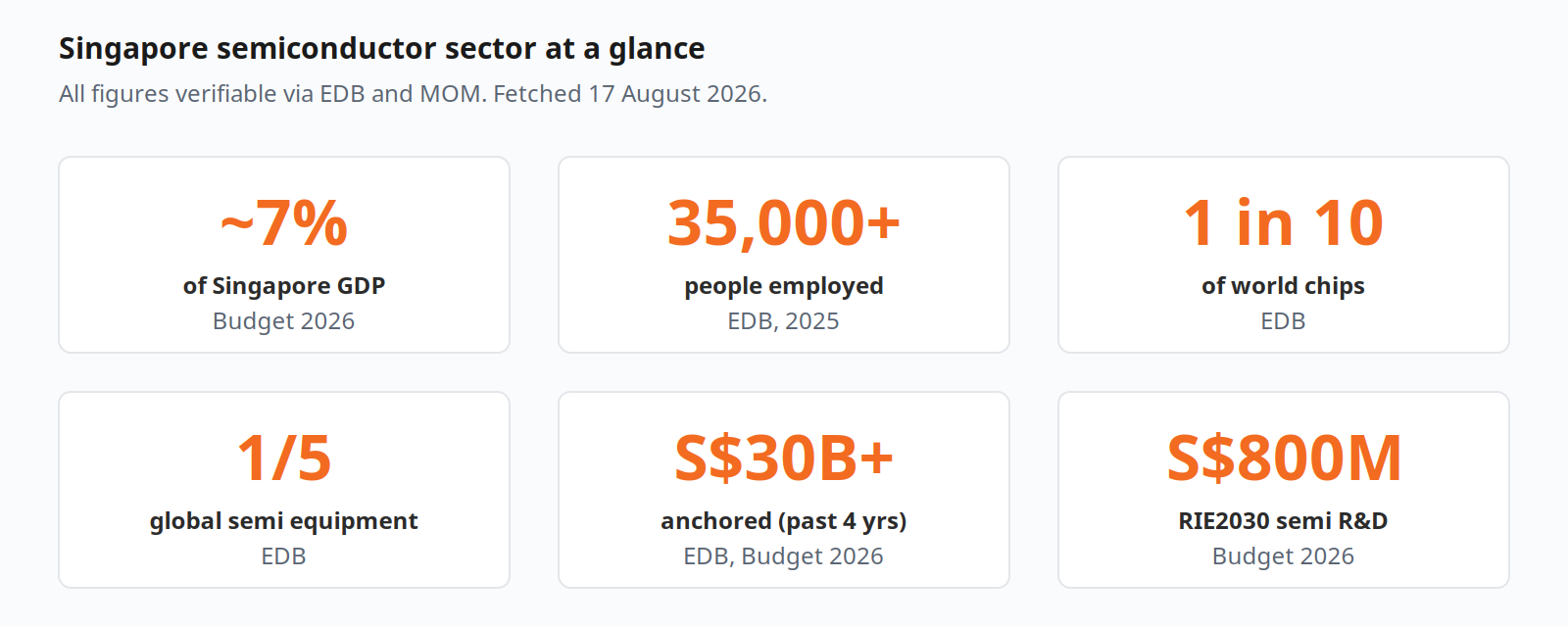
Before framing the hiring approach, look at what the primary sources actually say. The Economic Development Board reports Singapore contributes one in 10 chips worldwide and one-fifth of global semiconductor equipment production. The sector employs over 35,000 people and accounts for nearly 6% of GDP; at Budget 2026 the Minister-in-Charge of Energy, Science and Technology cited the sector at close to 7% of GDP, reflecting fresh investment inflow.
Global semiconductor market size is projected to reach USD 1 trillion by 2030 per EDB. Singapore’s positioning is backed by over SGD 30 billion in semiconductor investment anchored in the past four years, plus the SGD 800 million semicon R&D flagship under the Research, Innovation and Enterprise 2030 plan.
The Government Signals Employers Are Missing
The government has been explicit that domestic training alone will not meet demand in the short term. Three signals matter:
Signal 1: The Shortage Occupation List addition (November 2024)
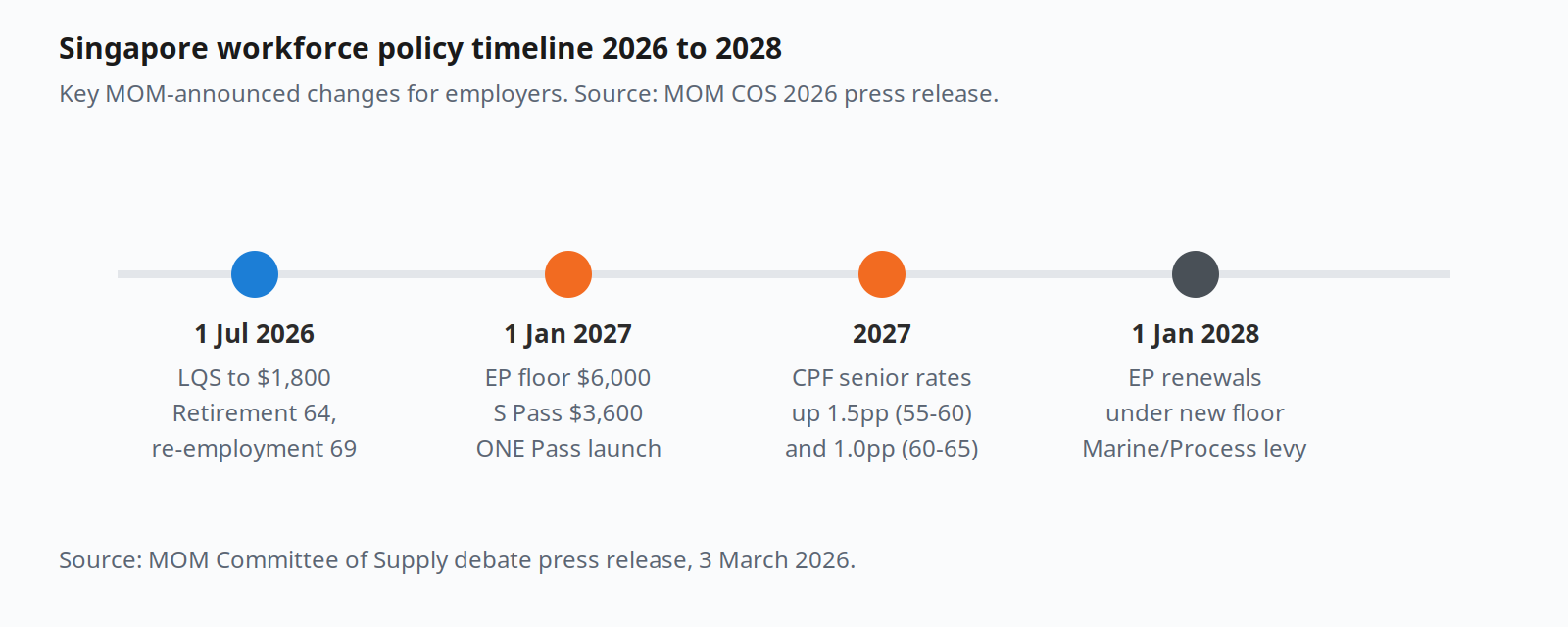
MOM added semiconductor, instrumentation, and process engineers to the SOL in November 2024. This is not a marketing signal; the SOL is co-developed by MOM and MTI with sector agencies, and it earns EP candidates bonus points under COMPASS C5. When MOM adds a role to the SOL, it is publicly acknowledging that Singapore’s local pipeline cannot meet current employer demand.
Signal 2: The 2027 EP floor increase
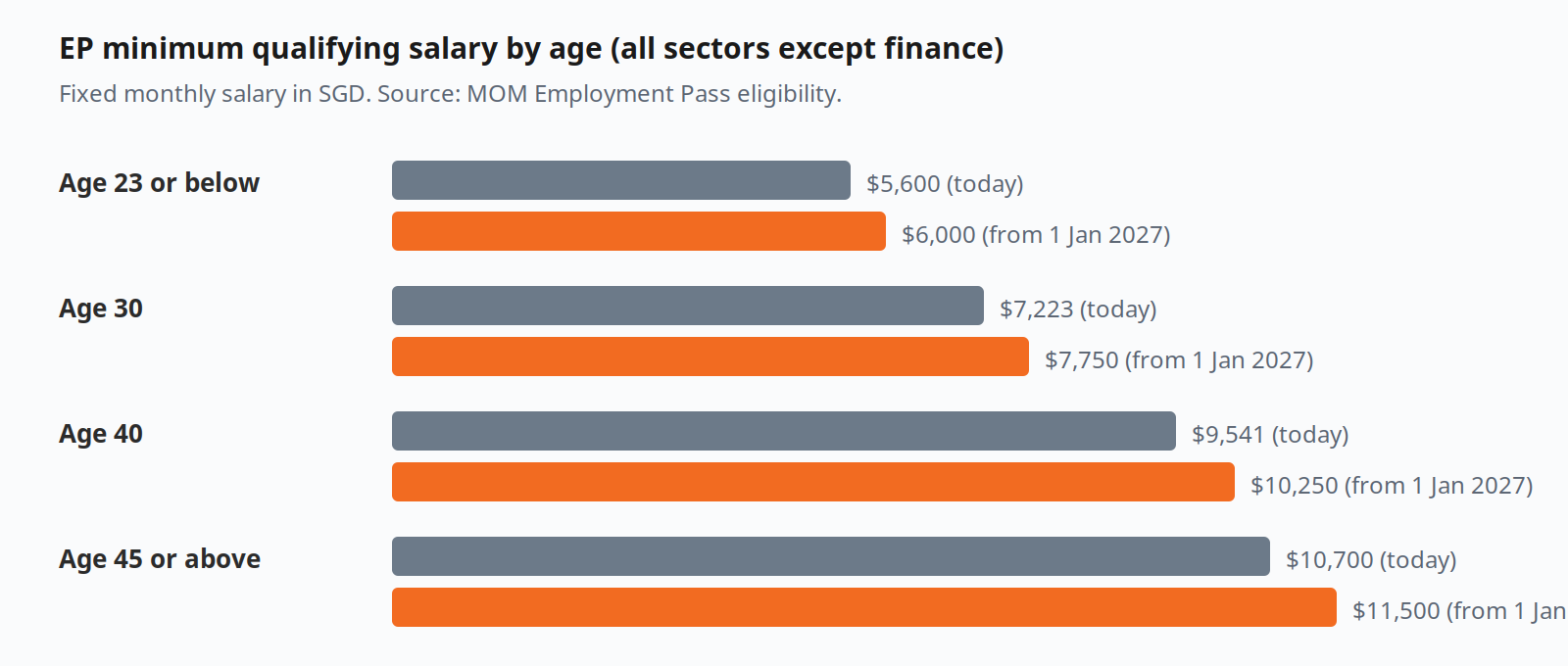
The EP minimum qualifying salary rises to SGD 6,000 from 1 January 2027 for new applications, SGD 6,600 for financial services. Renewals expiring from 1 January 2028 fall under the same new floor.
Signal 3: The RIE2030 investment
The SGD 800 million semicon R&D flagship is the largest sector allocation under Singapore’s SGD 37 billion RIE2030 plan. A new SGD 60 million National Semiconductor Translation and Innovation Centre for Power Electronics opens April 2026, hosting an 8-inch silicon carbide R&D pilot line. Every new facility drives multi-quarter hiring.
Three Reasons Singapore Semiconductor Hiring Just Got Harder
1. Multiple large employers are chasing the same candidate pool
Global players with active Singapore operations include Applied Materials, GlobalFoundries, Infineon, Micron, NXP Semiconductors, Vanguard International Semiconductor, Siltronic, Pall Corporation, plus ASE Group and STATS ChipPAC on the outsourced assembly and test side. When a mid-career process engineer is on the market, they are typically being approached by two or three of these firms simultaneously.

🔬 Losing shortlists to the big fabs?
Corestaff sources semiconductor engineers with realistic salary framing, structured interview support, and passive-candidate outreach so mid-market employers can compete without being outbid.
2. The 2027 EP floor raises the cost of every foreign hire
Because semiconductor roles frequently need foreign talent, the 2027 floor raises baseline hiring cost for many mid-career engineers. Employers who benchmark salaries against pre-2027 offers will find shortlists moving to competitors that have re-based.
3. COMPASS C1 percentile compounds the pressure
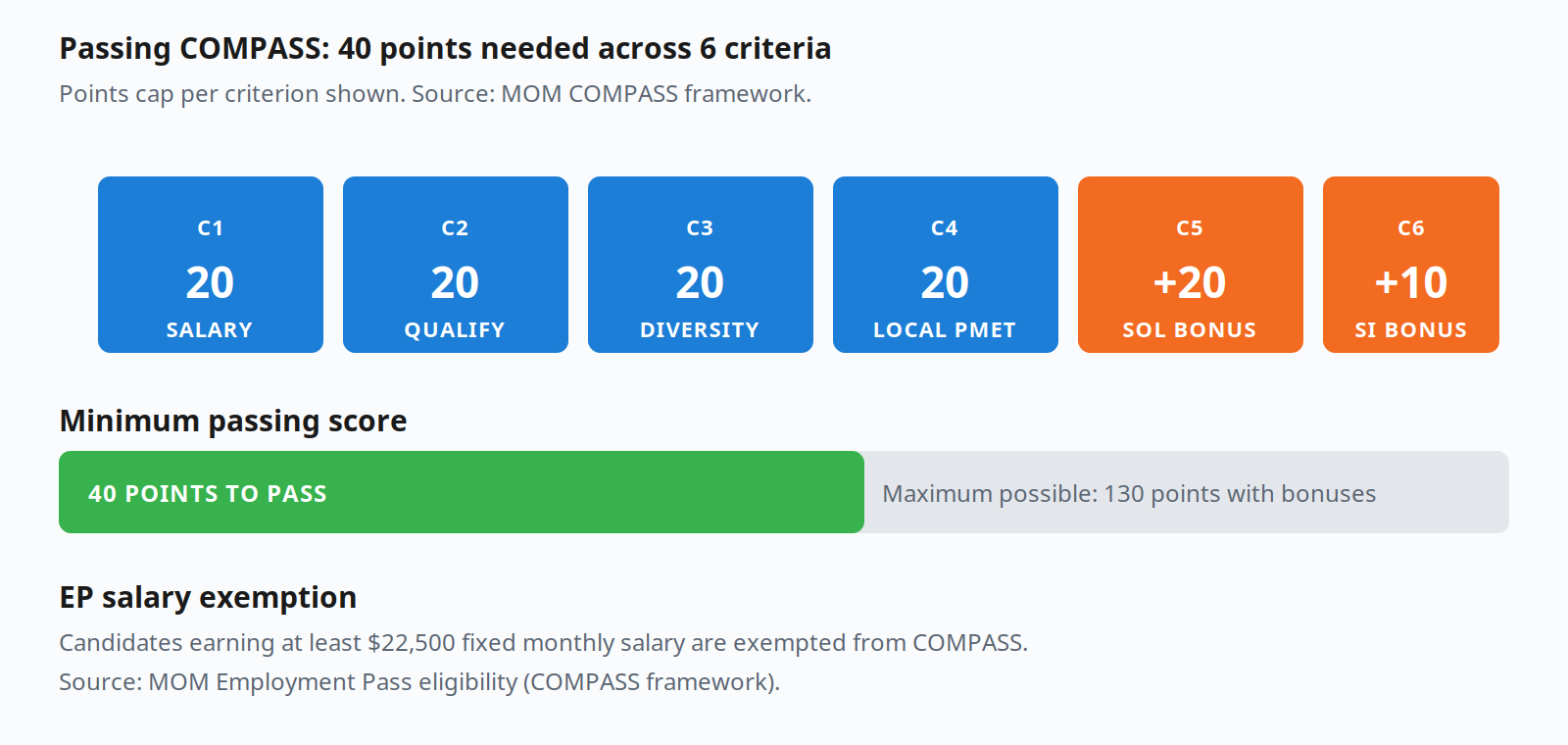
Meeting the qualifying salary is only Stage 1. Under COMPASS C1 Salary, candidates need at least the 65th percentile of local PMET salaries in the sector to earn 10 points; the 90th percentile earns 20. Employers relying on borderline salaries fail COMPASS even when they clear the EP floor, unless the candidate contributes points elsewhere.
COMPASS: The Second Gate You Have to Clear
How the C5 Skills Bonus works for SOL roles
Semiconductor engineers on the SOL earn up to 20 bonus points under C5. Combined with the C1 salary points and C2 qualification points, this means well-positioned candidates can pass COMPASS comfortably. But the SOL entry must be selected explicitly in the EP application, and the job duties in the application must match the SOL entry.
The C1 Salary Benchmark Table
| Fixed monthly salary vs sector benchmark | COMPASS points | What it means |
|---|---|---|
| 90th percentile and above | 20 | Strong position; single criterion nearly clears half of COMPASS |
| 65th to 90th percentile | 10 | Meets the C1 threshold; must earn points elsewhere |
| Below 65th percentile | 0 | Zero C1 points; COMPASS clearance often fails |
Source: MOM COMPASS C1 Salary benchmarks.
What Effective Employers Are Doing Differently in 2026
- Structuring foreign hires against the 2027 floor now. Offer letters are being written with the 2027 renewal salary in mind. See our EP and S Pass Employer Playbook.
- Using SOL positioning deliberately. The EP application selects the SOL job title, and the job description mirrors the SOL entry.
- Building a passive candidate map, not just a job post.
- Sequencing offers around COMPASS. C1 benchmarks and C2 qualifications are pre-checked, not verified post-shortlist.
Special Note for Mid-Market Chip Employers
The employers who feel this squeeze most are Tier 2 and Tier 3 semiconductor firms competing head-on with global majors for the same engineers. Three tactics work:
- Compete on career narrative, not brand-pull. A mid-market chip firm cannot outbid Micron on brand. It can offer a bigger scope role with a shorter reporting line, if that is genuinely true.
- Move faster on offers. In a hot market, decision speed is the biggest differentiator. Compress interview cycles to two weeks maximum.
- Use SOL points ruthlessly. The C5 Skills Bonus is available to every eligible employer, but many mid-market firms fail to draft job descriptions that mirror the SOL entry precisely. Fixing that is free and closes 20 points on COMPASS.
🗺 Mid-market chip firm competing with the majors?
We help Tier 2 and Tier 3 semiconductor employers win on narrative, speed and offer discipline. No brand-pull tax needed.
What the Government Is Doing on the Supply Side
The Institute of Technical Education signed MOUs with GlobalFoundries, Micron, STMicroelectronics and A*STAR’s Institute of Microelectronics in 2024; Siltronic and Vanguard International Semiconductor were added in 2025. SIT engineering intake grew nearly 19% between 2022 and 2024. NUS added an advanced electronics specialisation. These are structural fixes with multi-year lead time. They do not fill your 2026 or 2027 roles.
Frequently Asked Questions
What is the new Employment Pass minimum salary from 2027?
Which semiconductor roles are on Singapore’s Shortage Occupation List?
How many COMPASS points does a candidate need to pass?
How large is Singapore’s semiconductor sector?
What is RIE2030 and how does it affect semiconductor hiring?
Conclusion: What to Do Next
Singapore semiconductor hiring in 2026 is a two-side problem. Demand is set by SGD 30 billion of anchored investment and the three semi engineer roles on the SOL; supply is a locally trained pool MOM itself has flagged as insufficient. Employers who pretend it is still a normal engineering market will lose 2026 shortlists. Employers who plan against the government’s own timelines, benchmark to COMPASS, and run continuous passive outreach will hire.
Hire semiconductor talent with Corestaff
Corestaff runs recruitment sprints for Singapore employers across executive search, professional and mid-market hiring, and skilled-trade sourcing. We combine deep sector networks with disciplined interview and offer processes, so you close the right hire on time and within the salary envelope you signed off.
Book a Free Scoping Call →
Learn about Manufacturing Recruitment
Phone: +65 6288 6866 ·
Email: recruit@corestaff.com.sg
Address: 175A Bencoolen Street #11-05 Burlington Square, Singapore 189650
Web: www.corestaff.com.sg