
Direct Answer
Temporary and contract staffing in Singapore manufacturing is a policy-aligned tool, not a workaround. Used well, it lets employers align headcount to project milestones, access specialist skills without long-term commitment, manage exposure to the 2027 EP floor of SGD 6,000, and pilot candidates before permanent conversion. The financial calculus shifts around three specific policy transitions: the 2027 EP and S Pass floor increases, and the 2028 Marine Shipyard and Process levy alignment.
What “Temporary” and “Contract” Actually Mean in Singapore
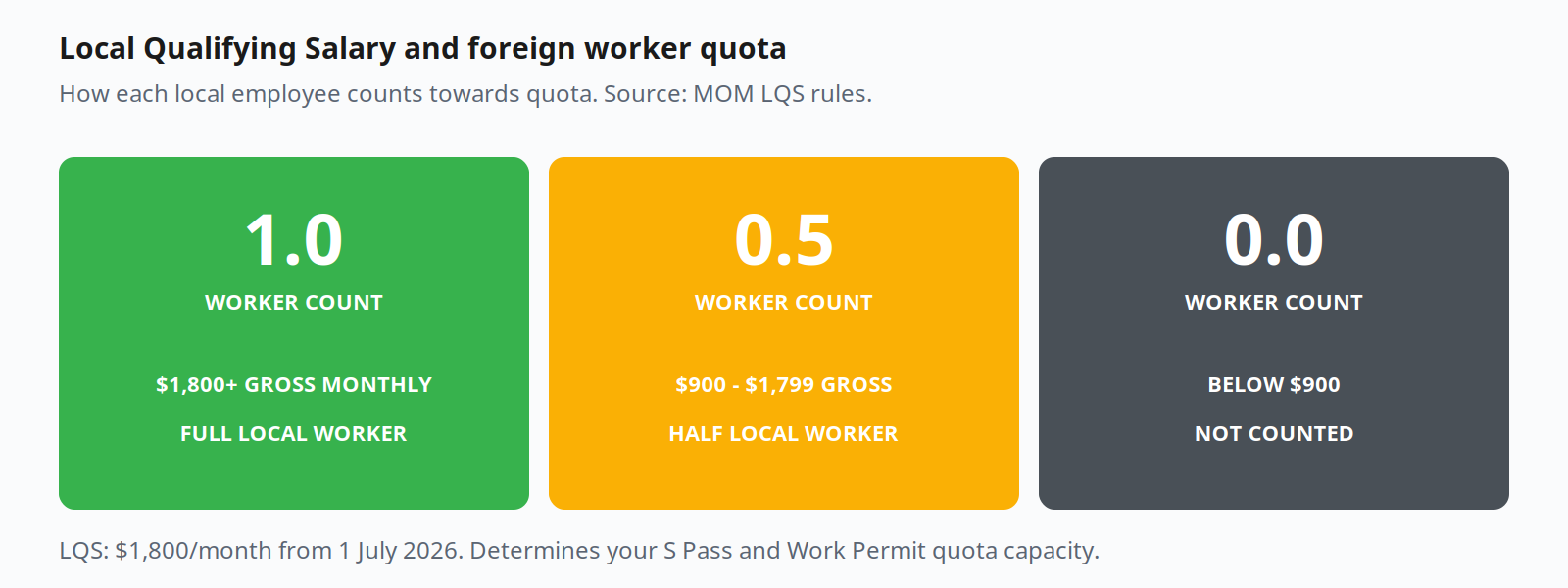
Under MOM’s contract of service framework, a local employee under a contract of service is counted as one local worker for foreign worker quota if they earn at least the LQS of SGD 1,800 monthly gross. Contract staff on payroll count the same way. Temporary staff working through a licensed employment agency count under the agency’s arrangement, not the client employer’s headcount.
Five Substantive Benefits of Temp and Contract Staffing in Singapore Manufacturing
1. Aligning headcount to project milestones
Manufacturing 2030 targets to increase manufacturing sector value-add by 50% from 2020 to 2030. Fab commissioning, packaging line startups, and biomedical build-outs create sharp headcount peaks.
2. Access to specialist skills without long-term commitment
For SOL-eligible semiconductor, instrumentation, and process engineer roles, contract engagement is often the only way to secure enough talent for a scheduled fab ramp.
3. Reduced exposure to the 2027 EP floor for short engagements
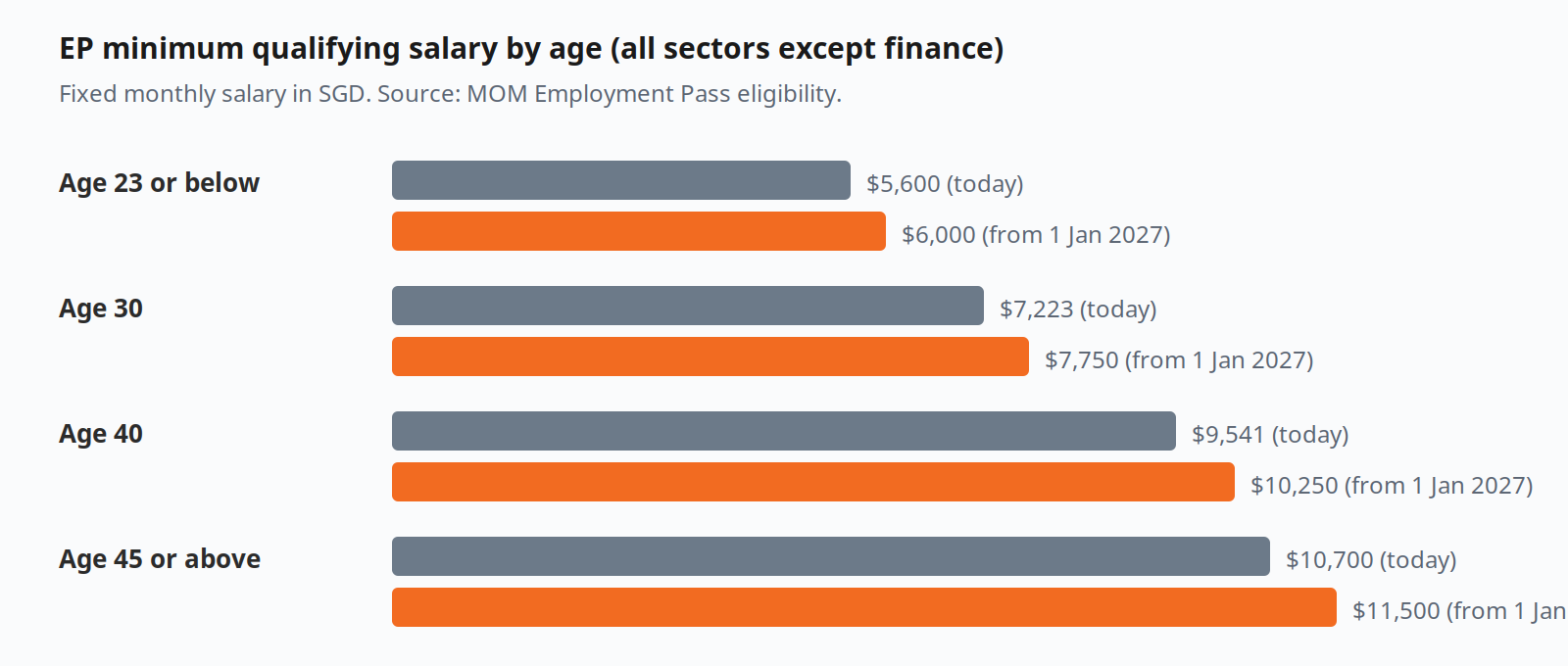
For roles under 12 months, contract engagement is financially cleaner because there is no forced EP re-basing at year 2.
4. Quota flexibility during peak periods
Temporary staff supplied through an agency during peak periods do not affect the client employer’s quota.
5. Trial-to-hire pathway
Contract engagement lets employers assess a candidate’s fit against real work before extending a permanent offer.
🏭 Considering temp or contract staffing for a 2026-2027 manufacturing project?
Corestaff sources contract and temporary talent across Singapore manufacturing, from process engineers on 6-month fab commissioning contracts to shift supervisors on 12-month ramp assignments.
How the 2027 Policy Timeline Changes the Temp-vs-Permanent Calculus
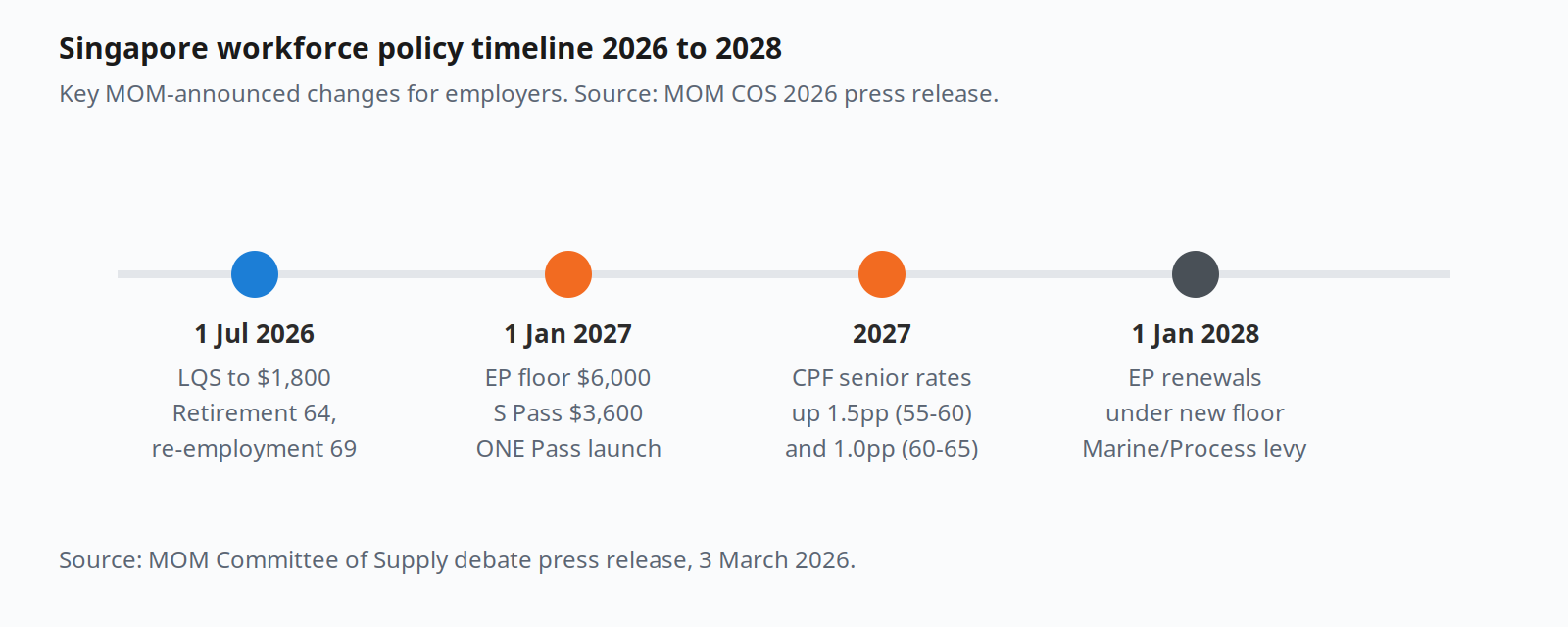
2027 EP floor changes renewal economics
New EP applications from 1 January 2027 fall under the SGD 6,000 floor; renewals from 1 January 2028 also do. For roles under 24 months, contract engagement often works out cheaper. For 4+ year roles, permanent hiring with an offer based on the 2027 floor is cleaner.
2027 S Pass floor changes technician hiring
The S Pass floor rises to SGD 3,600 from 1 January 2027, expected to reach SGD 4,000-4,500 by around 2030.
2028 Marine Shipyard and Process levy alignment
Levy rates for basic-skilled (R2) Work Permit holders in Marine Shipyard and Process rise by SGD 100 and SGD 150 respectively from 2028.
Common Temp and Contract Structures in Singapore Manufacturing
| Structure | Best for | Typical duration |
|---|---|---|
| Payrolled contract | Specialist roles, uncertain fit | 6-18 months |
| Client-sponsored contract | Client has quota headroom | 6-24 months |
| Trial-to-hire | Technical fit uncertain | 3-6 months, then permanent |
| Project-based staffing | Fab commissioning, event ramp | Duration of project |

Where Temp and Contract Staffing Does Not Fit
- Core operator roles. Roles that are permanent to the plant’s operating model should be permanent hires.
- Roles needing full-cycle accountability. Quality management, safety leadership, Green Mark documentation ownership.
- Where local headcount below LQS constrains you. Adding temp staff does not solve the fundamental quota problem, wage restructuring using PWCS at 30% co-funding does.
📞 Need a partner who understands the pass framework as well as the recruiting?
We are a licensed Singapore recruitment agency. Every temp and contract engagement we structure stands up to MOM audit.
Frequently Asked Questions
Does temporary staffing affect our foreign worker quota?
When is contract engagement cheaper than permanent hire?
What is the 2028 levy change for Marine Shipyard and Process?
Can I convert a contract hire to permanent?
- MOM, Local Qualifying Salary
- MOM, EP eligibility
- MOM, S Pass key facts
- MOM, COMPASS C5 SOL
- MOM, COS 2026 press release
- EDB, Advanced Manufacturing
How to Model the Cost Difference: Contract vs Permanent
For a senior process engineer role at SGD 8,000 monthly base salary, the 24-month cost comparison illustrates when contract engagement wins:
Permanent EP hire (24 months)
Base SGD 8,000/month + AWS + variable bonus + CPF contributions + medical insurance + EP renewal fee. Approximate 24-month direct cost: SGD 240,000 to SGD 280,000, depending on bonus structure.
Contract engagement via agency (24 months)
Loaded contract rate typically SGD 10,000 to SGD 11,500/month (agency margin, work pass sponsorship, PCP/medical, admin). Approximate 24-month direct cost: SGD 240,000 to SGD 276,000. Comparable to permanent, but with cleaner project-end wind-down and no severance exposure.
Where contract clearly wins
Projects under 18 months (avoids EP renewal cost). Roles with uncertain long-term fit (avoids severance). Fab commissioning ramps where headcount collapses at project end. For SOL-eligible semiconductor, instrumentation, and process engineer roles, contract engagement also lets employers layer C5 Skills Bonus into a fixed-term EP application.
The COMPASS Angle for Contract Engagements
Contract EP holders still go through the same 2-stage COMPASS framework: qualifying salary floor at Stage 1, then 40 points across the 6 criteria at Stage 2. Sponsoring employers (whether the agency or the client) need to model C1 sector percentiles just as tightly for contract hires as for permanent. Contract engagement does NOT lower the COMPASS bar.
Trial-to-Hire in a Post-COMPASS World
Trial-to-hire (typically 3 to 6 months contract, then permanent conversion) is under-used in Singapore manufacturing partly because employers assume pass conversion is complicated. In practice, converting a contract EP holder to a permanent EP holder with the same employer is straightforward: the new employer files a new EP application at the same qualifying salary or higher. What matters is that the salary meets the 2027 floor at conversion date, not the original contract date.
Conclusion: What to Do Next
Temp and contract staffing in Singapore manufacturing is policy-aligned when used deliberately. Used poorly it stores up problems.
Structure your next temp or contract hire with Corestaff
Corestaff runs recruitment sprints for Singapore employers across executive search, professional and mid-market hiring, and skilled-trade sourcing. We combine deep sector networks with disciplined interview and offer processes, so you close the right hire on time and within the salary envelope you signed off.
Book a Free Scoping Call →
Learn about Manufacturing Recruitment
Phone: +65 6288 6866 ·
Email: recruit@corestaff.com.sg
Address: 175A Bencoolen Street #11-05 Burlington Square, Singapore 189650
Web: www.corestaff.com.sg