
Direct Answer
Ten manufacturing role families are under the sharpest hiring pressure in Singapore for 2026. Three of them (semiconductor engineer, instrumentation engineer, process engineer) sit on the MOM Shortage Occupation List since November 2024, meaning EP applications for these roles earn C5 Skills Bonus points. Add automation/robotics engineers (Singapore ranks second globally at 730 robots per 10,000 workers), precision CNC programmers, facilities and M&E engineers, quality engineers, manufacturing engineers, production managers, and equipment/tools engineers.
The Ten Most Pressured Manufacturing Roles
| # | Role family | SOL status | Primary demand driver |
|---|---|---|---|
| 1 | Process Engineer (Semi) | On SOL | SGD 30B+ anchored semi investment |
| 2 | Semiconductor Engineer | On SOL | Fab and advanced packaging ramps |
| 3 | Instrumentation Engineer | On SOL | Metrology and process control |
| 4 | Equipment / Tools Engineer | Adjacent to SOL | Fab tool installation and integration |
| 5 | Manufacturing Engineer | Not on SOL | Manufacturing 2030 capacity expansion |
| 6 | Production Manager / Shift Manager | Not on SOL | Under-supplied at senior level |
| 7 | Quality Engineer | Not on SOL | Medical device and semiconductor regulatory push |
| 8 | Automation and Robotics Engineer | Not on SOL | 730 robots per 10,000 workers (EDB) |
| 9 | Precision CNC / Toolmaker | Not on SOL | Tightest skilled-trade market |
| 10 | Facilities and M&E Engineer | Not on SOL | AI data centre demand |
SOL data from MOM COMPASS C5 SOL, sector context from EDB Advanced Manufacturing.

What Makes These Roles Especially Hard to Fill in 2026
SOL positioning helps, but only if used deliberately
The three semiconductor SOL roles let EP candidates score C5 Skills Bonus points. But the additional requirements in the SOL Employer Guide must be met precisely: employers who select the SOL job title without matching duties and qualifications get rejected.
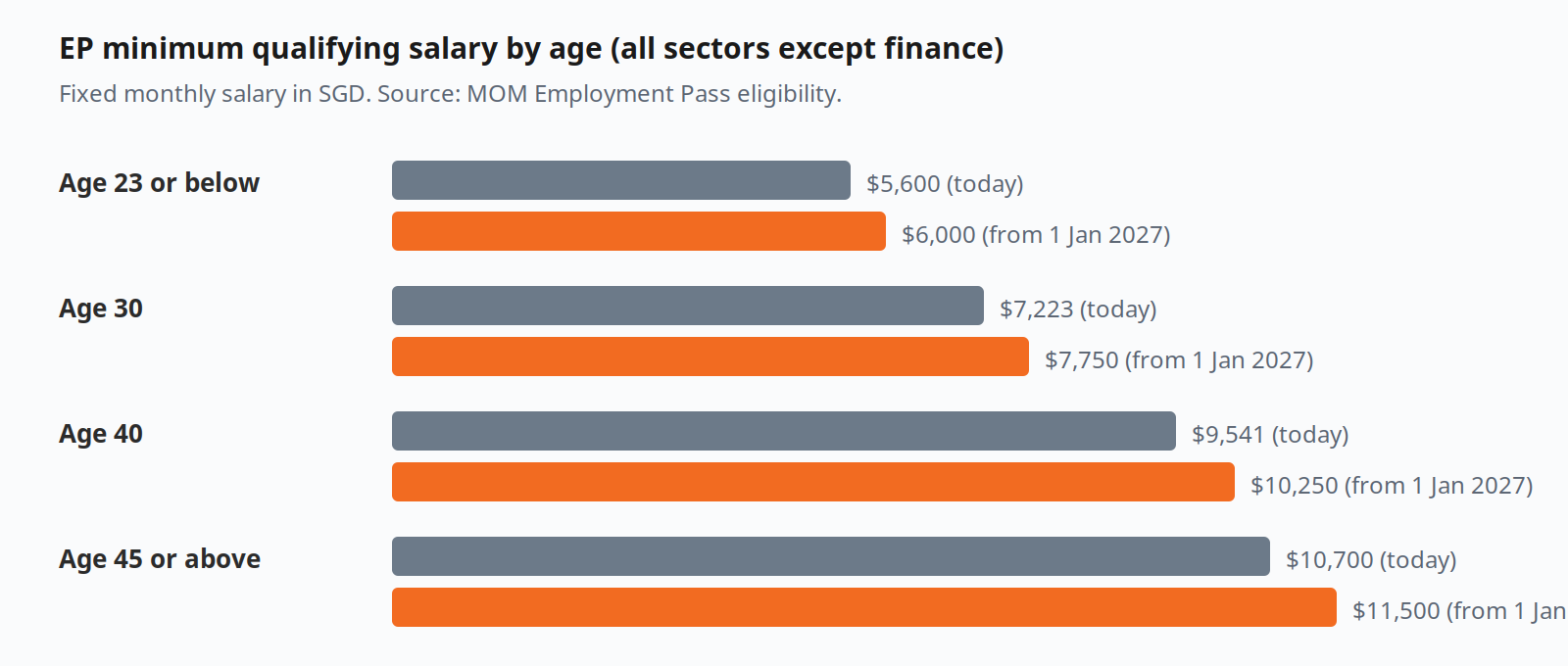
The 2027 EP salary floor pulls up every foreign hire baseline
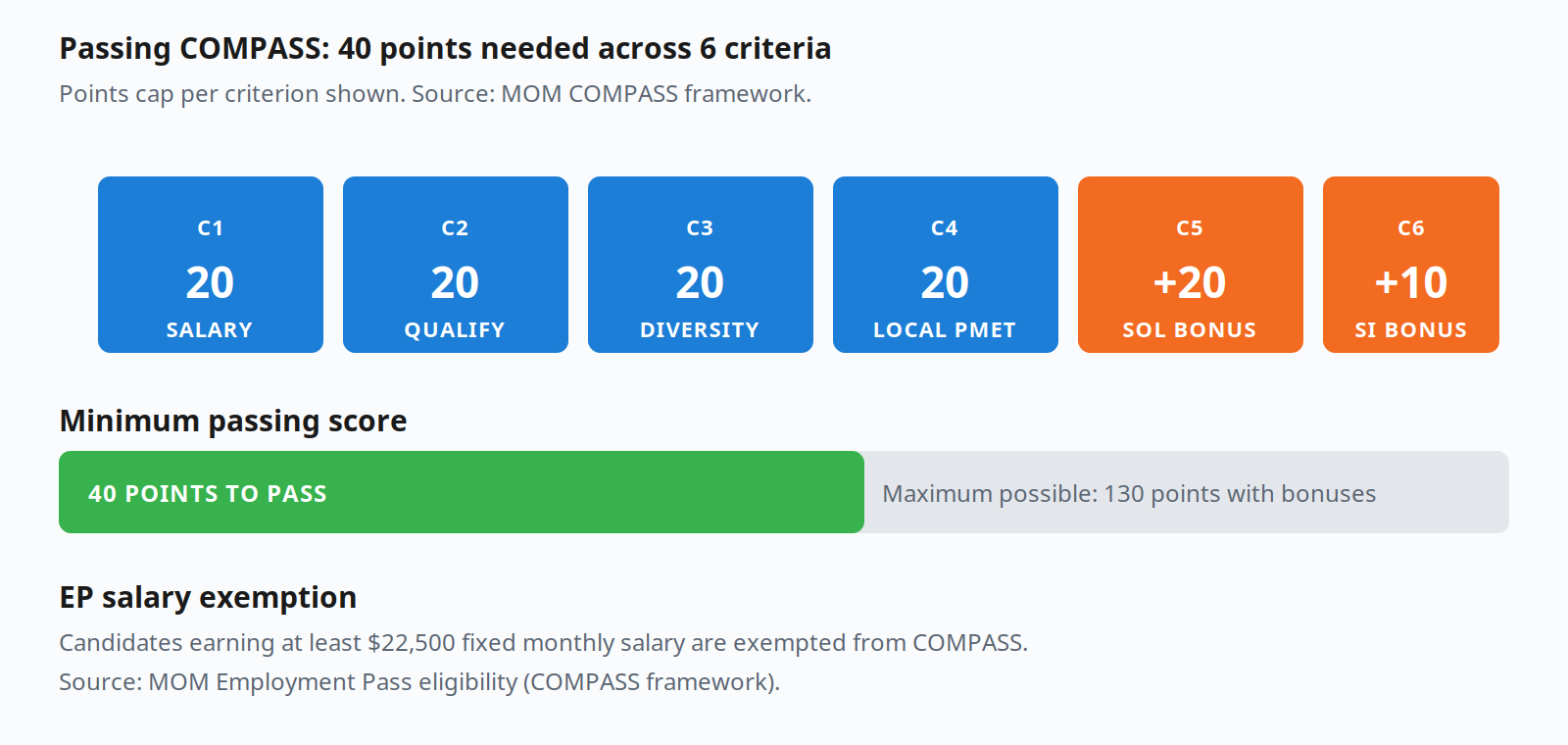
COMPASS C1 salary percentile is the second gate
🏭 Filling any of these ten roles in the next six months?
Corestaff maintains active candidate maps across the Singapore semiconductor, precision engineering, automation, and facilities engineering pools. We know which candidates are open, which recruiters they trust, and what salary bands actually close in 2026.
The Employer Actions That Actually Close These Ten Roles
Audit COMPASS clearance before shortlisting
Every EP candidate should be pre-scored against COMPASS before they enter your interview funnel.
Use the SOL positioning explicitly
The SOL Employer Guide lists specific job duties and additional requirements for each SOL role. Draft job descriptions that mirror the SOL entry.
Structure salary bands against the 2027 floor now
For 2026 hires with 2028 renewals, structure offers against the SGD 6,000 EP floor from 1 January 2027 plus headroom.
Layer SkillsFuture Workforce Development Grant on retention
SkillsFuture Workforce Development Grant (Job Redesign+) provides up to 70% of project costs (capped at SGD 150,000 per company).
Leverage the extended Senior Employment Credit
Retirement age rises to 64 and re-employment to 69 from 1 July 2026, with the top tier of 7% wage support for workers 69+.
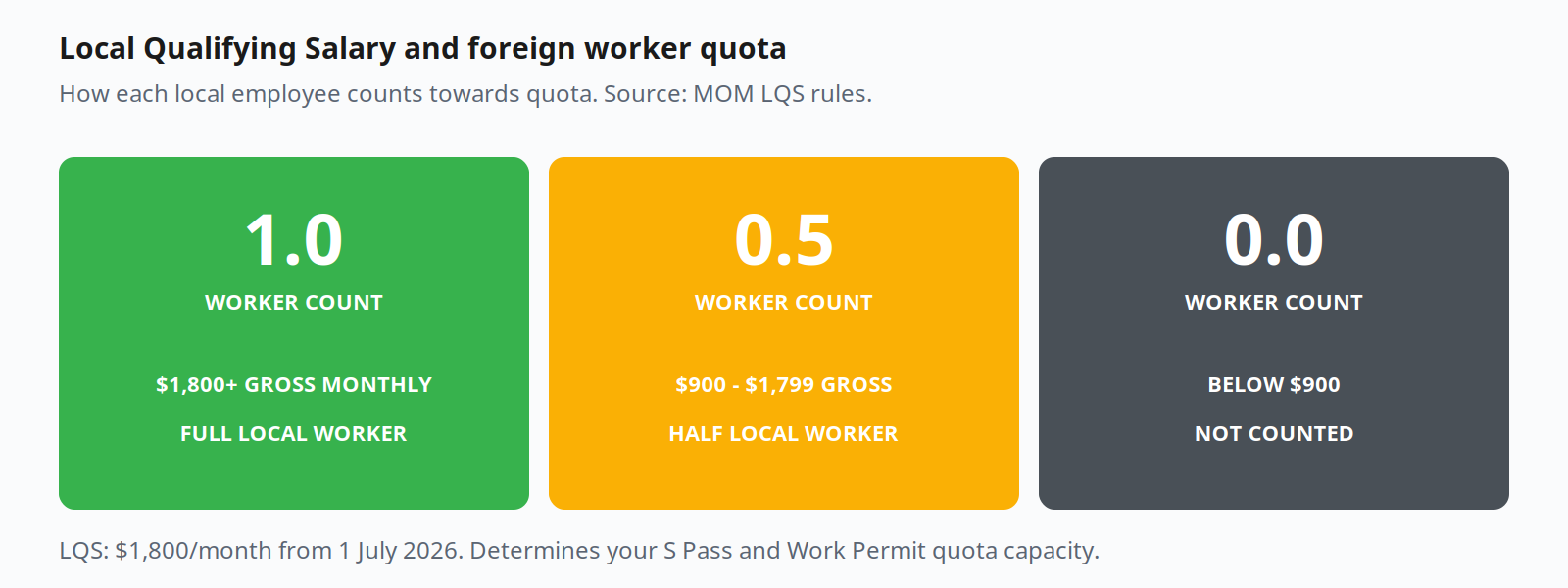
Watch the July 2026 LQS raise
How to Prioritise Your 2026 Hiring Pipeline
Focus first on the SOL-eligible semiconductor roles (process, semiconductor, instrumentation). They have the clearest government signal, the most support under COMPASS, and the fastest close cycle. Precision CNC and automation follow. Facilities and M&E engineers are the wildcard.
See our Manufacturing Salary Guide Singapore 2026 for sector-specific benchmarks, and Singapore Semiconductor Hiring Wave 2026-2027 for the semi-specific outlook.
Frequently Asked Questions
Which manufacturing roles are on the Singapore Shortage Occupation List?
What is Singapore’s Manufacturing 2030 target?
How does Singapore rank in global robot density?
What is the EP salary threshold for manufacturing roles in 2027?
- MOM, COMPASS C5. Skills bonus (SOL)
- MOM, EP eligibility
- MOM, COMPASS C1 salary benchmarks
- EDB, Advanced Manufacturing
- EDB, Semiconductor talent
- EDB, Budget 2026 semi R&D
Salary Benchmark Notes for the Ten Roles
Government publications alone do not release role-level salary benchmarks, but the MOM COMPASS framework exposes the sector percentile logic that determines actual market pay. Employers looking at any of the ten roles above should read the sector’s C1 salary benchmark PDF (Manufacturing, ICT, or Professional Services depending on the role) and set salary bands at or above the 65th percentile to earn C1 points.
For the three SOL-flagged roles specifically (semiconductor engineer, instrumentation engineer, process engineer), the C5 Skills Bonus effectively shifts the practical pay floor because employers can shortlist candidates at the 65th percentile without losing COMPASS clearance. That widens the addressable candidate pool.
How Sector Coverage Differs Under Manufacturing 2030
Under the Manufacturing 2030 vision, EDB’s sector coverage spans semiconductor, precision engineering, biomedical sciences, chemicals, aerospace, and Industry 4.0 automation. Not every role above appears equally in each sub-sector: precision CNC concentrates in precision engineering; quality engineers concentrate in biomedical and semiconductor; facilities and M&E engineers cross-cut all four. Employers scoping their hiring plan should map role families to their sub-sector, then run the COMPASS check against that sub-sector’s C1 benchmark, not against a generic manufacturing benchmark.
Sector-Level Salary Benchmarks: How to Actually Use Them
The COMPASS C1 sector salary benchmarks are published as PDF tables and updated annually by MOM’s Manpower Research and Statistics Department. Employers should download the current benchmark for their sector before setting the salary band for any of the ten roles above.
For August 2026, the benchmark that applies to new EP applications runs through 31 December 2026; a fresh benchmark released in August 2026 applies from 1 January 2027 onwards. That means an offer written in October 2026 for a January 2027 start needs to be benchmarked against the new table, not the current one. Employers who miss this transition are the most common source of COMPASS rejections in Q1 hiring windows.
How the 2027 CPF Senior Worker Rate Change Affects Manufacturing Employers
CPF contribution rates for senior workers aged over 55 to 60 rise by 1.5 percentage points, and for those aged over 60 to 65 by 1 percentage point, from 2027. For manufacturing employers with an aging local base (common in precision engineering and process manufacturing), this is a real cost increase.
The offset: the CPF Transition Offset was extended to December 2027, covering 50% of the increase in employer CPF contributions in 2027. Combined with the extended Senior Employment Credit (top tier of 7% wage support for workers 69+), the net cost of retaining a senior local supervisor is often lower than the cost of hiring and training a replacement. Employers should factor this into 2027 headcount planning.
The Manufacturing 2030 Signal for Long-Term Planning
Beyond the tactical picture, the Manufacturing 2030 vision targets a 50% increase in sector value-add from 2020 to 2030. Combined with Singapore ranking second globally in robot density (730 robots per 10,000 workers), this is a signal that role families 5, 8, and 10 above (manufacturing engineer, automation and robotics engineer, facilities and M&E engineer) will see structurally rising demand through the decade. Employers should treat these as long-tail hires, building continuous passive candidate pipelines rather than treating each opening as a discrete search.
Conclusion: What to Do Next
The ten roles above are pressed because the underlying investment thesis is real. Employers who plan against MOM’s own EP and COMPASS timelines, benchmark to the sector percentile, and run continuous passive outreach will close 2026 shortlists.
Fill Singapore’s hardest manufacturing roles with Corestaff
Corestaff runs recruitment sprints for Singapore employers across executive search, professional and mid-market hiring, and skilled-trade sourcing. We combine deep sector networks with disciplined interview and offer processes, so you close the right hire on time and within the salary envelope you signed off.
Book a Free Scoping Call →
Learn about Manufacturing Recruitment
Phone: +65 6288 6866 ·
Email: recruit@corestaff.com.sg
Address: 175A Bencoolen Street #11-05 Burlington Square, Singapore 189650
Web: www.corestaff.com.sg