

A company’s senior operations manager has been underperforming for months. The board has already decided that a replacement is needed, but the person is still in the role, still leading meetings, and still managing a team that trusts him. If the search is handled badly, rumours spread, morale drops, and key staff may start taking calls from competitors. That is why many leadership replacements in Singapore are never posted publicly. They are handled quietly, through a specialist agency, with a tight shortlist and a controlled process from start to finish.
This matters even more in 2026. Singapore’s labour market is still expanding; job vacancies continue to outnumber unemployed persons, and employers are hiring in an active yet selective market. In that environment, companies replacing a manager cannot rely on a public job ad and expect the right person to appear. The best replacement candidates are usually already employed, cautious, and only willing to engage if the process is credible and discreet.
For employers in Singapore, a confidential search is not just about secrecy. It is about protecting business continuity, managing leadership risk, and finding a candidate who can step into a sensitive situation without destabilising the team. That is where a specialist partner like Corestaff adds value: executive search capability, market salary benchmarking, discreet outreach, and employer-side communication management under one roof.
Key takeaways
- A confidential manager search allows a company to replace a senior employee without alerting the incumbent or the wider team.
- The process is best used when the hire is sensitive, business-critical, or linked to performance, succession, restructuring, or culture fit.
- The biggest reason confidential searches fail is not sourcing. It is a salary misalignment discovered too late.
- Specialist agencies act as a confidentiality buffer, reach passive candidates more quickly, and reduce the risk of a poorly handled leadership transition.
- For roles involving overseas candidates, the process may also require an Employment Pass, S Pass or COMPASS advisory.
What is a confidential manager search?
A confidential manager search is a recruitment process in which a company fills a senior role without publicly advertising the vacancy, announcing the hiring project internally, or revealing the client’s identity to candidates in the early stages.
The company continues operating as usual. The incumbent stays in place while the replacement search is conducted discreetly behind the scenes. Candidates are approached directly, screened privately, and only introduced to authorised decision-makers once mutual interest is clear.
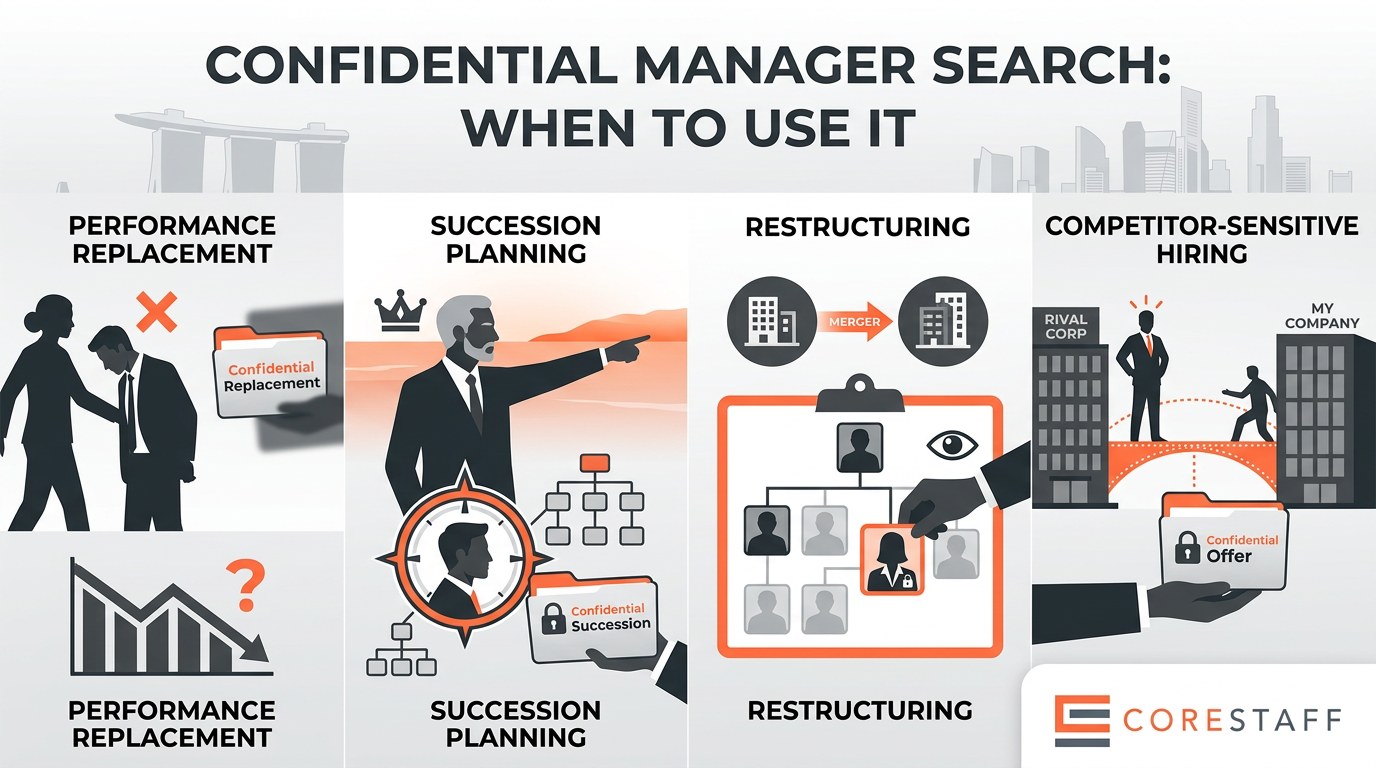
In Singapore, this approach is most common for:
- performance-based replacements,
- retirement or succession planning,
- leadership roles in SMEs and family businesses,
- restructurings where the role scope is changing,
- and situations where competitor visibility would create unnecessary risk.
For these assignments, the question is not whether the company can post the role publicly. It is whether doing so creates more business risk than it solves.
Why do companies not handle these searches in-house?
In theory, an internal HR team can run a discreet replacement. In practice, most companies quickly run into three problems.
1. Internal visibility is hard to control
The more people who know about a sensitive search, the harder it is to contain. A recruiter speaking to external candidates, an executive assistant booking unexplained interview slots, or a line manager suddenly requesting compensation data can all signal that something is happening.
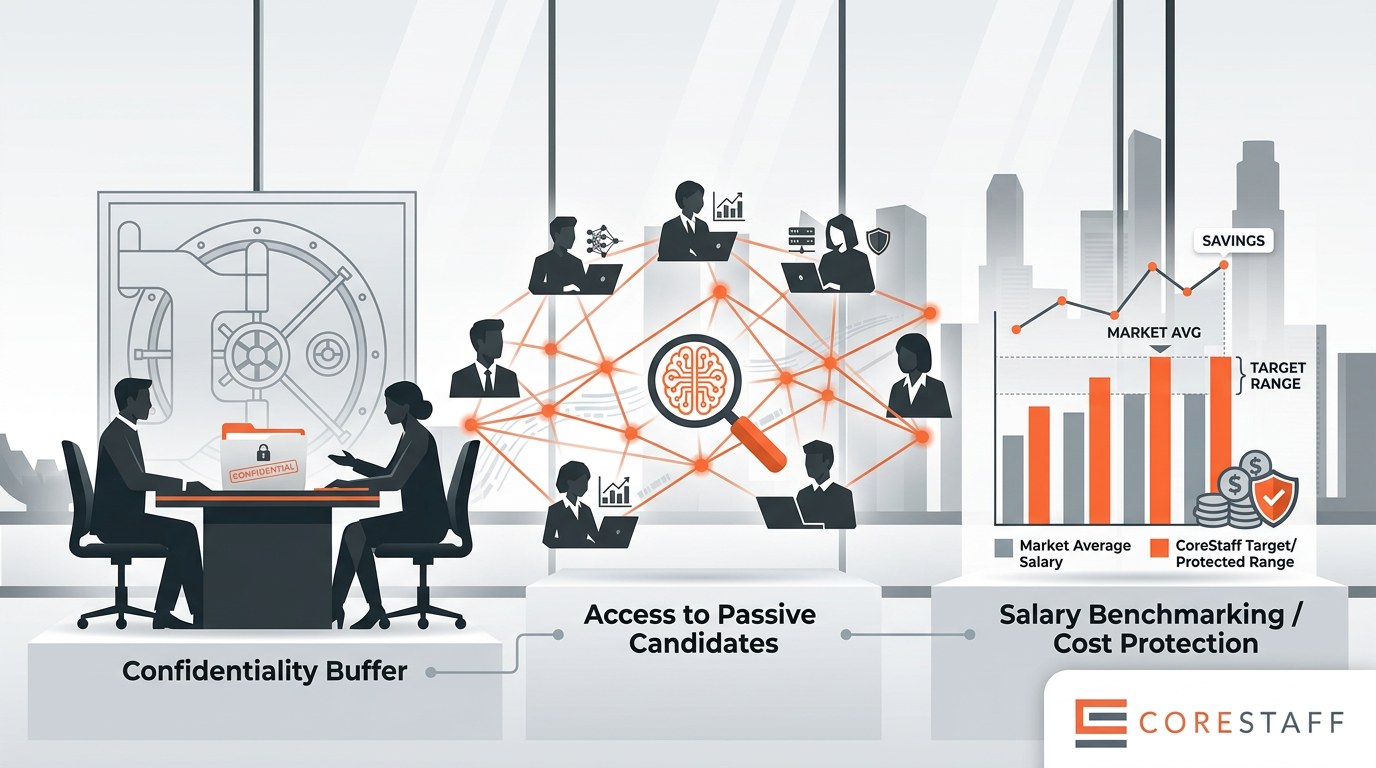
Using an external agency creates a clean buffer. The agency handles outreach, first-stage conversations, and shortlisting without involving the wider business.
2. The best candidates are passive
A strong replacement candidate is usually already employed and rarely browses job boards. Reaching that person requires targeted headhunting, not just inbound applicants. A specialist recruiter can approach passive candidates credibly and maintain control of the conversation from the first contact.
This is especially important in a market where employers remain active but cautious. Strong candidates know they have options and will only engage if the opportunity is handled professionally.
3. Salary surprises kill momentum
Many confidential searches do not fail because the role is unattractive. They fail because the company is working with a budget set a year ago, while the market has already moved.
By the time the employer meets the shortlist, the best candidate is interested, but the offer is below market. At that point, the company loses time, the search has to restart, and the risk of internal discovery rises.
That is why salary benchmarking should happen before outreach, not after.
An anonymised case: replacing a manager without triggering internal disruption
In one anonymised Singapore assignment, a company in the engineering and operations space needed to replace a manager who had lost the confidence of senior leadership. The problem was not only performance. The person had built a loyal team, was still managing live projects, and remained central to daily operations. A public job ad would have raised questions immediately.
The company engaged Corestaff to run a confidential search under a small decision group consisting of the business owner, finance lead, and HR point person. The objective was simple: find a stronger replacement, protect the team, and avoid disruption to customers and projects.
The brief was refined around four points:
- what the new manager had to fix in the first six months,
- what kind of leadership style would stabilise the team,
- what salary the market would realistically accept,
- and how disclosure would be handled at each stage.
This is where a specialist executive search process matters. The search is not only about CVs. It is about timing, messaging, and risk control.
How Corestaff handles a confidential search

Step 1: confidential briefing with authorised decision-makers
The first conversation should involve only the people who actually need visibility on the transition. That usually means the owner, CEO, HR director, or board representative.
The agency needs a full picture:
- Why the role is being replaced,
- What business problems the new hire must solve,
- What leadership style will fit the current team,
- And whether the replacement needs to be stronger technically, commercially, or culturally than the incumbent.
This is also the stage at which the employer decides how much of the story to share with candidates later.
Step 2: Salary benchmarking before outreach
This is one of the most valuable parts of the process.
Before any candidate is approached, Corestaff benchmarks the role against current market levels in Singapore. That may involve comparisons across operations, finance, engineering, HR, or management functions, depending on the role. If the company is under budget, it is better to address it early than to lose shortlisted candidates later.
Where relevant, employers can also benchmark adjacent hiring trends through Corestaff’s existing content, such as the Manufacturing Salary Guide Singapore and the broader Best Recruitment Agency in Singapore guide.
Step 3: discreet market mapping and direct outreach
The role is not posted publicly. Suitable candidates are identified through existing networks, referrals, sector knowledge, and direct search.
At this stage, the client’s name is usually withheld. Candidates are given only enough information to assess whether the move is worth a first conversation. That keeps the process credible while protecting the employer’s identity.
Step 4: screening for fit, not just experience
In a confidential replacement, technical competence is only part of the picture.
The real questions are:
- Can this person enter a sensitive situation without escalating politics?
- Can they lead a team that may still feel loyal to the outgoing manager?
- Can they earn trust quickly?
- Are their salary expectations realistic?
This is where a good recruiter adds value. The shortlist should not be a pile of “possibly good” profiles. It should be a small number of candidates who have already been assessed against the role’s actual risks.
Step 5: controlled disclosure and interview management
Only once the employer is ready should the company identity be revealed.
At that point, the agency coordinates interviews, candidate communication, feedback flow, and expectation management. This is especially important because even excellent candidates will walk away if a confidential process feels disorganised or evasive.
Step 6: offer strategy and transition planning
Offer management in a confidential search has to cover more than compensation. It also needs to account for the start date, notice period, timing of the incumbent’s exit, internal communications, and first-90-day expectations.
Handled properly, the transition feels deliberate and stable. Handled poorly, even a successful hire can cause unnecessary turbulence.
Why salary advisory matters more than most employers expect
The biggest hidden risk in confidential hiring is not the search fee. It is the cost of delay.
If an employer spends six weeks reaching the shortlist stage, only to discover that the best candidate expects materially more than budgeted, the company loses time twice:
- once on the failed process,
- and again on the restart.
In a confidential assignment, delay is expensive because the business is already operating with a leadership problem it is trying to solve quietly.
That is why market-rate advice should be part of the search from Day 1. Employers do not need perfect precision, but they do need a commercially honest range before outreach starts.
When a confidential search should include a work-pass advisory
Not every confidential manager replacement involves an overseas hire. But some do, especially when the role requires specialised regional experience, a niche technical background, or sector knowledge not easily found in the local market.
In those cases, the search should include upfront advisory on:
- whether the role is likely to be filled by a local candidate or an overseas candidate,
- whether the likely route is EP, S Pass or another structure,
- whether the employer’s salary range is realistic for pass eligibility,
- and whether COMPASS scoring could become a bottleneck.
That is increasingly relevant in 2026 because MOM has already signalled higher future EP and S Pass qualifying salary thresholds, while maintaining the overall focus on the quality and complementarity of foreign hires. Employers planning leadership replacements with an international talent pool should prepare for that early, not at the offer stage.
Why a specialist agency is often the safer choice
A confidential replacement search is one of the clearest examples of why agency quality matters.
The employer is not just buying access to candidates. It is buying:
- discretion,
- market judgement,
- candidate messaging,
- compensation realism,
- and a more controlled transition.
For companies comparing options, that is exactly why it helps to understand the wider Singapore recruitment agency landscape. The right partner for a sensitive manager replacement is rarely a generalist recruiter pushing volume. It is usually a specialist firm that can combine executive search discipline with practical employer advisory.
Frequently asked questions
How do you keep a confidential search from reaching the incumbent?
By limiting visibility, avoiding public ads, using direct outreach, and carefully controlling interview logistics. The fewer internal touchpoints there are, the lower the chance of leakage.
Is this only for large companies?
No. In Singapore, SMEs and owner-managed businesses often use confidential searches more frequently because a single senior hire can materially affect culture, delivery, and customer confidence.
How long does a confidential manager search usually take?
It depends on role seniority and how fixed the brief is, but the key factor is speed of alignment, not just speed of sourcing. Employers who confirm the role scope, salary range, and decision process early usually move faster.
Can Corestaff run a confidential search for a foreign professional?
Yes. If the right candidate is overseas, the process can be conducted alongside foreign worker recruitment and work pass advisory, including guidance on COMPASS.
If your company needs to quietly replace a manager, speed and confidentiality matter equally. A public job post may create more problems than it solves. A structured confidential search gives you a tighter process, a better shortlist, and more control over what happens next.
If you would like to discuss a sensitive replacement in a discreet manner, contact Corestaff here. You can also explore Executive Search Singapore or read Corestaff’s employer guide to choosing the best recruitment agency in Singapore.