

For overseas companies entering Singapore, the biggest hiring mistake is not hiring too slowly. It is hiring the wrong first three to five people. Your pioneer team becomes the operating system of the new office. Those first hires shape local credibility, internal culture, customer response times, reporting discipline, compliance habits, and the success of future work-pass applications. Get the first team right, and expansion becomes easier. Get it wrong, and the company spends its first year fixing avoidable mistakes.
Singapore remains attractive for regional expansion in 2026. MTI upgraded GDP growth to 2.0% to 4.0%. MAS says near-term growth should remain resilient, supported by the AI-related capex cycle and technology-linked sectors, and Budget 2026 continues to prioritise growth clusters such as semiconductors, aerospace, biomedical sciences, decarbonisation solutions, and other high-value activities. But attractive market conditions do not remove hiring risk. They increase the cost of getting the first hires wrong.
This is exactly why overseas employers often work with a local specialist partner like Corestaff: local salary benchmarking, sequencing of local and overseas hires, executive search support for leadership roles, and practical guidance on EP, S Pass, Work Permit and COMPASS.
Key takeaways
- The first hires in Singapore should be planned as a sequence, not treated as independent vacancies.
- In many cases, local PMET hires should come first because they improve market knowledge and support future EP applications.
- Overseas firms should design salary ranges and role scope with Singapore market conditions in mind, not home-country assumptions.
- Work-pass strategy should be built into hiring from the start, especially for founders, technical specialists, and regional leaders.
- A local recruitment partner reduces delays by handling salary benchmarking, candidate mapping, shortlist building, and advisory on pass readiness.
An anonymised case: an overseas business entering Singapore
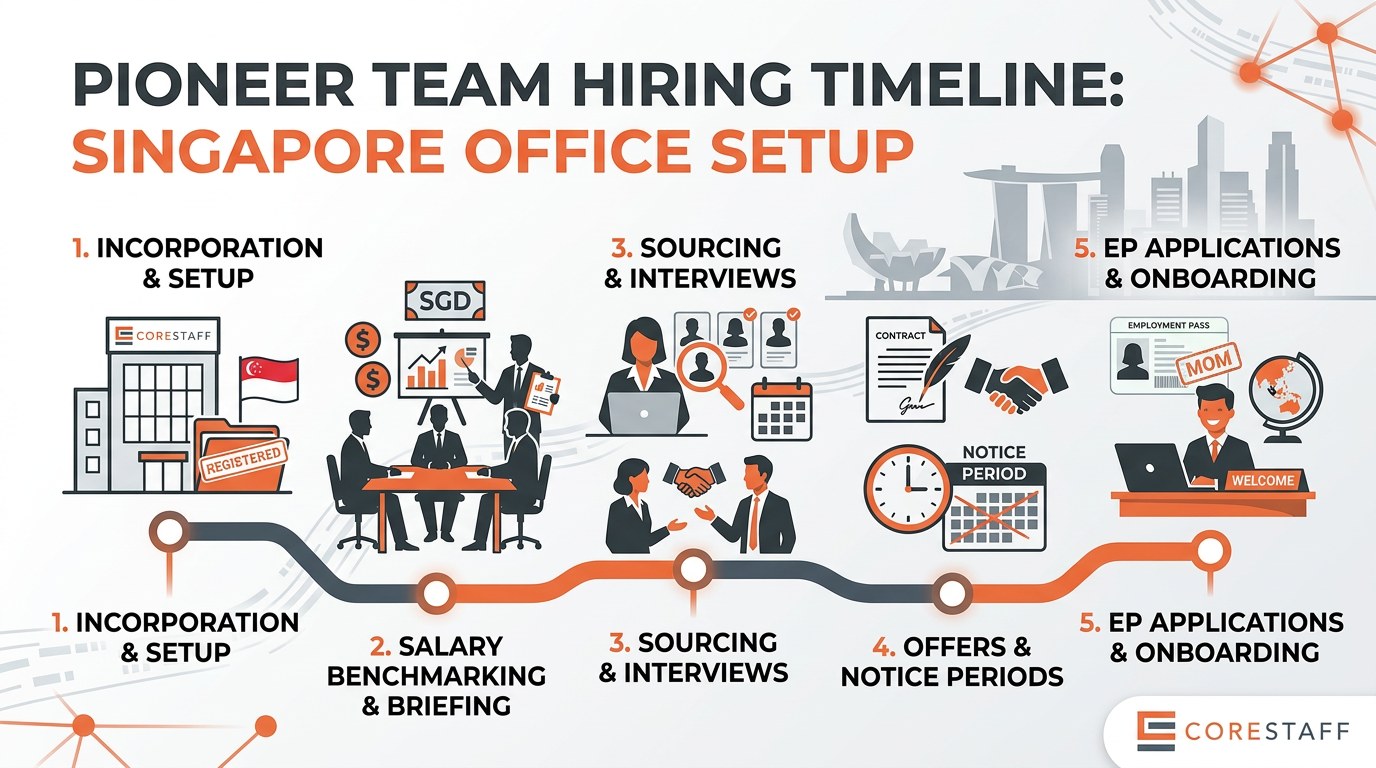
In this anonymised case study, an Australian warehouse and supply-chain operator decided to establish a Singapore entity to support regional customers and build a Southeast Asia footprint.
The commercial opportunity was clear. The hiring strategy was not.
The client initially thought the first move should be to relocate a trusted overseas leader to Singapore, then build the rest of the team around that person. On paper, that looked efficient. In practice, it created three risks:
- too much dependence on one overseas hire,
- weak early local market knowledge,
- and a more difficult path for future EP applications if the office began with little or no local PMET presence.
That is a common market-entry mistake. Singapore is not just a location for staff. It is a regulated hiring environment in which the local hiring mix, salary structure, job scope, and pass strategy interact.
Why the first hire matters more than most overseas employers expect
A new company often focuses first on the “most senior” role. That is understandable, but it can produce the wrong sequence.
For a Singapore launch, the better question is:
Which first hire makes the next three hires easier?
Often, that is not automatically an intra-company transfer.
A strong local first hire can help with:
- local client relationships,
- market credibility,
- operational setup,
- salary calibration,
- and the employer’s local workforce profile.
That last point matters. Singapore’s foreign-professional framework increasingly rewards complementarity, not just salary. Corestaff’s own COMPASS guidance explains why new companies should consider the local PMET ratio, role classification, and salary benchmarks early on, before submitting EP applications.
The hiring problem the client needed to solve
The Australian company needed a first-phase team that could:
- lead the Singapore entity,
- build local customer relationships,
- coordinate warehousing and operations,
- handle finance and compliance,
- and still leave room for a small number of specialist overseas hires later.
What they did not need was a team that looked efficient on paper but was misaligned with local market realities.
The early brief included a mix of possible roles:
- Country Manager,
- Operations Manager,
- Business Development Lead,
- Finance / Admin support,
- and one overseas technical or process specialist familiar with the parent company’s systems.
The challenge was deciding what to hire first, who should be local, and which role—if any—should come from overseas in the first wave.
How Corestaff reframed the project

Corestaff’s value in market-entry hiring is not only sourcing. It is helping the client sequence the search correctly.
In this case, the project was reframed around four decisions:
1. Define the first 90-day operating priorities
Instead of asking, “Who is the most senior person we need?”, the better question became, “What must the Singapore office be able to do in its first 90 days?”
That changed the discussion immediately.
The office first needed:
- local market coverage,
- commercial responsiveness,
- operational coordination,
- and a credible employer setup.
That pointed to at least one strong local commercial/operational hire early in the process.
2. Benchmark the real Singapore salary range
Overseas employers often under-budget for Singapore because they anchor to home-market assumptions or outdated salary references.
Corestaff benchmarked the likely roles against current local expectations so the client could see:
- what local candidates would realistically accept,
- where a premium was necessary,
- and where overpaying a first hire might create internal equity problems later.
This is especially important because Singapore’s labour market remains tight in the skilled-professional segment, even as employers stay more selective overall. MOM reported that vacancies exceeded the number of unemployed persons at the end of 2025, while resident employment growth was driven by sectors such as financial services and health and social services.
3. Build the local-versus-overseas hiring sequence
The client originally wanted to move an overseas manager first. Corestaff advised a more balanced sequence.
A sensible pioneer-team structure in many Singapore market-entry situations looks like this:
- local commercial or operations leadership,
- local support role or second PMET hire,
- then, overseas specialists are hired where they are genuinely needed.
That approach gives the company local traction and makes later pass-based hiring easier to structure.
4. Separate “must transfer” talent from “good to transfer” talent
Not every trusted overseas employee has to be in Singapore from Day 1.
In many expansions, only a small number of hires truly need proprietary product knowledge, regional process ownership or group-level reporting responsibilities. Everyone else can often be hired locally more quickly and effectively.
That distinction reduces cost and lowers the risk of building the Singapore office around the wrong profile.
What a practical pioneer-team hiring sequence looks like
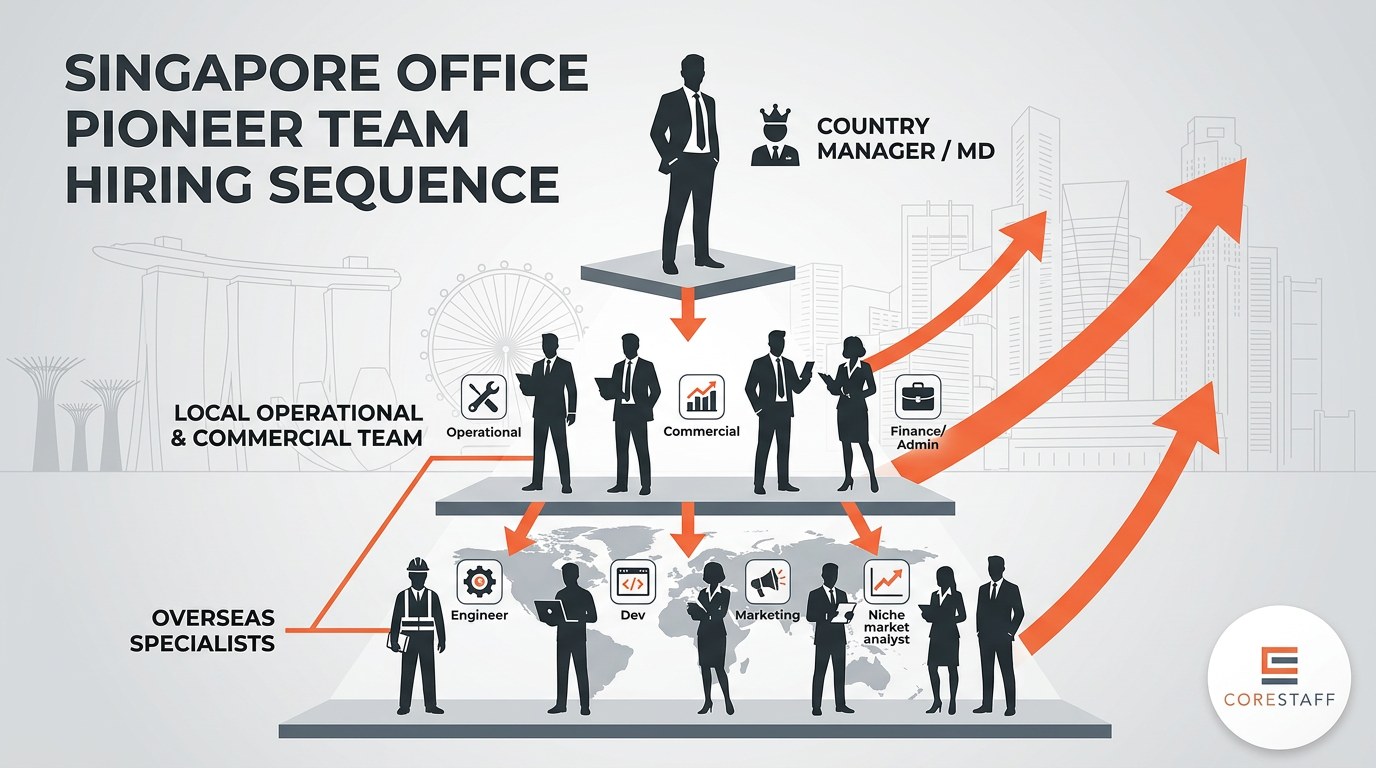
For many overseas firms, the most effective sequence is:
Hire 1: local country manager or senior commercial / operations lead
This person gives the office local credibility and practical market understanding. They help shape realistic hiring briefs for upcoming roles and support early customer-facing activities.
For some companies, this may still be an internal transfer. But it should be a strategic choice, not a default one.
Hire 2: local PMET support role
This could be operations, business development, customer success, finance or HR, depending on the business model.
This role matters because it adds local bandwidth quickly and improves the shape of the workforce before overseas-hire applications are submitted.
Hire 3: overseas specialist, only if truly required
This is where the company brings in product, technical, or process expertise specific to the parent business and difficult to replicate quickly in-market.
At this stage, the company is in a stronger position to structure the role properly and assess the right pass route through guides such as:
- Foreign Worker Recruitment Singapore: Work Permit, S Pass & EP Guide
- COMPASS Scoring Explained for Singapore Employers 2026
- Work Permit vs S-Pass vs EP: Which Pass for Which Role?
Why a work-pass strategy must be built in from the start
Overseas employers often think of work passes as an admin step after hiring. In Singapore, that is too late.
By 2026, employers need to think early about:
- whether the role should be local or overseas,
- whether the likely route is EP, S Pass or Work Permit,
- whether the salary range supports the intended pass,
- and whether the business is building a workforce profile that supports the application.
This matters even more because MOM has already announced future increases in EP and S Pass qualifying salaries from 2027, while continuing to emphasise the quality and complementarity of foreign hires. Budget 2026 also raised the Local Qualifying Salary from July 2026 and continued broader workforce-transformation support for employers. Companies setting up in 2026 should plan with that direction in mind, even if the threshold changes apply later.
Where overseas companies usually go wrong
Mistake 1: hiring the “trusted internal person” first without testing local alternatives
A transfer can work well. But if it becomes the default answer for every leadership role, the new office may be slower to localise and less commercially effective.
Mistake 2: copying the home-market job scope into Singapore
The Singapore role often requires a different blend of commercial, operational, and stakeholder management capabilities than the equivalent role at HQ.
Mistake 3: treating salary as a negotiation problem instead of a market problem
If the budget is too low for the role, no amount of negotiation skills will consistently fix it.
Mistake 4: leaving work-pass questions to the end
If the likely hire depends on pass eligibility, the strategy must be built around that from the start.
Mistake 5: underestimating how much the first team shapes the next team
A weak pioneer hire is expensive not only because of the replacement cost but also because it distorts every decision that follows: culture, salary benchmarks, reporting lines, and employer reputation.
Where Corestaff fits into the process
For market-entry hiring, Corestaff’s role is not limited to finding CVs.
It includes:
- advising on which roles should be local first,
- benchmarking salary against the Singapore market,
- sourcing and shortlisting local PMET candidates,
- supporting executive search where senior leadership is required,
- and helping employers think through pass route, hiring sequence and candidate mix before mistakes become costly.
That is particularly useful for overseas firms that want one local partner to cover commercial hiring, specialist recruitment and work-pass-aware workforce planning, rather than coordinating separate vendors. Corestaff positions itself as a local specialist with multi-sector depth across executive search, manufacturing, logistics, technology, healthcare and more.
Frequently asked questions
Should the first hire in Singapore be local or transferred from HQ?
It depends on the business, but local-first is often stronger for market credibility and future workforce planning. The right answer is role-specific, not ideological.
How early should we start recruitment?
Ideally, in parallel with entity setup, not after incorporation is complete. Waiting until the company is fully ready often unnecessarily delays the launch.
Can we bring in one overseas specialist in the first wave?
Yes, if there is a clear business reason. But the role, salary and pass path should be checked early against likely eligibility and overall workforce structure.
What roles does Corestaff typically support for new offices?
Country managers, operations managers, finance managers, HR managers, business development managers, and specialist professional roles are linked to the employer’s expansion plan. For senior mandates, the process can be run through Executive Search Singapore.
If your company is setting up in Singapore, do not treat the first three to five hires as separate vacancies. Treat them as a sequence.
The right pioneer-team structure gives you better local traction, fewer hiring delays, and a cleaner path for future growth. The wrong first hire can slow your expansion before it really begins.
If you want a local partner to help plan the team, benchmark salaries, and map the right hiring sequence, contact Corestaff here. You can also review Corestaff’s best recruitment agency in Singapore guide, foreign worker recruitment guide, and COMPASS guide before starting.