
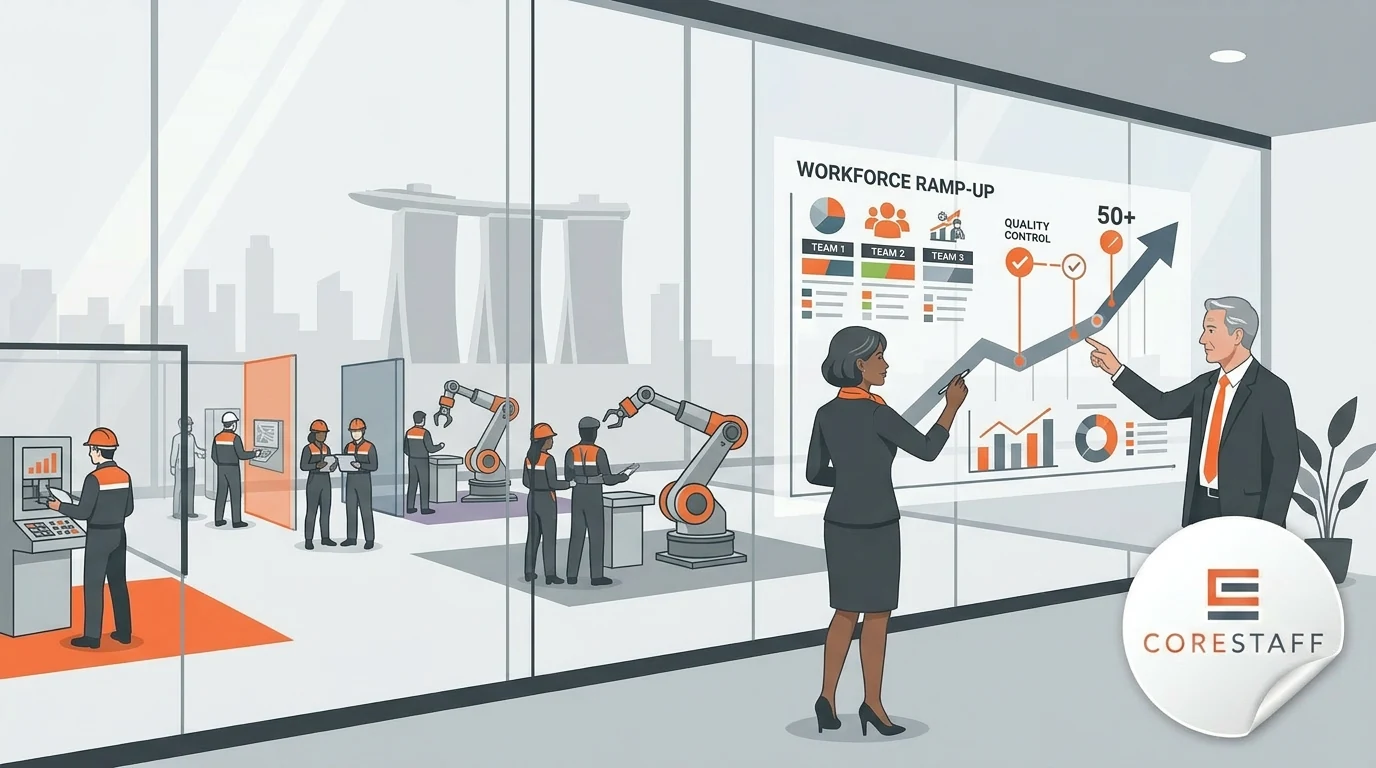
Singapore’s manufacturing sector is entering a period where workforce planning matters as much as production planning. The broader economy remains supportive, with Singapore’s 2026 GDP forecast upgraded to 2.0%–4.0%, while the labour market remains tight, with job vacancies still outnumbering unemployed persons. At the same time, the Economic Development Board has said investment commitments secured in 2025 are expected to create around 15,700 jobs over the next five years, with 37% of those roles in manufacturing. For employers on the ground, that means one thing: hiring pressure is real, and it is not limited to niche technical roles alone.
For many manufacturers, the challenge is no longer hiring one or two positions. It is building 50, 80, or even 100+ hires over a compressed period without letting screening standards, interview discipline, attendance quality, or onboarding follow-through collapse under the weight of volume. That is where a proper mass hiring playbook becomes essential.
You may also like: semiconductor hiring guide case study
Why High-Volume Manufacturing Hiring Breaks Down
Mass hiring in manufacturing often fails for predictable reasons.
The first problem is that companies underestimate how different large-scale hiring is from ordinary recruitment. A hiring process that works for replacing one engineer does not automatically work for hiring 40 operators, 15 technicians, and several shift-support roles over the same quarter. Once volume rises, operational weaknesses become visible very quickly: interview delays multiply, candidate quality becomes inconsistent, feedback loops slow down, and offer drop-offs increase.
Read more: Case Study: Scaling 80+ Semiconductor Hires Through Mass Interview Strategy in Singapore
The second problem is market reality. In Singapore, manufacturers are not only competing against other factories. They are also competing with logistics, automation, precision engineering, and adjacent technical sectors for similar candidates. For shift-based roles, the competition is even broader because candidates often compare manufacturing jobs against non-shift alternatives that look easier to sustain over time.
The third problem is speed. In a market where vacancies exceed the number of unemployed people, strong candidates do not remain available for long. Employers that take too long to shortlist, schedule, interview, approve, and onboard will usually experience weaker acceptance rates and more unstable pipelines.
When Employers Need a Mass Hiring Playbook

A structured mass hiring model becomes necessary when a manufacturer is facing one or more of these situations:
- a new plant, line, or facility ramp-up
- a sudden increase in production demand
- project-based hiring over a fixed period
- repeated attrition in shift teams
- expansion into technician-heavy or operator-heavy headcount
- backlog in interviews, onboarding, or attendance conversion
These are not ordinary recruitment problems. They are workforce-building problems. And workforce-building problems require tighter coordination between recruiters, HR, hiring managers, and operations.
The Playbook: How to Scale 50+ Hires Without Compromising Quality
1. Start with operational clarity, not job ads
Before mass hiring begins, employers need alignment on what the operation actually needs. That includes role mix, headcount phasing, shift structure, reporting lines, non-negotiable requirements, trainable requirements, and likely bottlenecks. When this stage is rushed, the rest of the hiring campaign becomes reactive.
In practical terms, employers should define:
- which roles must be hired first
- which skills are essential from day one
- which roles can be trained after entry
- what candidate objections are likely
- what onboarding timeline is acceptable for production
This is especially important in manufacturing environments where attendance, physical demands, cleanroom requirements, shift work, and safety culture all affect conversion and retention. A candidate who looks acceptable on paper may still be the wrong fit for a high-discipline factory environment.
2. Build a repeatable screening framework
When employers scale past 20 or 30 hires, screening consistency becomes more important than screening volume.
A proper mass hiring framework does not simply aim to produce more profiles. It creates a repeatable way to assess candidate fit across multiple batches. That means recruiters and hiring managers must align in advance on what makes a candidate shortlist-worthy, what should trigger rejection, and what can be clarified later in the interview.
For manufacturing roles, strong screening usually covers:
- relevant production or machine experience
- willingness for shift patterns
- transport practicality
- attendance reliability
- communication level for line instructions and safety
- physical suitability where relevant
- realistic compensation expectations
This is one of the biggest quality controls in mass hiring. Without it, volume expands, but conversion quality drops.
3. Use structured mass interview days, not ad hoc scheduling
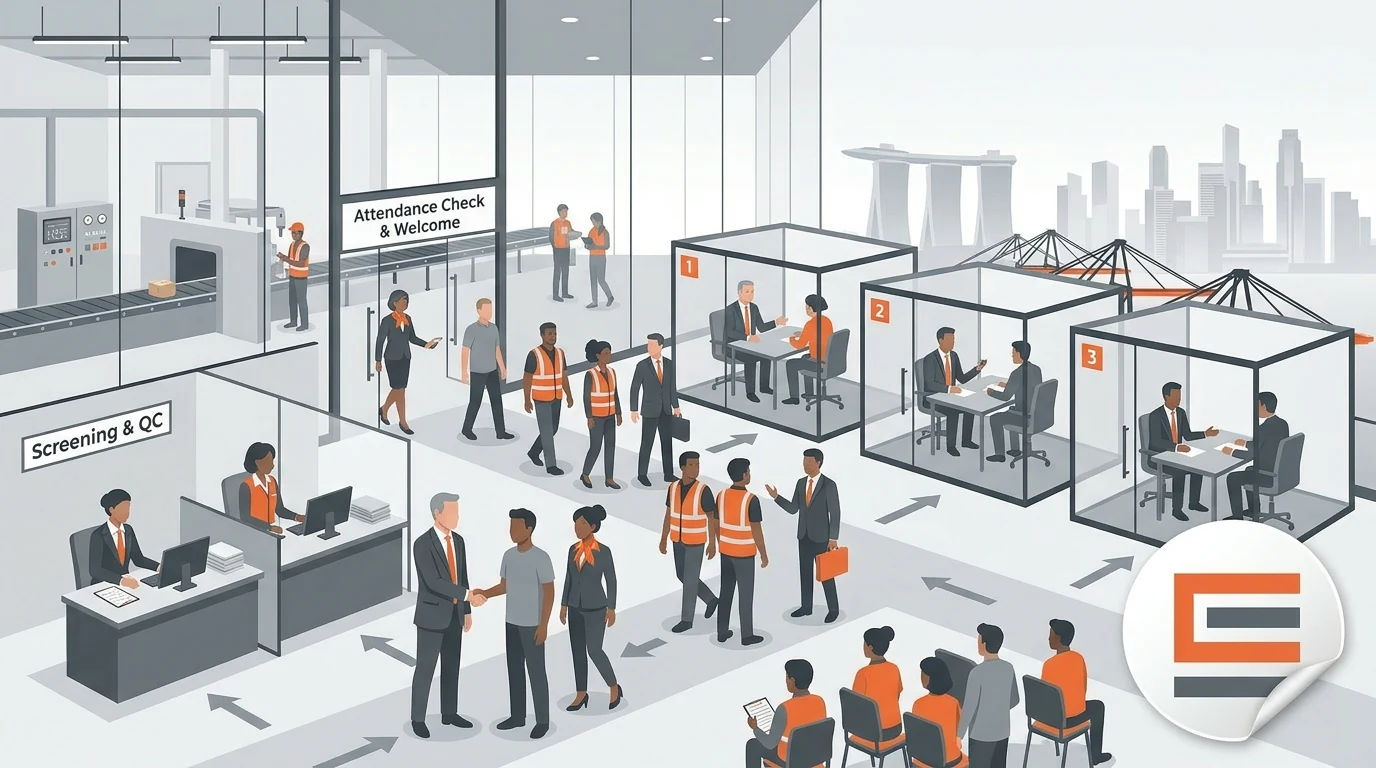
Once hiring scales are in place, interview logistics become part of hiring quality.
The staff’s semiconductor case study showed that structured mass-interview execution supported 80+ hires over six months by coordinating schedules closely, pre-screening candidates before interview sessions, and deploying recruiters on-site to manage candidate flow and real-time coordination. This improved candidate experience, interview efficiency, and offer turnaround time. That lesson applies well beyond semiconductors. Corestaff case study
A strong mass interview model should include:
- interview blocks instead of scattered appointments
- pre-qualified candidates per batch
- attendance confirmation before interview day
- recruiter coordination on-site or in real time
- clear interview score criteria
- fast post-interview decision ownership
The goal is not just speed. It is controlled speed.
4. Create a feedback loop after every batch
One of the biggest mistakes in mass hiring is repeating the same weak hiring cycle.
The best hiring teams treat every interview round as data. After each batch, they review candidate quality, reasons for rejection, attendance issues, offer acceptance patterns, and hiring manager feedback. Then they refine the next round.
This matters because large-scale hiring is rarely perfect in the first cycle. The advantage goes to employers who improve faster.
A useful feedback loop should answer:
- Were the shortlisted candidates technically close enough?
- Were rejections caused by skill mismatch or expectation mismatch?
- Were candidate objections predictable?
- Was the role positioned clearly enough?
- Did shift expectations reduce conversion?
- Are salary or benefits creating avoidable friction?
That is how employers protect quality while continuing to hire at a pace.
5. Use real-time market insight to keep the campaign realistic
Mass hiring becomes expensive when the employer operates under outdated assumptions.
Throughout Corestaff’s semiconductor hiring engagement, the client was continuously advised on market salary benchmarks, shift- and role-related expectations, and competitive hiring pressures. That helped the client make faster and more informed decisions. In high-volume recruitment, this kind of market visibility can prevent delays that would otherwise weaken candidate conversion.
For manufacturing employers in Singapore, market intelligence is especially useful in areas like:
- technician and operator pay expectations
- shift premium expectations
- notice-period realities
- hiring competition in the same industrial cluster
- candidate willingness for night or rotating shifts
- temporary versus permanent hiring mix
A better-informed employer usually hires faster and loses fewer candidates.
6. Treat onboarding as part of recruitment, not a separate phase
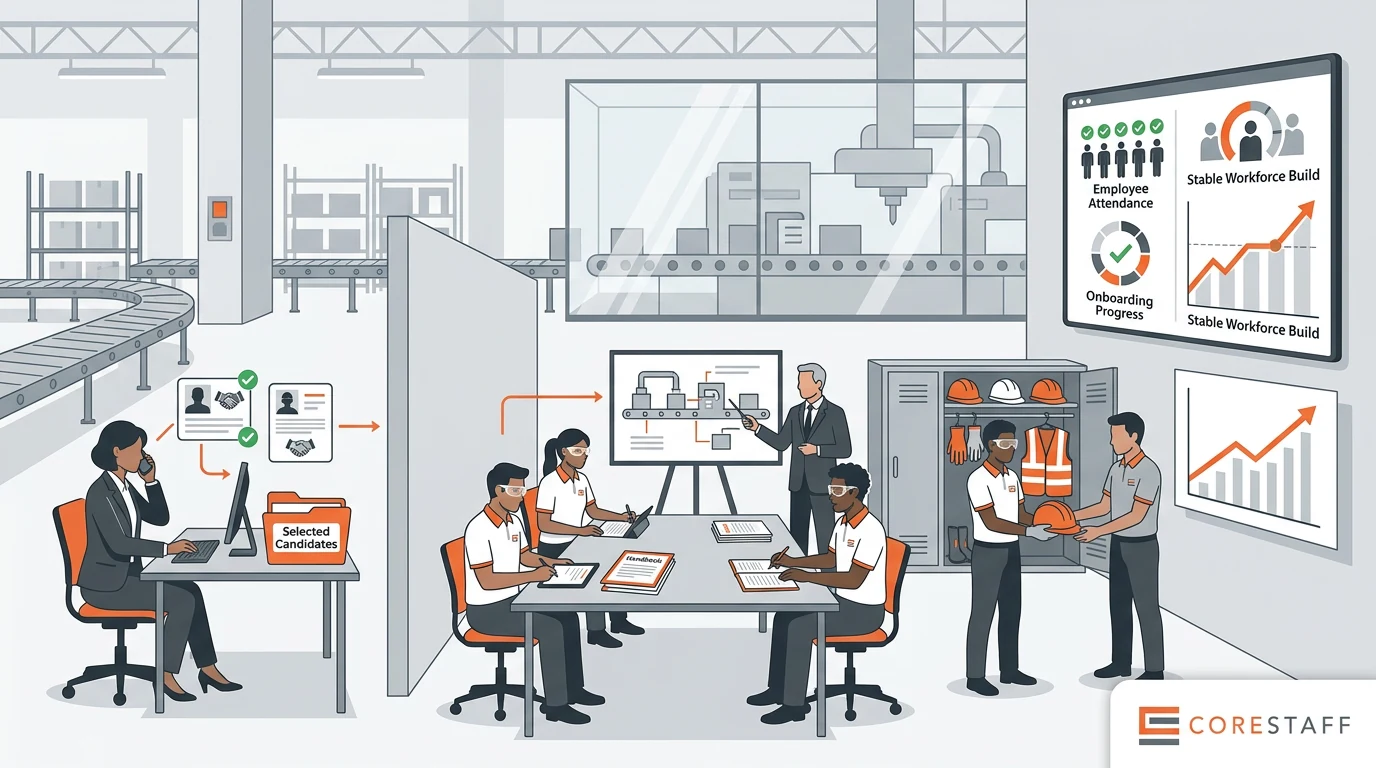
One of the quietest failure points in mass hiring is the gap between offer acceptance and first-day reporting.
In large-volume campaigns, candidates can still disappear after saying yes. Some receive competing offers. Some reconsider shift work. Some lose momentum because communication is weak. Some simply do not feel committed enough to report.
That is why onboarding support must begin before day one. A stronger process includes:
- regular candidate follow-up after offer acceptance
- start-date confirmation
- document and compliance coordination
- first-day briefing clarity
- work-pass coordination where needed
- quick escalation if a candidate becomes uncertain
In Corestaff’s case study, this kind of end-to-end support reduced the risk of drop-off and helped the hiring process remain stable across multiple hiring rounds.
What “quality” really means in mass hiring
Employers often say they do not want to compromise quality. But in practice, quality in manufacturing hiring is not only about finding the most technically perfect candidate.
At scale, quality means building a workforce that can actually report, adapt, stay, and operate safely in the real production environment. It means balancing technical fit with attendance reliability, shift suitability, onboarding readiness, and manager confidence.
In other words, quality hiring is not the opposite of mass hiring. It is what happens when mass hiring is designed properly.
What manufacturing employers can learn from Singapore’s current market
Singapore’s manufacturing pipeline remains supported by macro and investment fundamentals, but employers should not mistake that for easy hiring. The labour market remains tight, manufacturing investments continue to drive demand for the workforce, and employers in high-value sectors often compete for overlapping talent pools.
That means the winning formula in 2026 is not simply “hire more.” It is:
- define roles more clearly
- screen more consistently
- interview more efficiently
- improve each batch using feedback
- support onboarding more actively
- use current market insight to stay realistic
That is the real playbook behind scaling 50+ hires without losing control.
Conclusion: Scale Requires Structure
Mass hiring in Singapore manufacturing is not just a sourcing exercise. It is a coordination, quality control, and workforce planning exercise.
When employers approach it casually, the process slows down and quality weakens. When they approach it with structure, they can scale headcount much faster while still protecting fit, attendance, and operational readiness.
If your business is preparing for expansion, production ramp-up, or a high-volume hiring project, the right recruitment partner should do more than send CVs. The right partner should help you design the hiring engine itself.
Looking to Scale Your Hiring?
If your organisation is planning to scale 50+ hires in Singapore manufacturing, Corestaff can support with:
- mass hiring strategy
- manufacturing recruitment support
- contract and permanent staffing solutions
- market insights and hiring advisory
- onboarding coordination for large-scale workforce builds
Explore Corestaff’s manufacturing recruitment solutions or contact the team to discuss your workforce plans.