

Singapore’s supply chain and logistics market in 2026 is not a simple story of either expansion or slowdown. It is a story of selective hiring. Some roles are being watched more carefully, budgets are under tighter control, and employers are more cautious about over-hiring. At the same time, warehousing, e-commerce fulfilment, distribution, freight movement, and third-party logistics operations still require talent to maintain stable service levels and keep operations responsive. That tension is exactly why employers need a clearer hiring strategy this year.
The backdrop matters. Robert Walters noted that hiring sentiment in supply chain and procurement has been more muted as employers react to inflation, geopolitical uncertainty, and changing immigration controls. But the same market commentary also points to stronger demand for strategic and digital supply chain roles, especially in planning, analytics, risk, and systems-enabled operations. In other words, the market is not switching off. It is upgrading its expectations.
For Singapore employers, that creates a practical challenge. Which roles are still worth prioritising? What are candidates expecting in salary? Which positions should be hired permanently, and where does flexible staffing make more sense? Most importantly, how can a logistics employer build a workforce plan that ensures continuity without inflating costs or slowing decision-making?
Why logistics and supply chain hiring still matters in 2026

Even where overall hiring sentiment is more cautious, supply chain vacancies still create immediate operational pain. A weak planner affects forecasting. A missing warehouse supervisor affects productivity and safety. A poor last-mile coordinator can trigger delivery delays, customer complaints, and overtime. That is why logistics hiring rarely disappears. It simply becomes more selective and more performance-driven.
Singapore’s logistics employers are also dealing with a market that is changing at two levels at once. The first level is operational: warehouses still need dependable staff, transport operations still need coordination, and peak seasons still require scalable manpower. The second level is strategic: employers increasingly want people who can work with digital dashboards, cross-functional planning, inventory visibility, trade compliance, and data-supported decision-making. That means the ideal hiring plan cannot focus only on headcount volume. It also needs to reflect capability.
Corestaff’s logistics recruitment content already reflects this tension well. On one side, employers still need warehouse associates, inventory staff, logistics supervisors, and quick staffing support to keep goods moving. On the other side, there is a growing need for supply chain coordinators, procurement specialists, planners, and more digitally capable team members who can operate in faster, more visible supply chains.
The roles employers are prioritising
The strongest hiring demand in Singapore’s logistics ecosystem is no longer limited to basic operations roles. Employers are hiring across a layered workforce model, in which frontline execution and planning capabilities need to work together. The following role groups are among the most important in 2026.
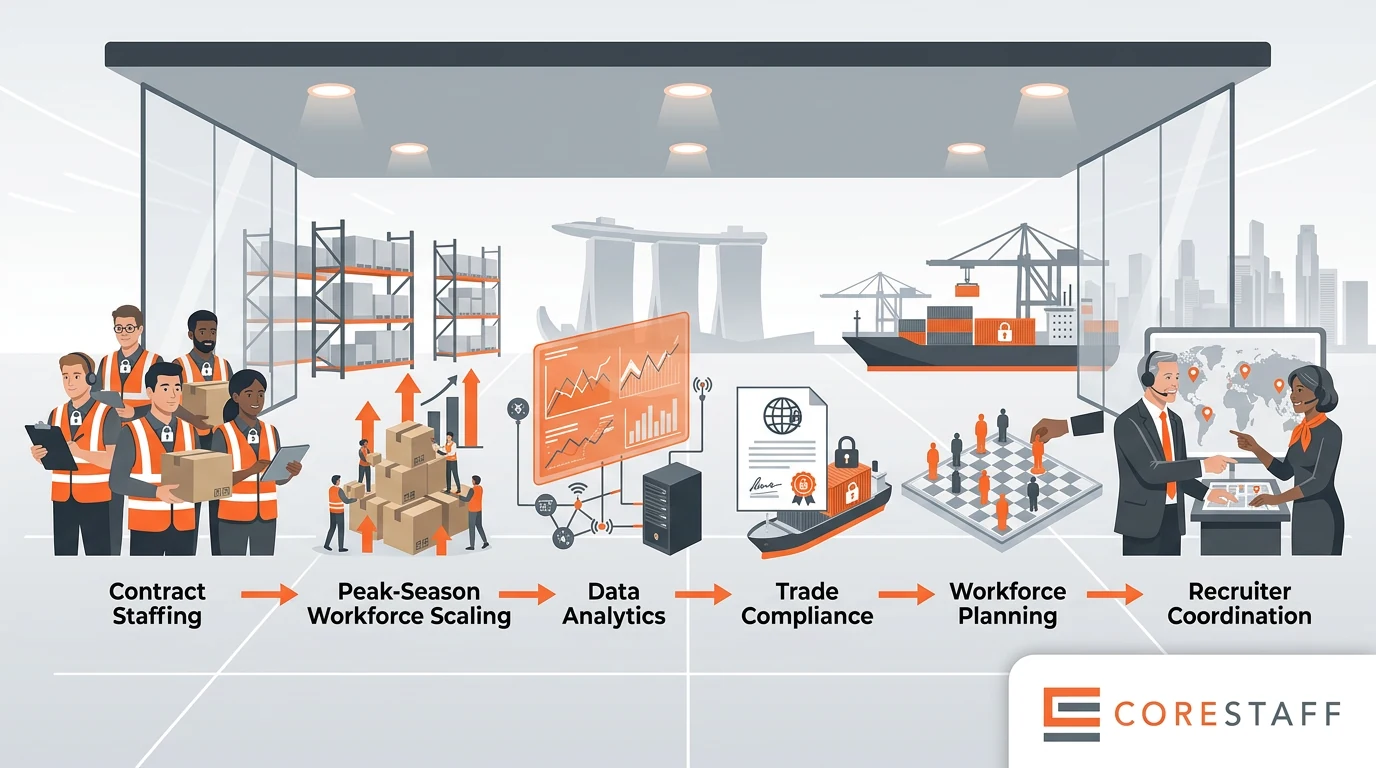
1. Warehouse leadership and fulfilment operations
Warehouse associates, inventory controllers, dispatch teams, and forklift-ready fulfilment staff remain essential, especially for e-commerce, 3PL, and distribution-led businesses. But the roles that create the most operational leverage are often warehouse supervisors and managers. These professionals help control shift productivity, inventory accuracy, attendance, safety discipline, and escalation handling.
2. Planning and network coordination roles
Supply chain planners, buyer-planners, and coordination executives are increasingly important because they sit at the point where sales forecasts, supplier lead times, inventory movement, and warehouse execution all meet. When these roles are strong, the business reacts faster. When they are weak, the whole chain becomes noisier and more expensive.
3. Procurement and compliance-related roles
Procurement specialists and purchasing managers are taking on wider responsibilities in 2026. They are not only buying. They are also supporting resilience, cost control, vendor risk management, and service continuity. In more complex operations, trade compliance knowledge is becoming increasingly valuable, especially for companies that depend on the regional movement of goods and on tighter documentation discipline.
4. Data-enabled logistics talent
Employers are placing more weight on candidates who can work comfortably with dashboards, warehouse systems, route planning tools, reporting layers, and digital process visibility. This does not mean every role has become highly technical. It does mean digital confidence is becoming a stronger differentiator, especially for people moving into planning, analysis, supervisory, or cross-functional operations roles.
Salary expectations: what employers should budget for
In 2026, salary strategy in logistics and supply chain is less about broad inflation across every role and more about targeted uplifts for scarce or business-critical skills. Robert Walters highlighted that the market remains cost-sensitive, while Morgan McKinley’s 2026 Singapore salary guide shows that compensation still varies widely by role level, experience, and scope. For employers, this means blanket budgeting is risky. Role-specific benchmarking is now much more important.
Based on representative 2026 salary guide figures in Singapore, a warehouse manager may earn between S$65,000 and S$100,000 annually, depending on experience, with S$85,000 a useful market-average reference point. Logistics managers can earn roughly S$70,000 to S$120,000 annually, while supply chain managers and planning managers can earn S$110,000 to S$200,000 at mid-to-senior levels. Specialist roles such as buyer-planner, supply chain specialist, procurement specialist, and logistics specialist typically fall within lower but still competitive ranges, often from around S$45,000 to S$90,000 per year, depending on the function and seniority.
The more important takeaway is not the exact number. It is the shape of the market. Operational roles may still feel more price-sensitive, but strategic or harder-to-replace roles are attracting stronger retention measures. Employers that rely on outdated salary bands often waste time, spending weeks interviewing before realising they are no longer competitive. In a cautious market, that kind of delay can be more expensive than paying correctly from the start.
This is especially relevant for warehouse leadership, planning, and digitally enabled coordination roles. Candidates in these segments often compare not only compensation but also the work model, systems maturity, operational stability, and whether the employer is solving the right supply chain problems. Salary gets attention, but positioning still decides many offers.
Why logistics hiring is getting harder
Corestaff’s logistics and supply chain recruitment guide points to recurring pain points in the Singapore market. One is a plain labour shortage. Another is high turnover in operational roles. A third is the increasing shortage of candidates who can handle modern warehouse and supply chain environments that are more system-driven and more time-sensitive than before.
In practical terms, employers are facing five common frictions. First, good candidates are more selective, especially if a move does not clearly improve growth, pay, or stability. Second, many businesses still hire too late, only after service strain becomes obvious. Third, job briefs are often too vague, which weakens both sourcing and conversion. Fourth, seasonal or project-based manpower needs are sometimes forced into permanent hiring models that do not fit the business problem. Fifth, onboarding and attendance risks remain under-managed in fast-moving operations environments.
The result is a market where employers can still hire — but only if they move with more structure. A generic recruitment campaign is usually not enough. The process needs sharper role calibration, faster shortlisting, clearer expectations, and better alignment between the recruiter and the operations team.
Talent strategy: how employers should respond
A stronger logistics hiring plan in 2026 is built around three decisions: what to hire permanently, what to flex, and what to benchmark more carefully before going to market.

1. Separate core continuity roles from volume support roles
Permanent hiring makes the most sense where continuity, accountability, planning quality, and leadership matter. This usually includes supervisors, planners, managers, procurement roles, and core coordination functions. Flexible staffing makes more sense where volume fluctuates — for example, warehouse support, fulfilment peaks, stocktake support, rollout projects, and special seasonal periods. The mistake many employers make is using the same hiring model for both categories.
2. Benchmark the role before launching the search
Before starting recruitment, employers should validate reporting line, shift expectations, salary band, must-have skills, and trainable skills. This sounds basic, but it is often the point where hiring quality is won or lost. If a warehouse supervisor role actually requires strong people leadership, system familiarity, and resilience to overtime, the package and candidate messaging need to reflect that reality.
3. Write for conversion, not for HR completeness
Many logistics job ads still describe tasks but fail to explain why a candidate should move. In a more selective market, employers should communicate what matters most: role impact, team structure, work model, shift expectations, progression, and whether the company is stable and operationally well run. The best candidates are not only choosing jobs. They are choosing environments.
4. Build speed into the interview process
Long decision cycles cost good candidates. For logistics hiring, employers should lock in interview slots earlier, reduce unnecessary stages, and make decisions more quickly after final interviews. This is especially important for operations roles where candidates may be considering several active options at once.
5. Use specialist recruitment support where the market is thin
This is where Corestaff’s logistics recruitment positioning becomes useful. A specialist recruitment partner can help employers distinguish between mission-critical hires and roles better served by flexible staffing, while also providing access to pre-screened talent, faster turnaround, and experience in warehouse, supply chain, and foreign-worker-related hiring support. For employers managing peak-season pressure or 3PL volatility, this can reduce both delay and risk.
What good hiring looks like this year
The employers who hire the best in Singapore logistics in 2026 are not simply the ones posting the most jobs. They are the ones who understand which roles protect continuity, which skills deserve targeted retention budgets, and which headcount needs are better solved with agile staffing. They also understand that logistics recruitment is now both an operational decision and a capability decision.
That is why a strong cluster of logistics articles for Corestaff matters. It helps employers see the sector more clearly while also positioning Corestaff not just as a recruiter but as a practical hiring partner that understands logistics pressures, warehouse realities, and the difference between a manpower problem and a talent strategy problem.
Conclusion
Singapore’s supply chain and logistics hiring market in 2026 is cautious but far from inactive. Demand remains strong in the roles that directly affect service continuity, planning quality, digital visibility, and warehouse performance. Salary pressure is more targeted than broad-based, and the employers who win are the ones who benchmark more carefully, hire with more structure, and match the hiring model to the real business need.
If your business is hiring warehouse leaders, planners, procurement talent, or operational manpower for peak periods, this is the right time to tighten the plan rather than wait for service pressure to rise. A well-structured hiring approach will almost always outperform a reactive one.