
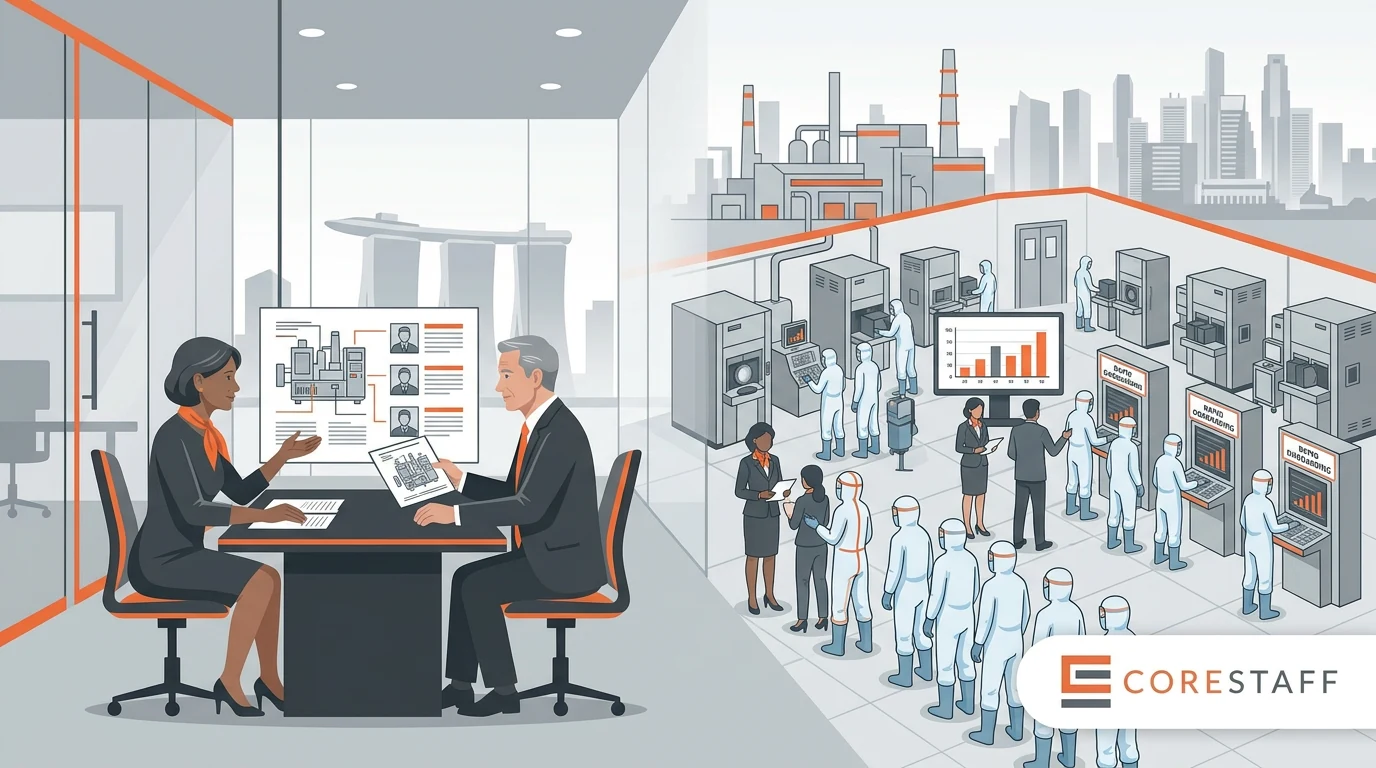
Manufacturing employers in Singapore often ask a simple question when a hiring push begins: which recruitment partner should we use? But the more useful question is usually the more specific one. Do we need a specialist recruiter who understands technical roles, sector nuance, and fit? Or do we need a mass-recruitment partner who can move large volumes of candidates quickly?
The answer depends on the workforce problem you are actually trying to solve. In 2026, that distinction matters more because manufacturing hiring is happening under tighter labour conditions, faster production timelines, and greater pressure to balance speed with retention. The wrong recruitment model can make hiring slower, noisier, and more expensive. The right model can protect both headcount delivery and hiring quality.
This is also where Corestaff has an opportunity to differentiate clearly. The market already includes relationship-led agencies with broad sector breadth and strong testimonials, as well as volume-led firms that emphasise speed, outsourcing, and mass-hiring support. What many manufacturing employers actually need, however, is a partner that combines sector-specific understanding with scalable execution. That is the gap this article is designed to address — and it aligns closely with Corestaff’s manufacturing recruitment approach.
Why this decision matters more in 2026
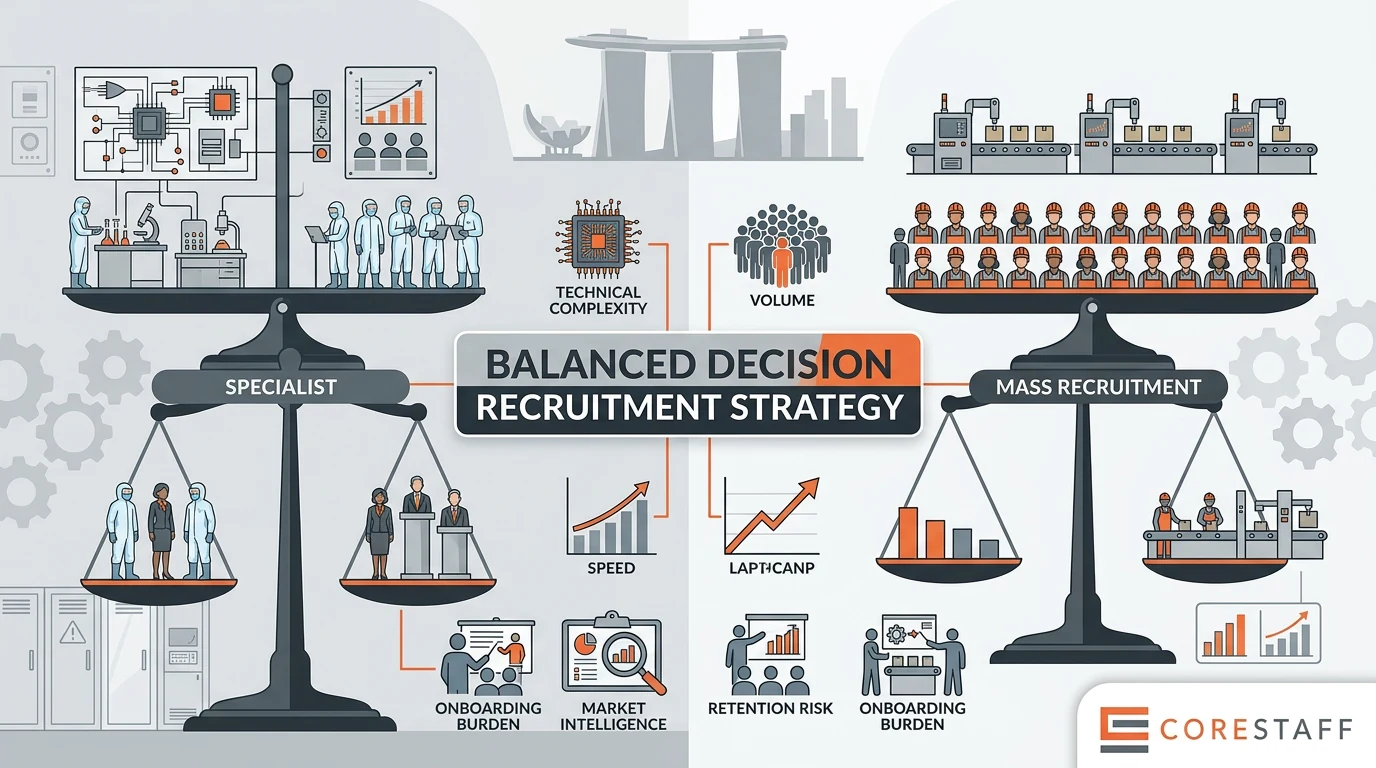
Manufacturing hiring in Singapore is no longer only about filling vacancies. Employers are dealing with a tighter labour supply, more specialised technical requirements, shift-based environments, rising expectations for consultant responsiveness, and greater pressure to avoid mis-hires that disrupt production. For some businesses, one poorly chosen recruiter creates months of avoidable hiring friction.
A manufacturing company scaling operators, technicians, supervisors, or engineers needs different support at different points of growth. Some phases demand precise technical screening. Others demand candidate throughput and interview coordination. That is why choosing a recruitment partner should never be treated as a generic procurement exercise. It is a workflow decision that directly affects output, onboarding, compliance, and team stability.
What a specialist recruiter does best
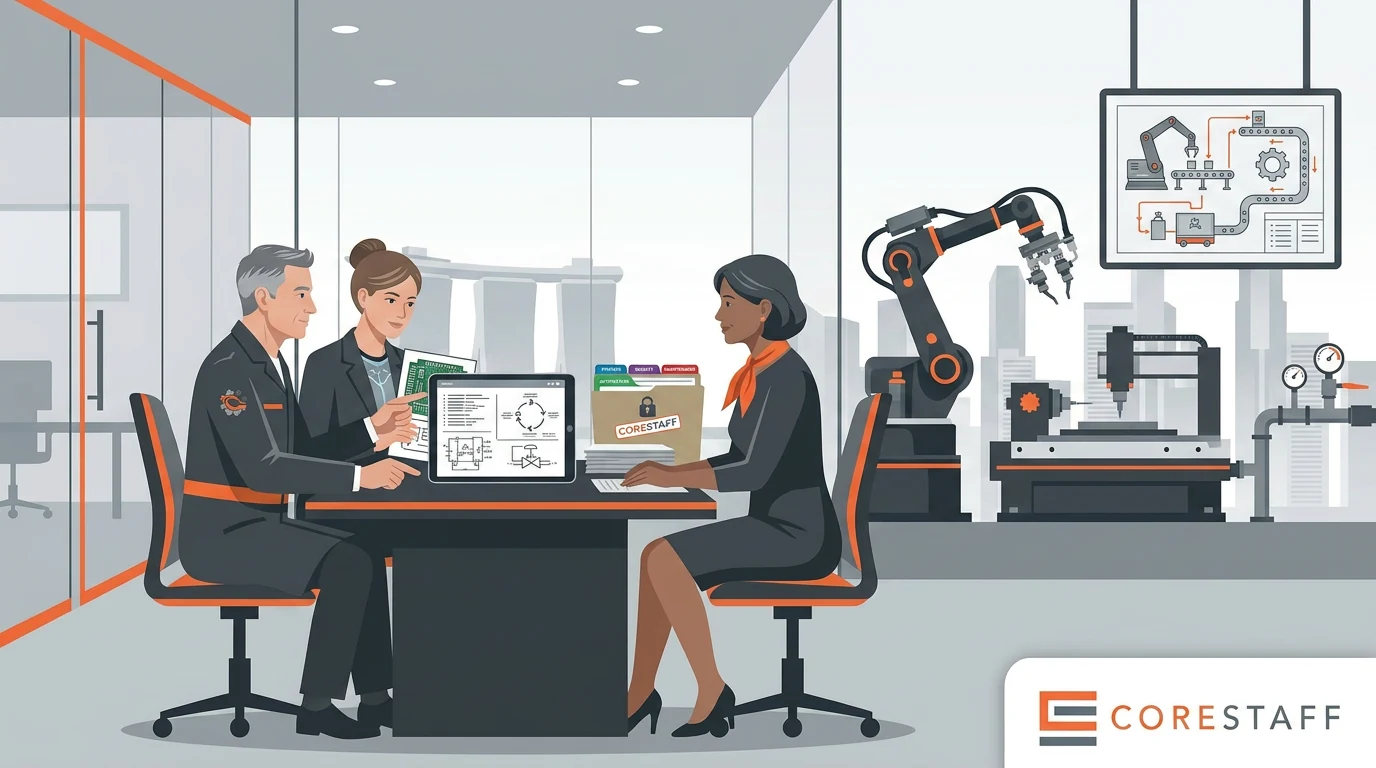
A specialist recruiter is strongest when the role is difficult, not because it exists, but because the fit is narrow. In manufacturing, that often applies to process engineers, automation engineers, maintenance specialists, quality engineers, niche technicians, production supervisors, technical team leads, and commercially sensitive replacement hires.
In these situations, the employer needs more than candidate volume. They need role calibration, market intelligence, sharper screening, and a recruiter who understands the environment the candidate will walk into. That means understanding production pressures, reporting structures, shift expectations, safety culture, equipment context, and which skills are essential versus trainable.
A true specialist recruiter should also be able to speak credibly about pay positioning, candidate objections, and why some manufacturing roles take longer to fill than others. That is what makes specialist recruitment valuable. It reduces noise. It narrows the funnel earlier. It improves shortlist quality. And it gives hiring managers greater confidence that the candidates they meet are genuinely relevant.
For employers making business-critical hires, specialist recruitment often wins because the cost of the wrong hire is higher than the cost of a slower but more accurate search. This is especially true where the role affects production continuity, compliance, equipment uptime, or frontline leadership.
What a mass recruiter does best
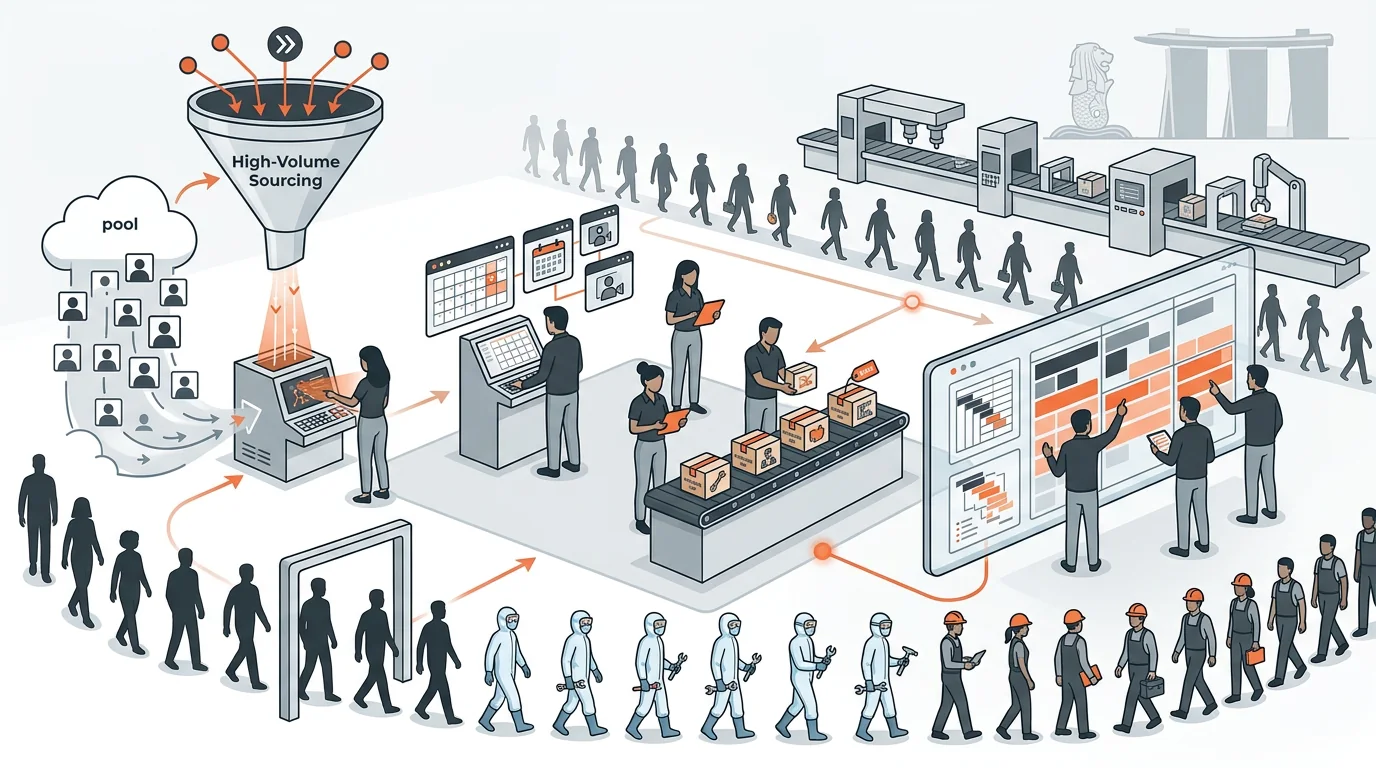
Mass recruitment becomes powerful when the core problem is scale, speed, and coordination. If a company needs 20, 50, or 100 hires across operators, assemblers, warehouse support, machine operators, or project-based staff, a recruiter with high-volume process discipline can create real value.
The strength of a mass recruiter is not just access to more candidates. It is the ability to manage candidate flow, coordinate multiple interviews, support batch hiring, assist with onboarding logistics, and keep operational momentum during high-volume campaigns. When a business is ramping a new line or filling repeated frontline vacancies quickly, that capability matters.
Mass recruitment is especially useful when the employer has already clearly defined the role, and the main risk is delay rather than technical ambiguity. In those cases, scale and execution discipline often matter more than deep niche-market mapping.
That said, volume alone does not automatically mean quality. A mass recruiter still needs a solid screening process, onboarding follow-through, and enough understanding of the manufacturing environment to avoid flooding the client with profiles that look available but convert poorly.
Where each model can fail
A specialist recruiter can underperform if the employer expects very high-volume delivery on a timeline that the specialist process was not designed for. A role that needs 60 operators in eight weeks cannot be treated like a retained executive search.
A mass recruiter can underperform if the employer assumes that speed alone will solve a technically demanding hiring problem. If the environment is shift-heavy, safety-sensitive, or equipment-specific, a purely volume-led approach may create activity without enough conversion.
This is why many manufacturing employers become frustrated. They appoint an agency based on brand familiarity or general claims, only to discover later that the recruiter was built for the wrong kind of problem.
So which approach actually wins?
For most Singapore manufacturing employers, the winner is not “specialist” or “mass” in isolation. The winner is the model that matches the hiring problem. If the company is hiring scarce technical talent, specialist capability should lead. If the company is scaling large frontline teams, mass recruitment capability should become more important. And in many real-world projects, the best answer is a partner that can do both.
This is exactly where Corestaff can position itself more strongly against the wider market. Relationship-led agencies may offer excellent communication and broad sector reach, while volume-led firms may offer speed and outsourcing support. But a manufacturing employer often needs a recruiter who understands production realities, can advise on fit and market expectations, and can still scale hiring when volume rises. That hybrid value is more compelling than either extreme on its own.
A practical checklist before choosing any recruitment partner
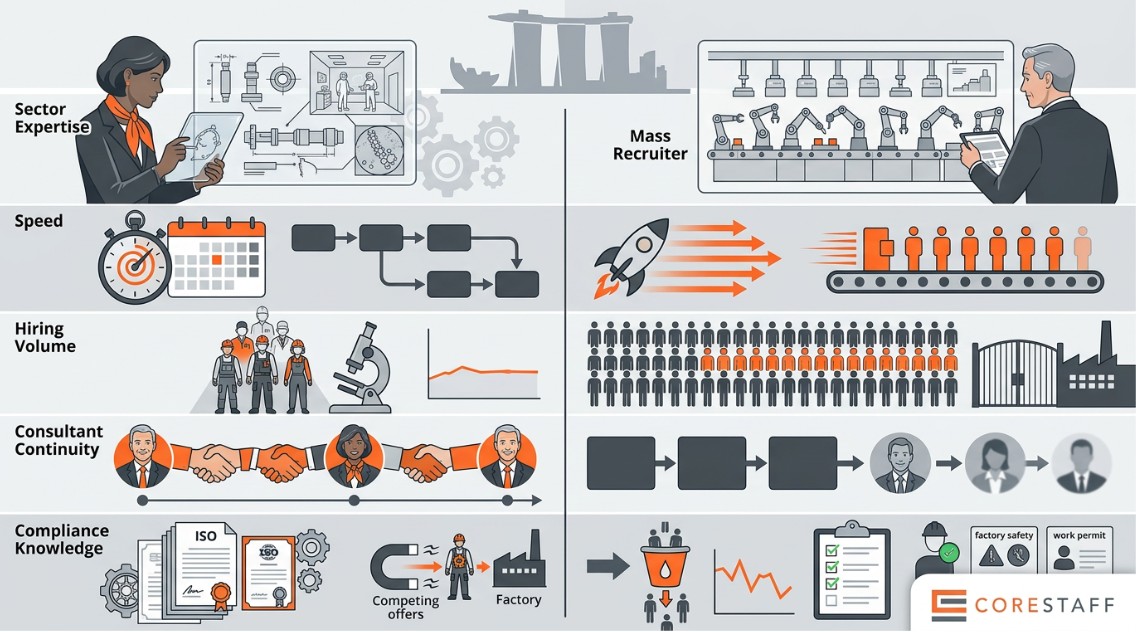
Corestaff’s own Best Recruitment Agency in Singapore guide offers a useful trust-signal checklist that manufacturing employers should apply before signing up with any agency. These checks are especially relevant when the business is comparing a specialist recruiter, a generalist relationship-led firm, or a volume-first partner.
- Verify the MOM employment agency licence and confirm it is in good standing.
- Ask for real sector evidence: how many manufacturing placements were completed in the last 12 months?
- Check whether the agency has a true manufacturing candidate database or is mainly reselling public job-board traffic.
- Request a clear fee structure and confirm whether payment is triggered upon offer, at the start date, or at another milestone.
- Ask about replacement guarantees, their duration, and the exclusion conditions.
- If foreign hiring may be involved, test the agency’s knowledge of compliance and practical work-pass advisory capabilities.
- Confirm consultant continuity: who will actually run the account, and how experienced are they?
- Ask for references from companies in the same or similar manufacturing segment.
This checklist helps employers move away from generic marketing claims and toward measurable decision criteria. It also reinforces an important point: choosing a recruitment agency is less about slogans and more about whether the operating model matches the hiring problem.
When Corestaff’s model is most compelling
Corestaff is strongest when a manufacturing employer wants sector understanding, practical hiring advice, and the ability to scale beyond single-vacancy recruitment. The company’s content-led positioning also helps, as the published articles themselves demonstrate subject-matter expertise in manufacturing recruitment, foreign-worker compliance, salary benchmarking, and workforce planning — areas that many competitors do not explain in depth on their websites.
That matters in bottom-funnel decision-making. Employers are not only buying CV flow. They are buying confidence. A specialist recruiter who can explain the market clearly, set expectations honestly, and still deliver at operational speed is often easier to trust than a partner whose message is built only around breadth or raw volume.
Conclusion
So which approach wins for manufacturing hiring in Singapore? The honest answer is: the approach that fits the hiring problem. Specialist recruiters win when technical accuracy, market intelligence, and fit are the main concerns. Mass recruiters win when scale, coordination, and high-volume throughput matter most. But for many manufacturing employers, the best long-term answer is a recruiter that can combine specialist understanding with scalable delivery.
That is the position Corestaff should own more clearly. In a market full of relationship-led and volume-led agencies, the most useful partner is often the one who can understand the role properly, advise the client honestly, and still execute when hiring volume increases.