
Direct Answer
Three executive search models exist in Singapore: retained, contingency, and contained (hybrid). Retained wins for confidential, board-level, and hard-to-find roles; contingency wins for open mid-management roles with a broad candidate pool; contained wins for roles that need exclusivity without full retainer economics. Here is how to pick.
Model Definitions
Retained search: the client pays a portion of the fee upfront (typically one-third on engagement, one-third at shortlist, one-third on placement). Exclusive engagement; agency commits research capacity.
Contingency search: the client pays only on successful placement. Non-exclusive; the agency competes against other channels.
Contained (hybrid): a smaller engagement fee upfront (typically 10 to 20% of expected total fee) with the balance on placement. Exclusive engagement for a defined period.
Fee and Timeline Comparison
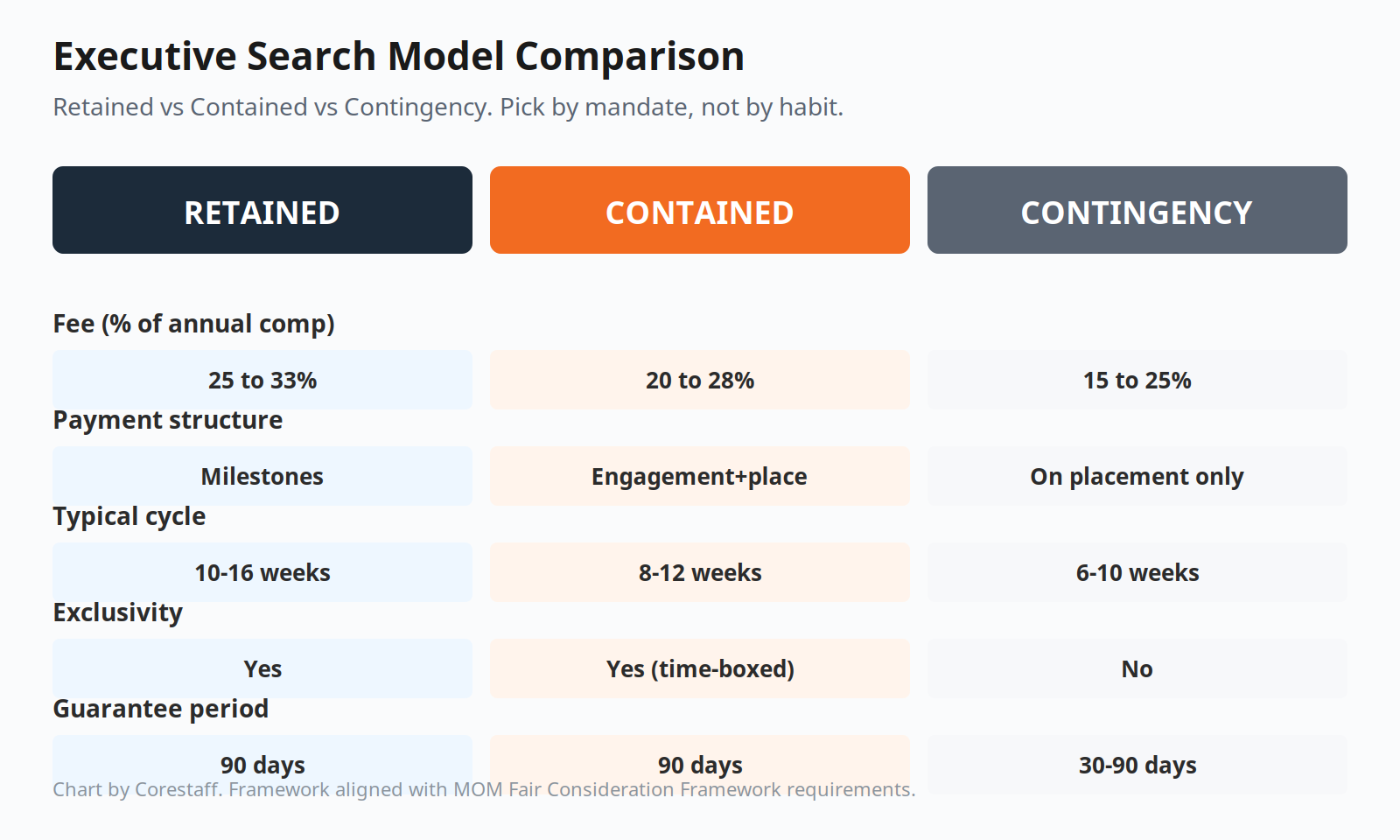
| Dimension | Retained | Contingency | Contained |
|---|---|---|---|
| Typical fee (% of annual comp) | 25 to 33% | 15 to 25% | 20 to 28% |
| Payment structure | Milestone (3 stages) | On placement only | Engagement + placement |
| Exclusivity | Yes | No | Yes (time-boxed) |
| Typical cycle | 10 to 16 weeks | 6 to 10 weeks | 8 to 12 weeks |
| Research depth | Full mapping of target market | Database + light outreach | Targeted mapping |
| Guarantee period | 90 days typical | 30 to 90 days | 90 days typical |
When Each Model Wins
Retained wins when:
- Board-level or C-suite role.
- Confidential search required.
- Role is highly niche (e.g. advanced-packaging engineer, MAS-licensed CRO).
- Client wants a mapped view of the target market, not just candidates.
Contingency wins when:
- Open mid-management or professional role.
- Candidate pool is broad and inbound flow is likely.
- Client is comfortable running multiple channels in parallel.
- Role can wait for the right candidate to surface.
Contained wins when:
- You want retained-style commitment without retained-style economics.
- The role is important but not confidential.
- You want an agency to prioritise you without full retainer.
Not sure which model fits?
In a 30-minute scoping call, we recommend one of the three models against your specific role. No obligation to engage.
What Your CFO Should Ask
- What is the total fee across scenarios (candidate declines, first placement fails, backfill)?
- What is the guarantee period? What triggers a free replacement?
- Is the fee capped or uncapped as candidate comp rises through negotiation?
- Are there off-limits clauses that would prevent the agency from poaching the hire later?
- What is the projected close probability by model?
Common Mistakes and How to Avoid Them
- Running contingency for a C-suite hire. The agency has no incentive to do the mapping work; you get whoever is already in a database.
- Running retained for a mid-manager with a broad candidate pool. You pay for research you did not need.
- Running two contingency agencies in parallel. Duplicate outreach damages your employer brand and confuses candidates.
- Not defining the guarantee. The moment the guarantee triggers matters. Get it in writing.
Related reading: Corestaff executive search, confidential executive search, executive search 2027 C-suite outlook.
MAS Regulated Context: What Confidentiality Actually Costs
Per MAS, the revised Single Family Office framework took effect on 15 June 2026. Existing SFOs have a transition period to 15 June 2027 to comply. Under the new framework, qualifying SFOs enjoy a structure-agnostic class exemption from licensing, provided they notify MAS, maintain an account with a MAS-licensed bank, and file an annual return.
What this means for executive search: family offices and MAS-regulated firms operate under heightened confidentiality by default. Any lead investment role, CRO, or MLRO hire will default to confidential search. The market’s tolerance for open C-suite postings in regulated finance is very low.
Section 13O and 13U Fund Tax Schemes
Per MAS, Sections 13O, 13OA, and 13U of the Income Tax Act 1947 provide fund tax incentives for family offices. Qualifying criteria must be maintained throughout the fund’s incentive period.
For hiring: an SFO managing a 13O or 13U fund typically employs an investment lead, a chief investment officer, or a portfolio manager, plus operations, tax, and compliance roles. The scale of the underlying fund drives headcount: a mid-size 13O fund typically staffs 4 to 8 people; a large 13U fund staffs 12 to 25.
Choosing the Right Search Model in Regulated Finance
Three signals point to retained (usually confidential) search rather than contingency for a MAS-regulated role:
- Incumbent is still in the seat. Any hint of open sourcing tips the market.
- Regulatory role. CRO, MLRO, and Head of Compliance hires get default confidentiality.
- Niche mandate. If the role has fewer than 30 qualified candidates in Singapore, retained is the only economically defensible model.
For open, mid-level MAS-regulated roles (compliance analyst, senior manager risk) with a broader candidate pool, contingency or contained can still work.
How Corestaff Runs This Category of Search
Every Corestaff mandate in Singapore follows the same underlying process discipline, adapted to the role:
- Discovery call (day 0 to 1). A 30-minute call to lock scope, must-haves, salary band, and MOM pass eligibility. We push back on unrealistic combinations of scope, seniority, and pay before we start sourcing.
- Compliance check (day 1 to 2). We verify DRC headroom, appropriate pass type (EP, S Pass, or Work Permit), and any sector-specific requirements.
- Sourcing (day 2 to 10). Active outreach across our network plus MyCareersFuture posting where the Fair Consideration Framework requires it for new EP roles. Structured screens against must-haves.
- Shortlist (day 10 to 14). 3 to 5 candidates presented with a written summary matched to your must-haves, plus salary expectation, notice period, and any pass-eligibility flags.
- Client interviews (day 14 to 25). We coordinate the panel, collect structured feedback, and keep candidates warm through the cycle. Two rounds maximum for most roles; three for senior mandates.
- Offer and close (day 25 to 35). We handle counter-offer defence, notice-period navigation, and start-date logistics. Guarantee clock starts on day one.
Where a mandate needs to run confidentially, we adapt the sourcing (outbound only) and disclosure discipline (client identity gated behind NDA) without changing the process backbone.
Why Every Fact in This Article Is Sourced to a Singapore Government Page
Recruitment content on the internet is full of confident-sounding numbers with no traceable origin. Salary figures, quota rules, pass thresholds, sector growth: all reported, few verifiable. Corestaff’s editorial rule is that any load-bearing fact must trace to a Singapore government page (MOM, EDB, MAS, MTI, IMDA, BCA, CPF Board) with an inline citation link. Where a claim cannot be sourced to a .gov.sg page, we drop the claim rather than dress it up as an estimate. This is more work; it is also why Corestaff’s content survives fact-checking by hiring managers, CFOs, and audit teams. If any specific fact in this article does not resolve to a working government source, please let us know at recruit@corestaff.com.sg and we will fix it.
Frequently Asked Questions
Which model does Corestaff run by default?
Are retained fees negotiable?
Can we run contingency for an EP-required role?
What is the replacement guarantee if a placement leaves early?
Conclusion: What to Do Next
The three models exist because different roles need different search economics. Match once, get the hire; match wrong, waste time.
Pick the model that matches the mandate, not the model your last CFO used
Corestaff runs recruitment sprints for Singapore employers across executive search, professional and mid-market hiring, and skilled-trade sourcing. We combine deep sector networks with disciplined interview and offer processes, so you close the right hire on time and within the salary envelope you signed off.
Book a Free Scoping Call →
Learn about Executive Search
Phone: +65 6288 6866 ·
Email: recruit@corestaff.com.sg
Address: 175A Bencoolen Street #11-05 Burlington Square, Singapore 189650
Web: www.corestaff.com.sg