

Direct answer: In Singapore, expect two to four weeks to fill operational and support roles, four to eight weeks for professional roles, six to twelve weeks for engineering and technology roles, and four months or more for executive searches. Global benchmarks put the median time to fill a non-executive role at about 39 calendar days. The biggest single lever is not the market: most delay sits inside the employer’s own approval and interview chain, and roughly a third of it is removable with process changes alone.
The benchmarks: how long hiring actually takes
Two independent benchmarks anchor the range. SHRM’s 2026 research across more than 4,600 organisations puts the median time to fill for non-executive roles at 39 calendar days. The staffing industry’s own tracking recorded an average of 44 days to hire in Q1, up from 43 a year earlier, which means hiring is getting slower even as tools improve. In Singapore specifically, the labour market cooled at the edges in 2026: job vacancies shrank 6.4 percent in Q2, and MOM’s data shows laid-off residents taking longer to find new work, which lengthens the screening stages as applications per posting rise.
One in three employers also reports that hiring has become slower than a year ago, a sentiment figure that matches the benchmarks. None of these numbers is a verdict on your process; they are the baseline you should measure against.
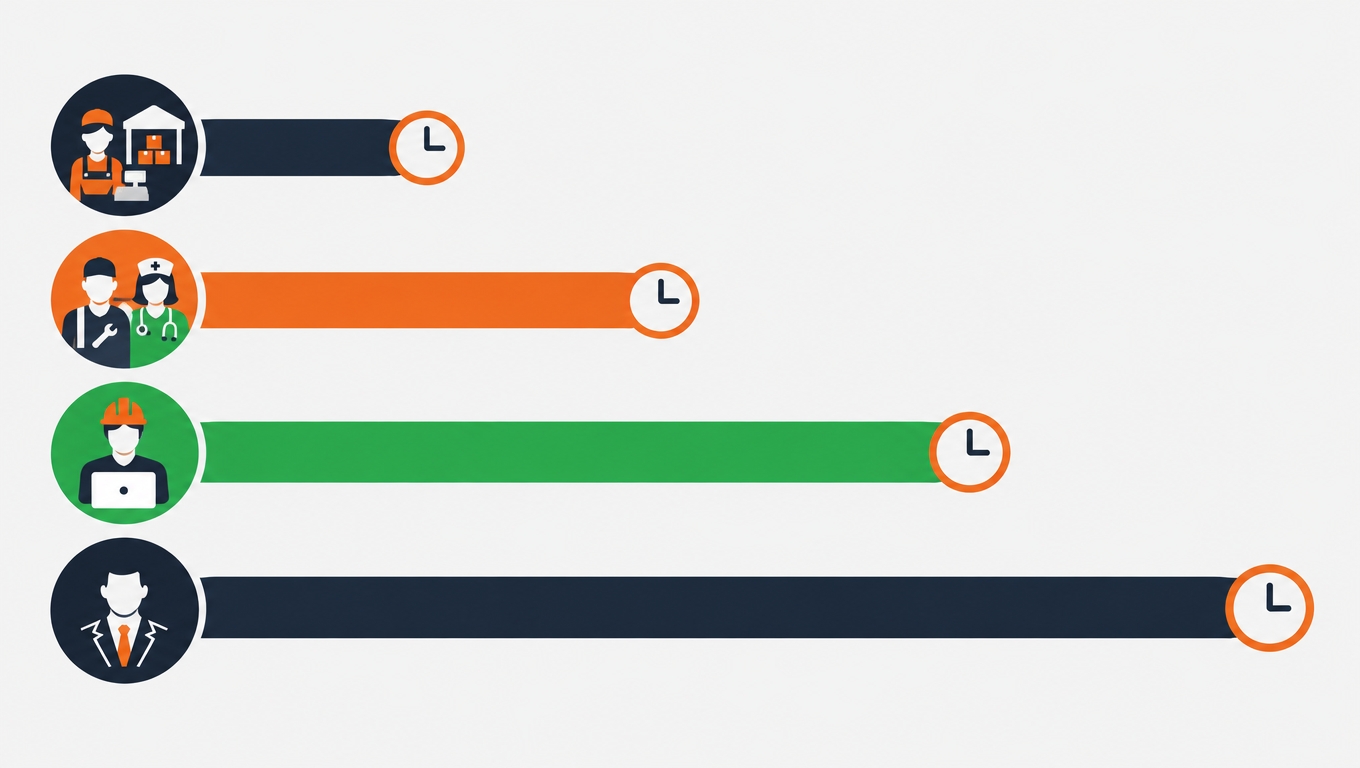
Time to fill by role type
Benchmarks flatten the differences between role families, and the differences are where planning goes wrong. The ranges below reflect Corestaff’s placement experience in Singapore in 2026:
| Role family | Typical time to fill | What drives the range |
|---|---|---|
| Operations, support, retail and warehouse | 2 to 4 weeks | Deep candidate pools, fast decisions |
| Skilled technical and supervisors | 4 to 8 weeks | Certification checks, quota and licence steps |
| Professionals (finance, HR, marketing) | 4 to 8 weeks | Multi-round panels, competing offers |
| Engineering and technology | 6 to 12 weeks | Thin supply, notice periods, counteroffers |
| Executive and C-suite search | 10 to 16+ weeks | Discretion, mapping, resignation and notice |
Add the notice period on top: a professional serving a two month notice adds roughly eight weeks between acceptance and day one, which is why the calendar from approval to productive start is often double the time-to-fill figure itself.
Why hiring takes longer than it should
Most timelines decompose into four delay blocks: internal approval before the role even opens (often one to three weeks), screening and interview scheduling (two to six weeks, multiplied by sequential rather than parallel rounds), offer decision and negotiation (one to three weeks), and the statutory and contractual steps, including the 14 day MyCareersFuture advertisement required under the Fair Consideration Framework for S Pass and EP hires and the notice period after acceptance. Only the last block is genuinely fixed. The first three are process choices.

Six ways to cut your time to fill
- Pre-approve the offer band before advertising. Roles that open with a pre-agreed salary range and signatory skip the slowest single step in the chain.
- Use a fixed scorecard. Panels misalign when each interviewer improvises criteria. A five point scorecard agreed before round one lets you decide after one round instead of three.
- Run interviews in parallel. Compressing three sequential rounds into one half-day panel routinely saves two to three weeks.
- Decide within 48 hours of the final interview. Speed is a signal to strong candidates, and it is the cheapest retention tool at offer stage.
- Overlap the statutory steps. Start the FCF advertisement and the sourcing shortlist in the same week so the 14 days are never idle time.
- Use interim cover for long-lead roles. For roles above eight weeks, a contract starter keeps the work moving while the permanent search runs. Our temporary staffing for interim cover guide covers how the route works.
The working-backwards timeline
Plan from the start date backwards, not from today forwards. If the new hire must be productive by 1 January, acceptance needs to land by mid-October for a professional with a two month notice, interviews must close by early October, and advertising must start by mid-September. For volume hiring the same logic applies at scale, which we set out in the mass hiring playbook for Singapore employers.
Corestaff Singapore maintains pre-qualified shortlists so client interviews start in week one, not week four. Request time to fill estimates for your open roles and we will map your realistic calendar before you commit.
Frequently asked questions
What is a good time to fill in Singapore?
Two to four weeks for operational and support roles, four to eight weeks for professionals, and up to four months for executive searches. If a mid-level professional role is still open after three months, the process, not the market, is usually the problem.
Why does hiring take so long in Singapore?
The largest delays are internal: approval chains, unaligned interview panels and slow offer decisions. External factors add fixed steps such as the 14 day Fair Consideration Framework advertisement for S Pass and EP hires and notice periods of one to three months.
Does the 14 day job advertisement delay apply to every hire?
It applies to S Pass and Employment Pass applications under the Fair Consideration Framework. Work Permit hires are not subject to the same advertising requirement, which is one reason operational foreign hires move faster.
How do I shorten my own hiring timeline?
Write the offer approval into the process before advertising, use a fixed scorecard so panels align after one round, run interviews in parallel rather than sequence, and decide within 48 hours of the final interview.