
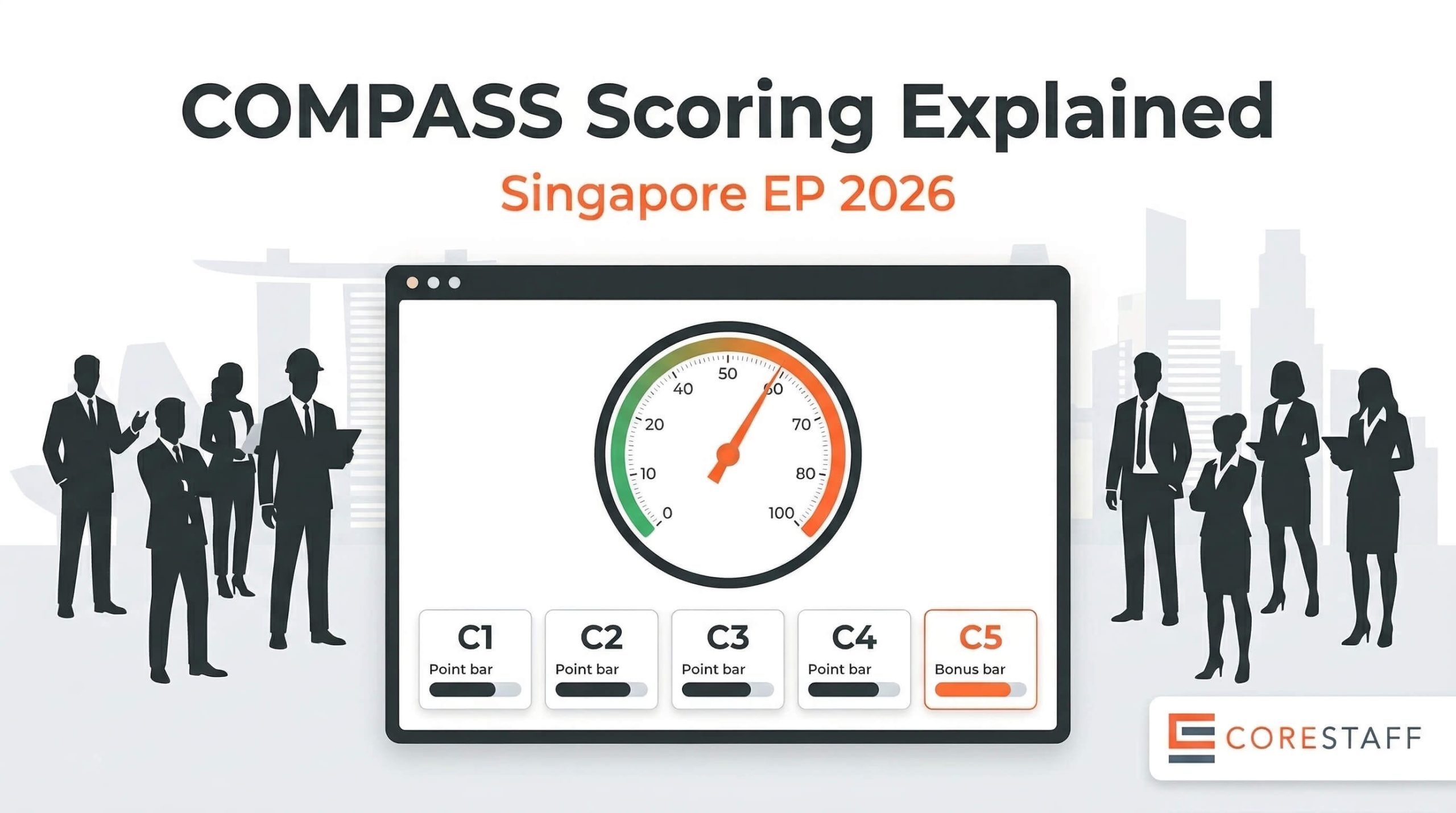
Since September 2023, every Singapore Employment Pass application has been evaluated using the COMPASS points system. Applications scoring below 40 points are rejected, with no exceptions. If you are hiring a foreign professional for an EP-level role and you do not understand how COMPASS works, your application is at risk.
This guide explains the five COMPASS criteria in plain English, shows you how the scoring works in practice, and tells you what you can do to improve a borderline application before you submit it. For full support with EP applications, Corestaff’s foreign worker recruitment team works with employers across Singapore to prepare strong, compliant applications.
Key Takeaways
- COMPASS applies to all Employment Pass applications lodged since September 2023. A score of 40 or above is required to pass.
- There are five criteria: salary benchmark, qualifications, nationality diversity, local employment support, and a skills bonus.
- Each criterion (except C5) contributes 0, 10, or 20 points. C5 adds up to 20 bonus points for shortage occupations.
- The most common reason for COMPASS failures is a salary that sits below the local PMET benchmark for the role (C1).
- You can check an indicative score before applying using MOM’s EP Self-Assessment Tool (EP SAT).
- Corestaff advises employers on COMPASS readiness before any EP application is submitted.
What is COMPASS, and why was it introduced?
COMPASS stands for Complementarity Assessment Framework. It is a points-based scoring system introduced by the Ministry of Manpower (MOM) to assess Employment Pass applications in a more structured and transparent way.
Before COMPASS, EP applications were evaluated on a case-by-case basis using criteria that were not fully published. Employers had limited visibility into why an application was approved or rejected. COMPASS changed that by making the assessment criteria explicit and measurable.
The framework was phased in from September 2022 for new applications, and from September 2023 for all renewals. As of 2026, every EP application, whether new or renewed, is assessed under COMPASS. (Source: MOM Singapore, Employment Pass Eligibility, mom.gov.sg)
The five COMPASS criteria explained

| Criterion | What it measures | Points available |
|---|---|---|
| C1 — Salary | Candidate’s salary vs. local PMET benchmark for the same job category and experience level | 0, 10, or 20 |
| C2 — Qualifications | Highest degree and institution ranking (Top 100 universities per QS/Times ranking) | 0, 10, or 20 |
| C3 — Diversity | Concentration of the candidate’s nationality among the firm’s EP holders | 0, 10, or 20 |
| C4 — Local employment support | The company’s share of local PMETs (Professionals, Managers, Executives, Technicians) in the workforce | 0, 10, or 20 |
| C5 — Skills bonus | The candidate is on the Shortage Occupation List (SOL) for their sector | 0 or 20 (bonus) |
The maximum base score is 80 points (C1 to C4). C5 adds up to 20 bonus points. An application needs 40 points to pass. The minimum possible score is 0 (if all four base criteria score 0).
How each criterion is scored in practice

C1 — Salary benchmark
MOM uses the local PMET salary benchmark for the same SSOC (Singapore Standard Occupational Classification) code and experience band. If your candidate’s salary:
- Meets or exceeds the benchmark: 20 points
- Falls within 90% to 100% of the benchmark: 10 points
- Falls below 90% of the benchmark: 0 points
The minimum EP salary in most sectors is SGD 5,000 per month as of 2026 (SGD 5,500 for financial services). However, for experienced candidates, the PMET benchmark can be significantly higher. A candidate applying for a senior finance role with 10 years of experience may need a salary of SGD 8,000 to 10,000 to score 20 points on C1.
C2 — Qualifications
MOM uses published global university rankings (QS and Times Higher Education). A degree from a university ranked in the global top 100 earns 20 points. A degree from outside the top 100 earns 10 points. No recognised degree earns 0 points. Note that professional qualifications (e.g., CPA, CFA) can be considered, but they are not automatically equated to a top-100 degree.
C3 — Nationality diversity
This criterion checks whether the candidate’s nationality is overrepresented among your existing EP holders. If more than one-third of your EP workforce shares the candidate’s nationality, you score 0 on C3. MOM wants to see a diverse EP workforce, not a single-nationality concentration. This criterion often catches employers by surprise when they have hired multiple candidates from the same country without tracking the ratio.
C4 — Local employment support
This measures the proportion of your workforce who are local PMETs. Companies with a high ratio of local PMET employees score higher. This criterion rewards companies that are investing in local talent alongside foreign professionals. For new companies with small headcounts, this can be a significant challenge.
C5 — Skills bonus
The Shortage Occupation List (SOL) identifies roles where Singapore has a recognised skills gap. Candidates applying for SOL roles receive a 20-point bonus in addition to their base score. As of 2026, the SOL includes roles in AI engineering, cybersecurity, advanced manufacturing, and healthcare technology. (Source: MOM, Shortage Occupation List, mom.gov.sg)
The most common reasons EP applications fail COMPASS

- Salary too low for the experience band (C1 scoring 0). Employers often offer the minimum EP threshold (SGD 5,000) regardless of experience level. For a candidate with 8 to 12 years of experience, this can be 20% to 30% below the PMET benchmark for that SSOC code.
- Nationality concentration already at the limit (C3 scoring 0). Companies that have hired multiple people from the same country find that subsequent applications from that nationality automatically score 0 on C3, making a 40-point total much harder to achieve.
- Low local PMET ratio (C4 scoring 0). Smaller firms or recently established Singapore offices often have a low proportion of local PMETs, which pulls C4 to 0 and requires higher scores elsewhere to compensate.
- Wrong SSOC code on the application. Using an incorrect SSOC code means the salary benchmark comparison is made against the wrong benchmark. This is an administrative error that can result in an unnecessary C1 failure.
Five ways to improve your COMPASS score before applying

- Review the salary benchmark for the correct SSOC code. Use MOM’s EP SAT tool to check the indicative score for the exact salary and SSOC code you plan to use. Adjust the salary if needed before lodging the application.
- Verify the SSOC code is correct. A wrong code can trigger a C1 failure even when the salary is competitive. Check the official MOM SSOC classification guide before submitting.
- Audit your nationality mix before each new EP hire. If one nationality is approaching the one-third threshold, consider whether the timing or the order of applications can be managed.
- Actively track your C4 ratio. If your local PMET ratio is low, work with Corestaff’s local talent recruitment team to increase it over time. This is a longer-term strategy, not a quick fix.
- Check whether the role qualifies for the Shortage Occupation List (C5). A 20-point C5 bonus can make an otherwise borderline application pass comfortably. MOM publishes the SOL on its website.
Key data and context
Minimum COMPASS score to pass an EP application (MOM, mom.gov.sg)
Minimum EP salary for most sectors in 2026; S$5,500 for financial services (MOM)
C1 Salary, C2 Qualifications, C3 Diversity, C4 Local Support, C5 Skills Bonus
Frequently asked questions
Does COMPASS apply to EP renewals?
Yes. Since September 2023, all EP renewals are also assessed under COMPASS. An EP holder who scored above 40 when first approved may score below 40 at renewal if, for example, the PMET salary benchmark has risen or the firm’s nationality mix has changed.
Can an application be appealed if it fails COMPASS?
Yes. Employers can submit an appeal to MOM with supporting documentation. However, appeals are rarely successful unless there is a specific circumstance that MOM’s automated scoring did not capture, such as a senior specialist role that falls outside normal SSOC benchmarks.
What is the EP Self-Assessment Tool (EP SAT)?
The EP SAT is a free online tool provided by MOM at mom.gov.sg. It takes under five minutes to complete and gives an indicative COMPASS score for your candidate before you submit the formal application. It is not a guarantee of outcome, but it is the most reliable pre-application check available.
How does COMPASS affect EP applications for new companies in Singapore?
New companies often struggle with C3 (diversity) and C4 (local employment support) due to their small workforce. MOM provides an allowance for companies in their first year of operation, but this is assessed on a case-by-case basis. Corestaff can advise on the correct approach to new company EP applications. See also our guide on setting up in Singapore and hiring your pioneer team.
Need help with an EP application?
Corestaff reviews your COMPASS score before submission and advises on salary benchmarking, SSOC classification, and FCF compliance. Avoid a rejection that delays your hire by weeks.
Phone: +65 6288 6866 | Email: recruit@corestaff.com.sg | Web: www.corestaff.com.sg
Related articles
- Work permit vs S-Pass vs EP: which pass for which professional role?
- Step-by-step foreign worker hiring guide Singapore 2026
- Setting up in Singapore: how an overseas business hired its pioneer team
- Hiring foreign professionals in Singapore: EP, S-Pass and COMPASS guide
- Why 200+ Singapore companies trust Corestaff
Published by Corestaff Pte Ltd
Corestaff is a specialist recruitment agency in Singapore. This article reflects MOM policy as published at mom.gov.sg as of March 2026. Policy thresholds and scoring criteria are subject to change by MOM. Always verify current requirements at mom.gov.sg or contact our team for current advice.