
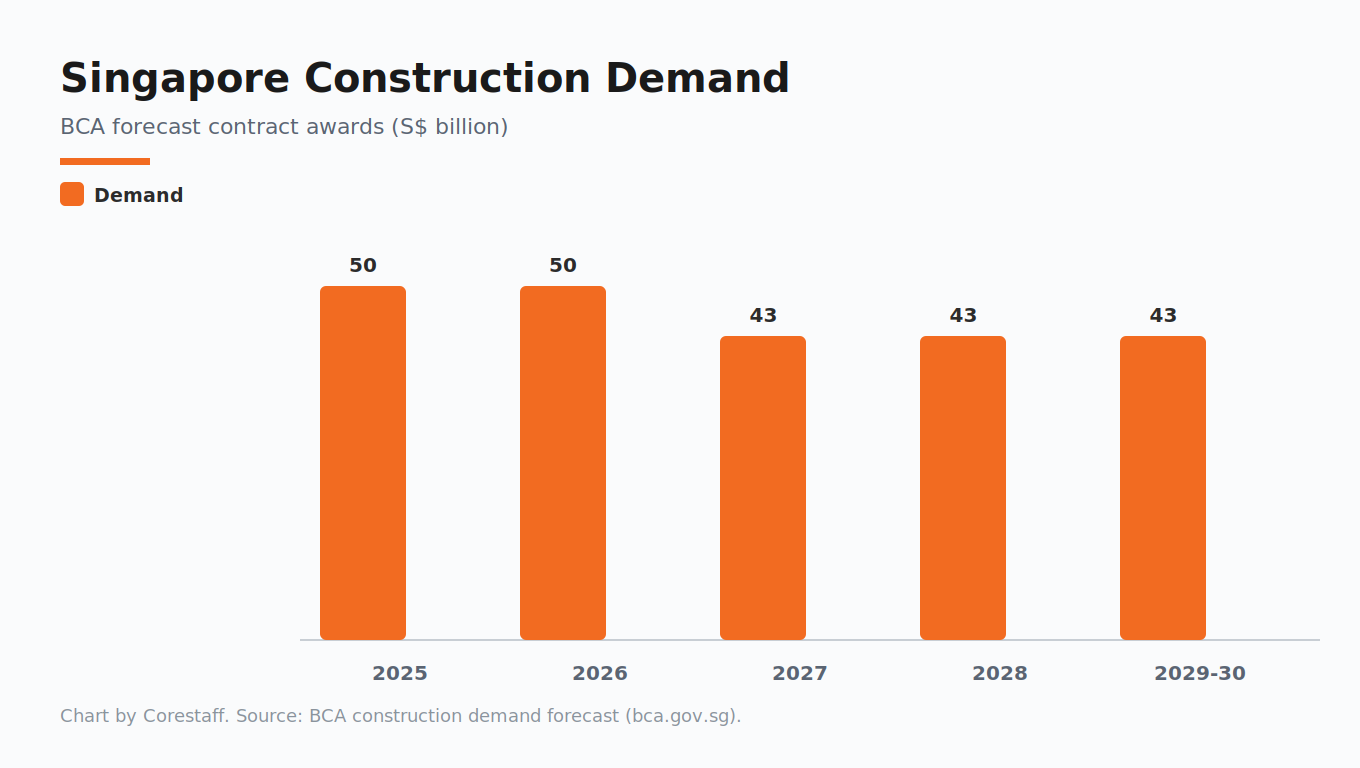
The Building and Construction Authority projects S$47 billion to S$53 billion of construction demand in 2026, with a further S$39 billion to S$46 billion a year from 2027 through 2030. The work is committed. The labour to deliver it is capped, and the cap is where projects slip. For contractors planning Q4 2026, the constraint is rarely the size of the workforce. It is the order in which it arrives.

This guide covers what construction employers face in Q4 2026 and how to plan a ramp without carrying a team you cannot deploy. For the cost side of the same picture, start with our work pass cost guide. Corestaff hires to the same ratios through its construction recruitment team, and can sequence peaks across several projects so the workforce arrives with the work rather than ahead of it.
The three constraints on construction manpower

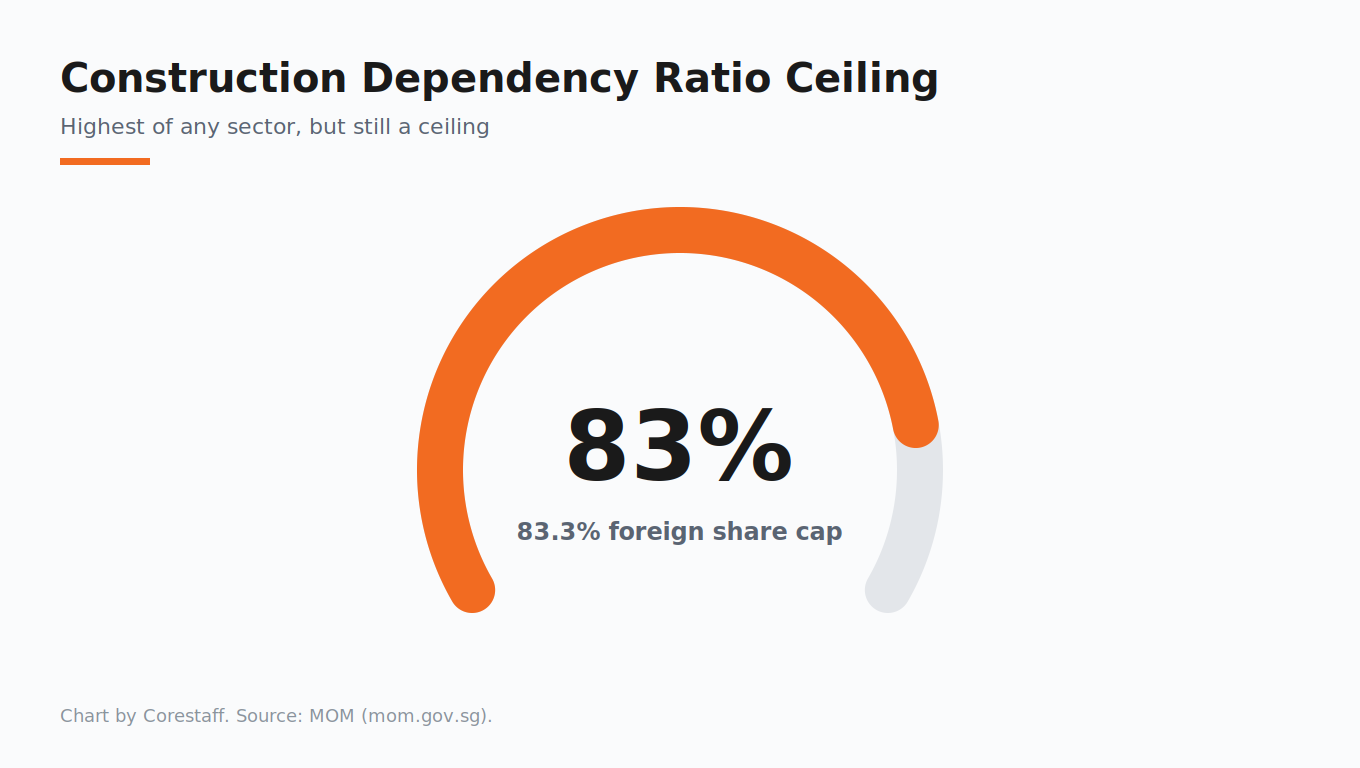
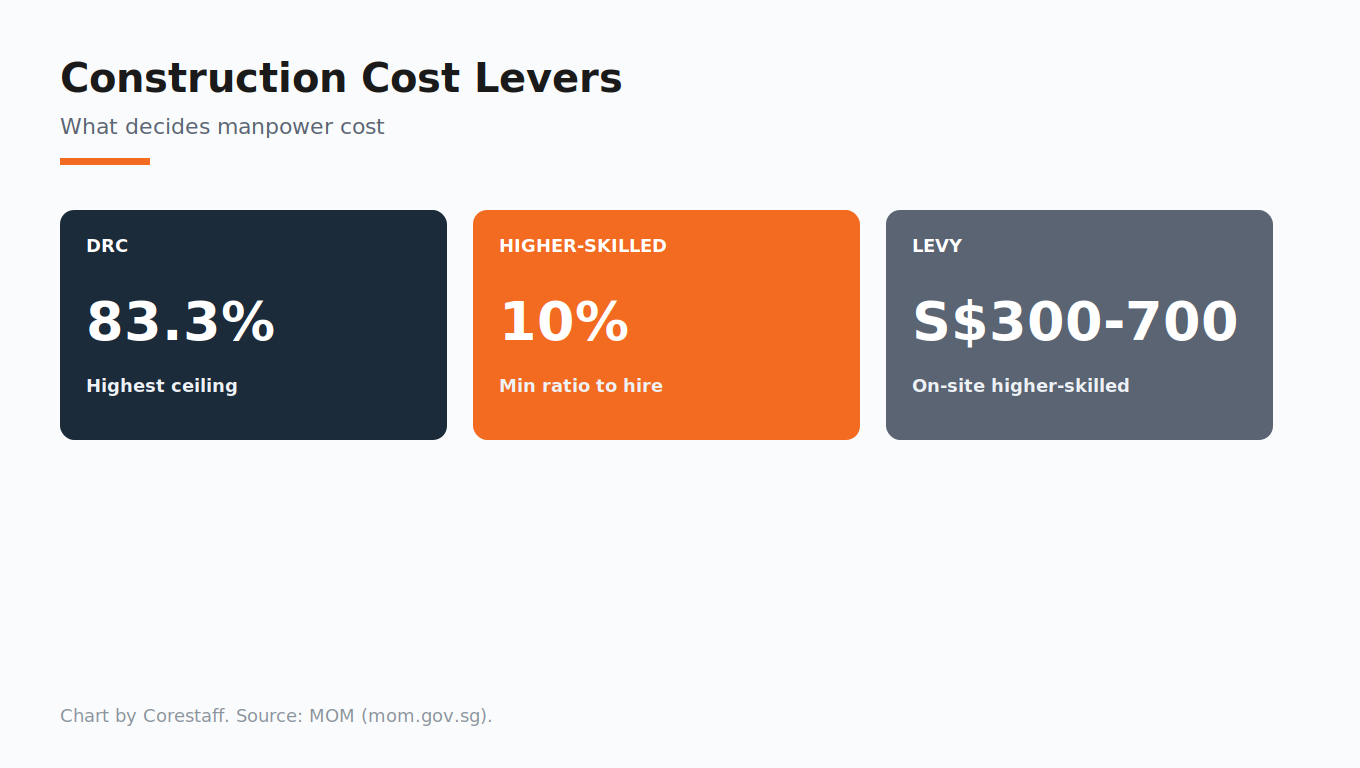
- Dependency Ratio Ceiling. Construction sits at 83.3 per cent, the highest of any sector, but it is still a ceiling and it counts against your local headcount.
- Levy tiers. The monthly levy moves with your higher-skilled share, so the composition of your workforce changes your cost, not just its size.
- The higher-skilled ratio. Before hiring or renewing basic-skilled Work Permit holders, at least 10 per cent of that sector workforce must already be higher-skilled.
Why the ramp shape matters more than the ramp size
Projects rarely fail because a team is too small. They fail because the team arrives in the wrong order. A structural phase needs steel fixers and formworkers early, then M&E and finishing trades later. Hiring to a single headcount number ignores that sequence and leaves you paying levy on workers you cannot deploy, which is the most expensive form of over-hiring there is.
| Phase | Typical intensity | Hiring trigger |
|---|---|---|
| Early works and substructure | Low headcount, high skill | Award and mobilisation |
| Superstructure | Peak headcount | Two to three months before peak |
| M&E and services | Mid headcount, specialised | Structural completion forecast |
| Finishing and handover | Falling headcount | Defects-liability planning |
Plan the S-curve before you post a single ad
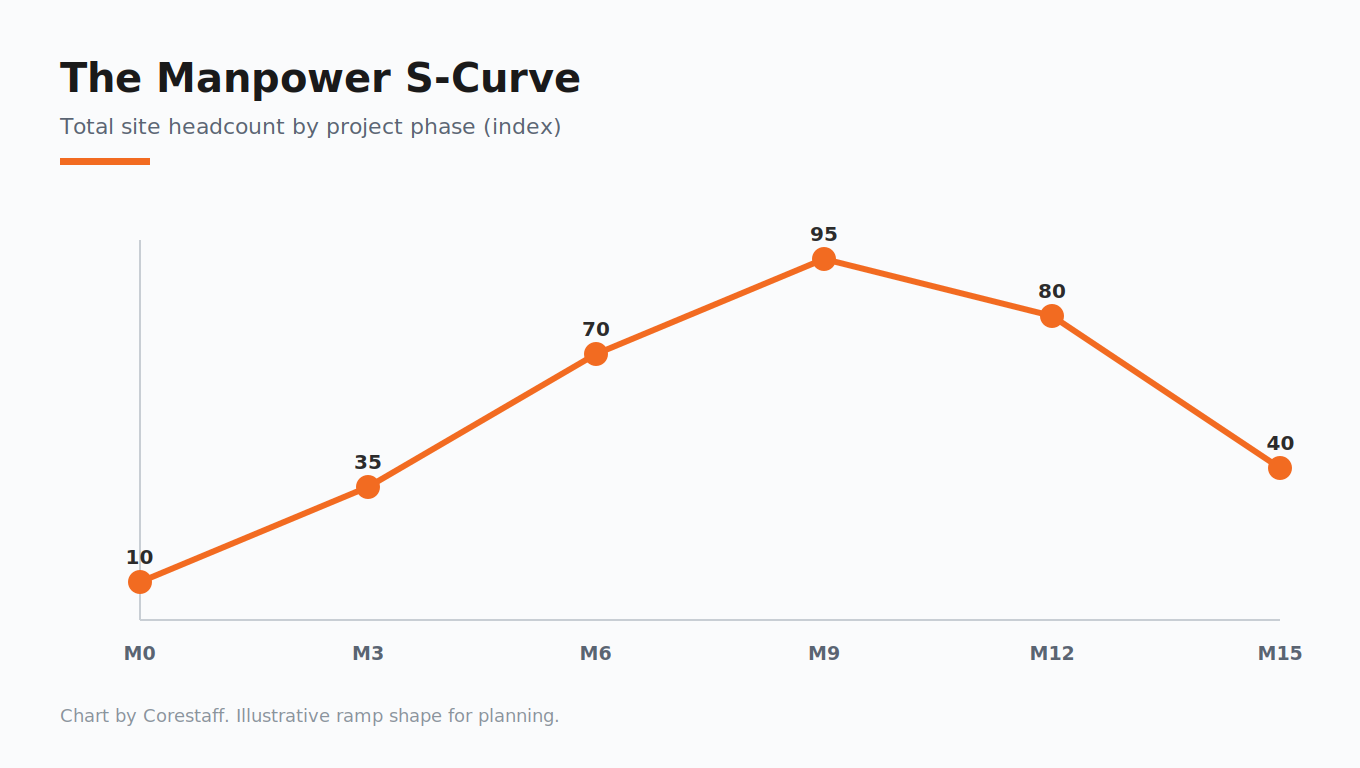
The efficient way to plan a construction ramp is to map the S-curve first: total manpower against month, split by phase. Only then does the hiring plan fall out, and you can see where the peak lands against your quota headroom and your higher-skilled ratio. Our construction manpower planner builds that curve from project value, start month, duration and phase split, so your site team works from the same chart as your HR team.
The higher-skilled ratio is your real bottleneck
The 10 per cent rule is the constraint employers discover latest. A contractor can be comfortably inside its 83.3 per cent ceiling and still be unable to renew a basic-skilled worker, because too little of the workforce is higher-skilled. The fix is planned upskilling, not recruitment: move a defined share of workers through the relevant trade tests each quarter, then hire against the ratio you actually have. Our construction recruitment team screens for trade certification as a standard field, not an afterthought.
A worked ramp: an S$80m project over ten months
Take a project with an S$80 million contract value and a ten-month build. Peak manpower might land around month five at 180 workers, split roughly 60 per cent structural trades and 40 per cent M&E and finishing. If hiring starts two months before peak, the recruitment wave needs to deliver about 30 to 40 workers a month across those months, not 180 at once. Sequencing the waves spreads the levy, keeps the higher-skilled ratio intact and avoids the demobilisation cost of a team that arrived too early and sat idle.
Build the S-curve in minutes
Enter project value, start month, duration and phase split, and the planner returns a month-by-month manpower curve with a phase breakdown you can hand to your site team.
Frequently asked questions
What is the construction Dependency Ratio Ceiling?
It is 83.3 per cent, the highest of any sector, but it still caps foreign workers as a share of your local workforce.
Can I hire basic-skilled workers freely?
No. At least 10 per cent of your Work Permit workforce in that sector must already be higher-skilled before you can hire or renew basic-skilled holders.
How early should construction hiring start?
Peak hiring should begin two to three months before the peak labour requirement, so workers clear quota and onboarding before they are needed on site.
What is the risk of hiring ahead of the S-curve?
Workers arrive before there is deployable work, so you pay levy and wages on idle headcount and lose the headroom you need for the next phase.
Related reading
Talk to Corestaff about this
Corestaff Pte Ltd is a Singapore employment agency, a trusted hiring partner since 2015, holding Employment Agency Licence 18C9027 under UEN 201633744E. If you want this article applied to your own workforce, our consultants will model it with you.
- Call: +65 6288 6866
- Email: recruit@corestaff.com.sg
- Visit: 175A Bencoolen Street, #11-05 Burlington Square, Singapore 189650
- Send a brief: Contact Corestaff · corestaff.com.sg