
Direct Answer
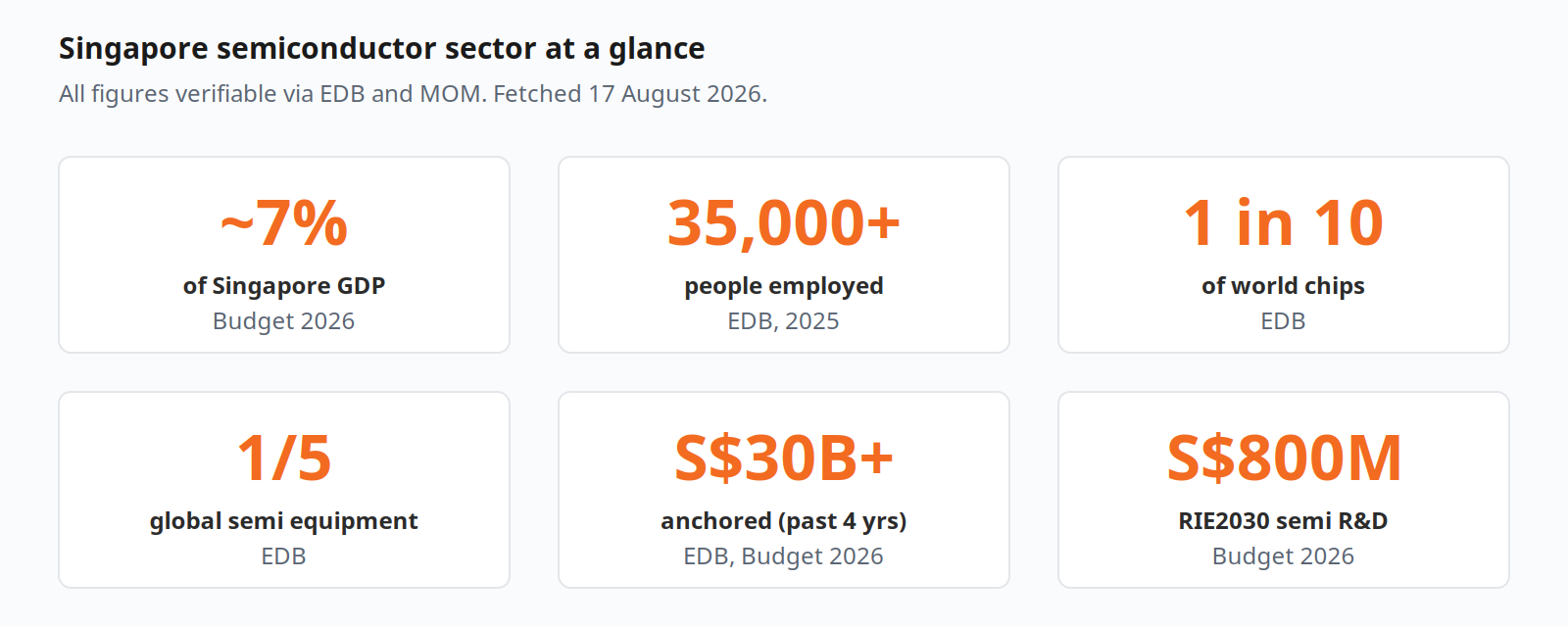
EDB Advanced Manufacturing continues to be the demand engine behind Singapore’s semiconductor, precision, and med-tech hiring in 2026. With manufacturing GDP +12.2% YoY in Q2 2026 and the SGD 800 million Budget 2026 semiconductor R&D flagship, the demand is not slowing. Here is how employers should plan around it.
EDB Advanced Manufacturing: Scope and Scale
EDB‘s Advanced Manufacturing programme covers semiconductor, precision engineering, aerospace, medtech, and specialty chemicals. In practice it targets high-value-added manufacturing that layers digital, automation, and data on top of physical production.
Two 2026 signals matter:
- Budget 2026 SGD 800 million semiconductor R&D flagship: multi-year funding for semiconductor R&D across process, equipment, and packaging.
- MTI Q2 2026 manufacturing +12.2% YoY: real growth in output, not just projections.
Roles That Get Multiplied
Every dollar of EDB-anchored capex tends to create demand for a specific role stack:
| Layer | Role examples |
|---|---|
| Shop floor | Machine operators, assembly technicians, clean-room technicians |
| Process | Process engineers, equipment engineers, QA engineers |
| Automation | Automation engineers, robotics engineers, IIoT engineers |
| Data | Manufacturing data engineers, MES architects, AI/ML engineers |
| R&D | R&D scientists, principal engineers, IP counsel |
| Leadership | Plant managers, site directors, VP engineering |
MOM Policy Interaction
EDB attracts investment; MOM sets who can be hired. In 2026 to 2027 the policy interactions matter:
- Manufacturing DRC 60% per MOM. Higher than services (35%), lower than construction (83.3%). This lets manufacturing employers rely on foreign hires for shop-floor scale.
- EP minimum SGD 6,000 from 1 Jan 2027 per MOM. Engineers earning above the age-adjusted floor are unaffected; entry-level engineers may need to be re-banded.
- S Pass minimum SGD 3,600 from 1 Jan 2027 per MOM. Technician bands need to be re-plotted.
- Shortage Occupation List per MOM SOL: several semiconductor-relevant roles qualify for COMPASS C5 bonus.
Ramping a plant under EDB-backed investment?
We build layered hiring plans that respect DRC, EP/S Pass floors, and your capex timeline. Book a scoping call.
How Employers Should Plan
- Sequence hires against capex milestones. Process engineers 12 months before equipment arrives; automation engineers 6 months before; operators 2 months before.
- Reserve DRC headroom. If you plan to add 200 shop-floor foreign hires, model the DRC math before you start.
- Salary-band once, revise quarterly. Do not renegotiate bands per offer; the market moves faster than your comp cycle.
- Pipeline junior talent through TeSA and SkillsFuture. IMDA TeSA and the SkillsFuture ecosystem subsidise conversions of adjacent-domain talent.
What the Numbers Actually Say
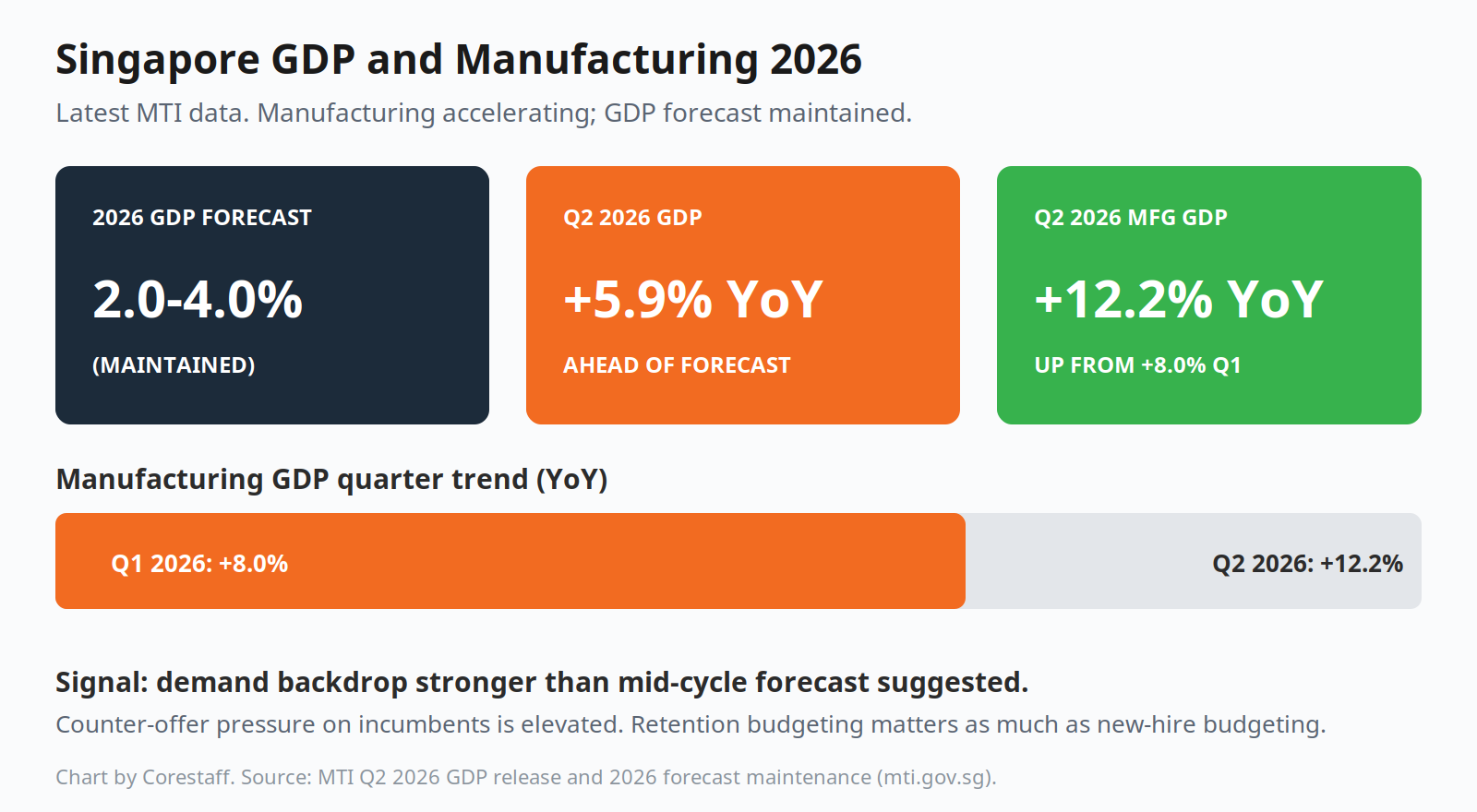
- Manufacturing GDP: +12.2% YoY in Q2 2026, accelerating from +8.0% in Q1 per MTI.
- Semiconductor R&D funding: SGD 800 million committed in Budget 2026 per EDB.
- Overall 2026 GDP forecast: 2.0 to 4.0% per MTI.
Related reading: semiconductor hiring: 300 roles EDB sees, Industry 4.0 hiring, Singapore manufacturing salary guide.
EDB Semiconductor Context and What It Funds
Per EDB, the Budget 2026 semiconductor R&D flagship commits SGD 800 million to deepen high-impact tech capabilities. Per EDB Semiconductor Talent, Singapore continues to develop the talent pipeline through partnerships with local universities, polytechnics, and the semiconductor industry.
The funding covers four capability layers:
- Process technology R&D for advanced nodes and specialty processes.
- Equipment and integration R&D in partnership with global tool vendors.
- Advanced packaging (2.5D, 3D, chiplet) with a strong Singapore anchor.
- Talent development at undergraduate, postgraduate, and mid-career conversion.
MTI Manufacturing Trajectory (Q1 to Q2 2026)
Per MTI’s Q2 2026 GDP release, Singapore’s manufacturing sector grew 12.2% year-on-year in Q2 2026, accelerating from 8.0% in Q1. Overall Q2 GDP was +5.9% YoY. The 2026 GDP forecast has been maintained at 2.0 to 4.0% per MTI, though downside risks have risen.
What this signals for hiring:
- The demand backdrop is stronger than the mid-cycle forecast suggested.
- Semiconductor is the dominant contributor within manufacturing; other sub-sectors also positive.
- Counter-offer pressure on incumbents is elevated. Retention budgeting matters as much as new-hire budgeting.
MOM Rules Specific to Manufacturing Employers
Manufacturing sits under a distinct MOM classification with different quota and levy rules from services:
- Manufacturing DRC 60% per MOM. Compared to services (35%) and construction (83.3%), manufacturing has materially more foreign-hire headroom.
- PRC sub-quota 25% of total workforce for manufacturing (services: 8%).
- S Pass levy SGD 650 flat per MOM S Pass levy, no tier optimisation possible.
- LQS thresholds apply the same way: local at SGD 1,800+ counts as 1.0; SGD 900 to SGD 1,800 counts as 0.5.
Employers who move plants between services and manufacturing classifications should confirm current classification with MOM before hiring at scale.
How Corestaff Runs This Category of Search
Every Corestaff mandate in Singapore follows the same underlying process discipline, adapted to the role:
- Discovery call (day 0 to 1). A 30-minute call to lock scope, must-haves, salary band, and MOM pass eligibility. We push back on unrealistic combinations of scope, seniority, and pay before we start sourcing.
- Compliance check (day 1 to 2). We verify DRC headroom, appropriate pass type (EP, S Pass, or Work Permit), and any sector-specific requirements.
- Sourcing (day 2 to 10). Active outreach across our network plus MyCareersFuture posting where the Fair Consideration Framework requires it for new EP roles. Structured screens against must-haves.
- Shortlist (day 10 to 14). 3 to 5 candidates presented with a written summary matched to your must-haves, plus salary expectation, notice period, and any pass-eligibility flags.
- Client interviews (day 14 to 25). We coordinate the panel, collect structured feedback, and keep candidates warm through the cycle. Two rounds maximum for most roles; three for senior mandates.
- Offer and close (day 25 to 35). We handle counter-offer defence, notice-period navigation, and start-date logistics. Guarantee clock starts on day one.
Where a mandate needs to run confidentially, we adapt the sourcing (outbound only) and disclosure discipline (client identity gated behind NDA) without changing the process backbone.
Why Every Fact in This Article Is Sourced to a Singapore Government Page
Recruitment content on the internet is full of confident-sounding numbers with no traceable origin. Salary figures, quota rules, pass thresholds, sector growth: all reported, few verifiable. Corestaff’s editorial rule is that any load-bearing fact must trace to a Singapore government page (MOM, EDB, MAS, MTI, IMDA, BCA, CPF Board) with an inline citation link. Where a claim cannot be sourced to a .gov.sg page, we drop the claim rather than dress it up as an estimate. This is more work; it is also why Corestaff’s content survives fact-checking by hiring managers, CFOs, and audit teams. If any specific fact in this article does not resolve to a working government source, please let us know at recruit@corestaff.com.sg and we will fix it.
Frequently Asked Questions
How much EDB funding is behind semiconductor R&D in 2026?
What is Singapore’s 2026 manufacturing growth rate?
How does the manufacturing DRC affect EDB-anchored ramps?
Are EDB-anchored roles typically EP or S Pass?
Conclusion: What to Do Next
EDB’s programmes are the demand engine; MOM’s policy is the guardrail. Employers who plan both together capture the growth, those who plan neither watch competitors capture it.
EDB-backed growth compounds when hiring keeps pace
Corestaff runs recruitment sprints for Singapore employers across executive search, professional and mid-market hiring, and skilled-trade sourcing. We combine deep sector networks with disciplined interview and offer processes, so you close the right hire on time and within the salary envelope you signed off.
Book a Free Scoping Call →
Learn about Manufacturing Recruitment
Phone: +65 6288 6866 ·
Email: recruit@corestaff.com.sg
Address: 175A Bencoolen Street #11-05 Burlington Square, Singapore 189650
Web: www.corestaff.com.sg