
Direct Answer
The manufacturing engineer role is an individual-contributor technical role focused on process improvement, quality, and equipment. The production manager role is a people-leader role focused on daily line output, shift management, and cost. Both typically require EP-qualifying salary for foreign hires. Here is the detailed comparison for 2026 Singapore.
Role Scope Comparison
| Dimension | Manufacturing Engineer | Production Manager |
|---|---|---|
| Type of role | Individual contributor | People manager |
| Primary output | Process improvement, yield gains, capex projects | Daily line output, cost per unit, shift OEE |
| Typical team size | None to 2 direct reports | 15 to 80 direct and indirect reports |
| Time horizon | Weeks to months per project | Daily and weekly |
| Career reports to | Engineering manager | Operations manager or plant manager |
Skills Required
Manufacturing engineer: Six Sigma or Lean methodology, statistical process control (SPC), DOE, root-cause analysis, MES / equipment data, capex justification.
Production manager: shift management, labour planning, KPI ownership (OEE, yield, cost per unit), safety-culture leadership, escalation to plant management.
The overlap is smaller than most JDs make it look. An engineer promoted straight into production management often struggles with the shift-people-management side. A production supervisor promoted into engineering often lacks the DOE/SPC discipline.
MOM Pass Eligibility
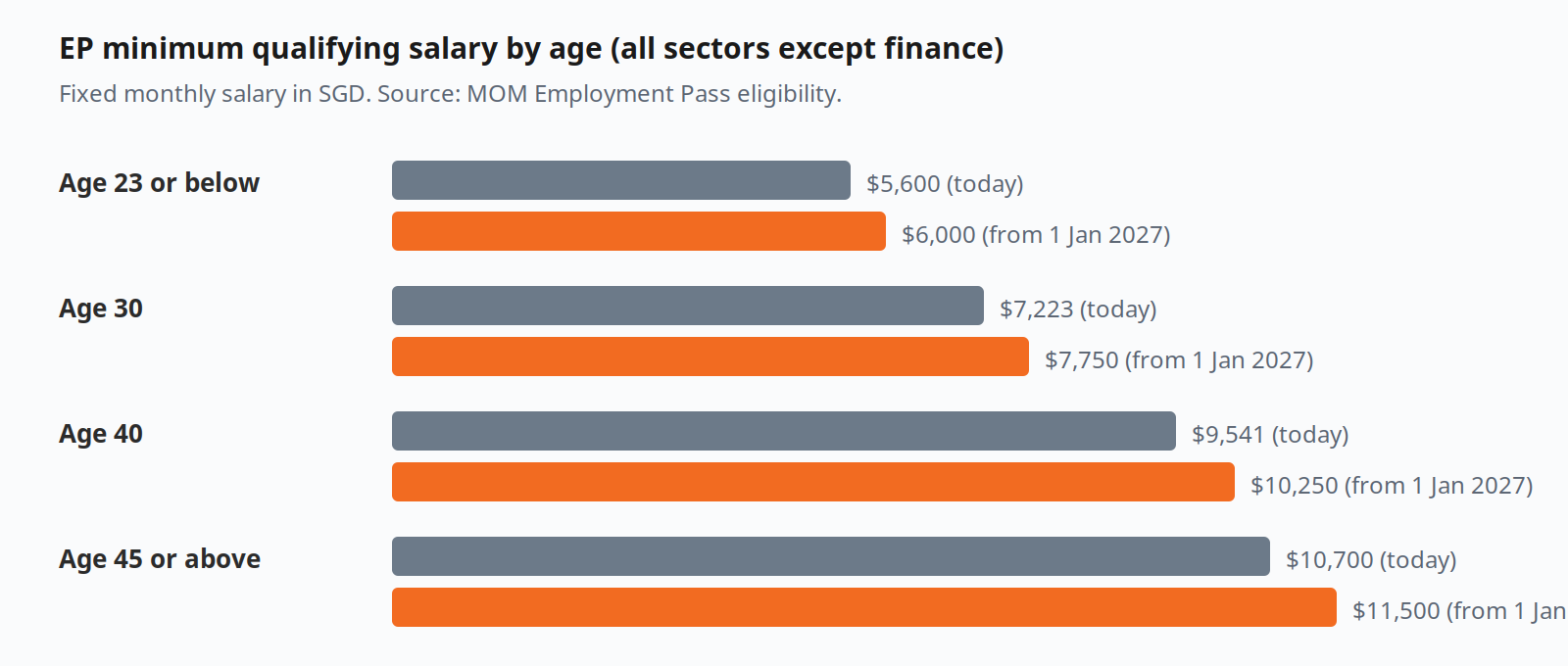
Both roles typically need EP for foreign hires. Current EP minimum:
- Age 23 or below: SGD 5,600 (rises to SGD 6,000 from 1 Jan 2027).
- Age 30: approx SGD 7,200 (rises to approx SGD 7,750).
- Age 40: approx SGD 9,500 (rises to approx SGD 10,250).
- Age 45+: SGD 10,700 (rises to SGD 11,500).
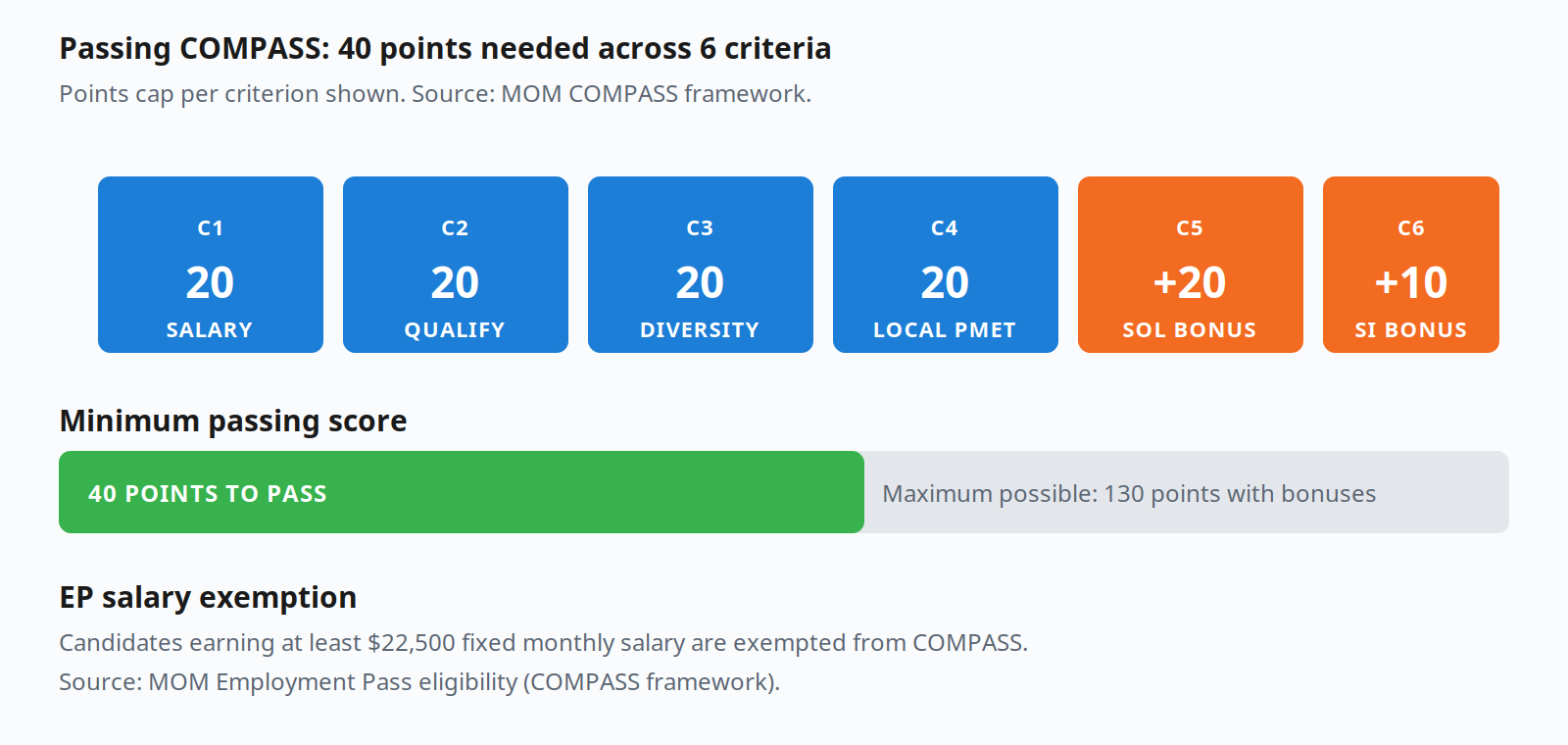
Both roles also need to pass COMPASS, unless the candidate earns at least SGD 22,500 fixed monthly and is exempted. Related reading: COMPASS scoring explained.
Recruiting either role in 2026?
Corestaff runs manufacturing engineer and production manager searches across Singapore semiconductor, precision engineering, and general manufacturing. Book a scoping call.
2026 Salary Bands Compared
| Level | Manufacturing Engineer | Production Manager |
|---|---|---|
| Junior (0-3y) | 4,200 to 5,200 | 4,800 to 6,200 (as line supervisor) |
| Mid (3-7y) | 5,600 to 7,500 | 6,500 to 9,000 |
| Senior (7-12y) | 7,800 to 10,500 | 9,000 to 12,500 |
| Principal / Manager+ (12y+) | 10,500 to 14,000 (Principal Engineer) | 12,500 to 18,000 (Sr Prod Manager) |
Which Role Should You Hire First
If you are ramping a new line: production manager first. They will set shift patterns and hire the team.
If you are optimising an existing line: manufacturing engineer first. They will run yield and OEE improvements while the production manager keeps output steady.
If you are moving to a new technology node or process: hire both together but stage the start dates one month apart to prevent scope collision.
Career Path Between the Two
The classic Singapore manufacturing career transition is engineer to production manager after 5 to 7 years, then to plant manager after another 5 to 8 years. The other direction (production manager back to engineering) is unusual and usually driven by burnout, not preference.
Related reading: Singapore manufacturing salary guide, Industry 4.0 hiring, semiconductor hiring guide.
EDB Semiconductor Context and What It Funds
Per EDB, the Budget 2026 semiconductor R&D flagship commits SGD 800 million to deepen high-impact tech capabilities. Per EDB Semiconductor Talent, Singapore continues to develop the talent pipeline through partnerships with local universities, polytechnics, and the semiconductor industry.
The funding covers four capability layers:
- Process technology R&D for advanced nodes and specialty processes.
- Equipment and integration R&D in partnership with global tool vendors.
- Advanced packaging (2.5D, 3D, chiplet) with a strong Singapore anchor.
- Talent development at undergraduate, postgraduate, and mid-career conversion.
MTI Manufacturing Trajectory (Q1 to Q2 2026)
Per MTI’s Q2 2026 GDP release, Singapore’s manufacturing sector grew 12.2% year-on-year in Q2 2026, accelerating from 8.0% in Q1. Overall Q2 GDP was +5.9% YoY. The 2026 GDP forecast has been maintained at 2.0 to 4.0% per MTI, though downside risks have risen.
What this signals for hiring:
- The demand backdrop is stronger than the mid-cycle forecast suggested.
- Semiconductor is the dominant contributor within manufacturing; other sub-sectors also positive.
- Counter-offer pressure on incumbents is elevated. Retention budgeting matters as much as new-hire budgeting.
MOM Rules Specific to Manufacturing Employers
Manufacturing sits under a distinct MOM classification with different quota and levy rules from services:
- Manufacturing DRC 60% per MOM. Compared to services (35%) and construction (83.3%), manufacturing has materially more foreign-hire headroom.
- PRC sub-quota 25% of total workforce for manufacturing (services: 8%).
- S Pass levy SGD 650 flat per MOM S Pass levy, no tier optimisation possible.
- LQS thresholds apply the same way: local at SGD 1,800+ counts as 1.0; SGD 900 to SGD 1,800 counts as 0.5.
Employers who move plants between services and manufacturing classifications should confirm current classification with MOM before hiring at scale.
How Corestaff Runs This Category of Search
Every Corestaff mandate in Singapore follows the same underlying process discipline, adapted to the role:
- Discovery call (day 0 to 1). A 30-minute call to lock scope, must-haves, salary band, and MOM pass eligibility. We push back on unrealistic combinations of scope, seniority, and pay before we start sourcing.
- Compliance check (day 1 to 2). We verify DRC headroom, appropriate pass type (EP, S Pass, or Work Permit), and any sector-specific requirements.
- Sourcing (day 2 to 10). Active outreach across our network plus MyCareersFuture posting where the Fair Consideration Framework requires it for new EP roles. Structured screens against must-haves.
- Shortlist (day 10 to 14). 3 to 5 candidates presented with a written summary matched to your must-haves, plus salary expectation, notice period, and any pass-eligibility flags.
- Client interviews (day 14 to 25). We coordinate the panel, collect structured feedback, and keep candidates warm through the cycle. Two rounds maximum for most roles; three for senior mandates.
- Offer and close (day 25 to 35). We handle counter-offer defence, notice-period navigation, and start-date logistics. Guarantee clock starts on day one.
Where a mandate needs to run confidentially, we adapt the sourcing (outbound only) and disclosure discipline (client identity gated behind NDA) without changing the process backbone.
Why Every Fact in This Article Is Sourced to a Singapore Government Page
Recruitment content on the internet is full of confident-sounding numbers with no traceable origin. Salary figures, quota rules, pass thresholds, sector growth: all reported, few verifiable. Corestaff’s editorial rule is that any load-bearing fact must trace to a Singapore government page (MOM, EDB, MAS, MTI, IMDA, BCA, CPF Board) with an inline citation link. Where a claim cannot be sourced to a .gov.sg page, we drop the claim rather than dress it up as an estimate. This is more work; it is also why Corestaff’s content survives fact-checking by hiring managers, CFOs, and audit teams. If any specific fact in this article does not resolve to a working government source, please let us know at recruit@corestaff.com.sg and we will fix it.
Frequently Asked Questions
Can one person do both roles in a small plant?
Which role has better career progression?
How does the 2027 EP change affect these hires?
Do both roles need Six Sigma?
Conclusion: What to Do Next
Manufacturing engineer and production manager solve different bottlenecks. Match the hire to the bottleneck you have.
Hire the right role for your bottleneck, not the JD library
Corestaff runs recruitment sprints for Singapore employers across executive search, professional and mid-market hiring, and skilled-trade sourcing. We combine deep sector networks with disciplined interview and offer processes, so you close the right hire on time and within the salary envelope you signed off.
Book a Free Scoping Call →
Learn about Manufacturing Recruitment
Phone: +65 6288 6866 ·
Email: recruit@corestaff.com.sg
Address: 175A Bencoolen Street #11-05 Burlington Square, Singapore 189650
Web: www.corestaff.com.sg