
Before signing with an agency, most employers run the same searches and ask the same question: what should this cost. The honest answer is that it depends on the model, and choosing the wrong model costs far more than negotiating the rate. A five per cent difference on a percentage fee is noise next to a placement that was never aligned to how you actually hire.

This is a framework guide. It explains how the four main recruitment fee models work, what to check in a written quote, and where the risk sits in each. Corestaff publishes its own bands to clients on request and in writing. For the wider selection process, see our our recruitment and staffing services overview and the selection toolkit below. Our staffing and search teams bill under the models described here, including temporary and contract staffing and executive search, so the quote and the terms arrive together.
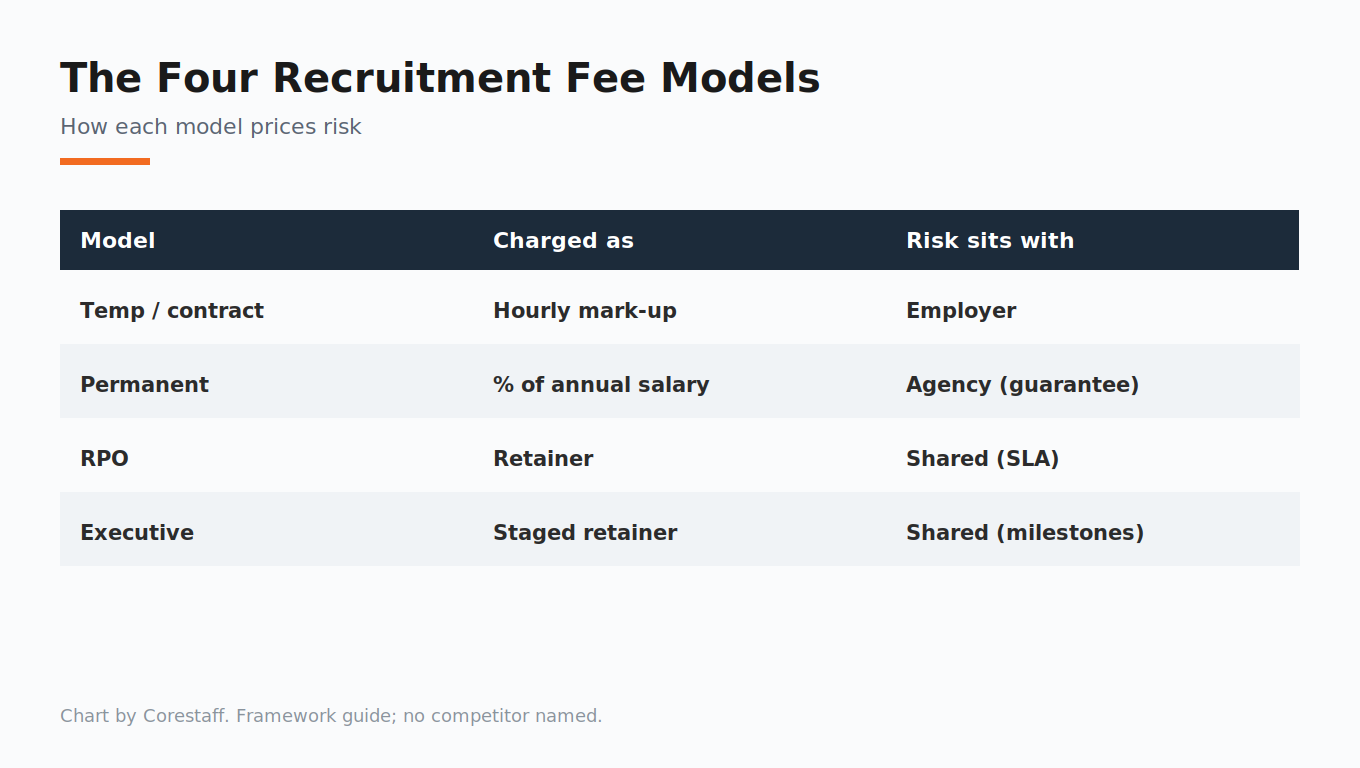
The four fee models at a glance

| Model | How you are charged | Where risk sits |
|---|---|---|
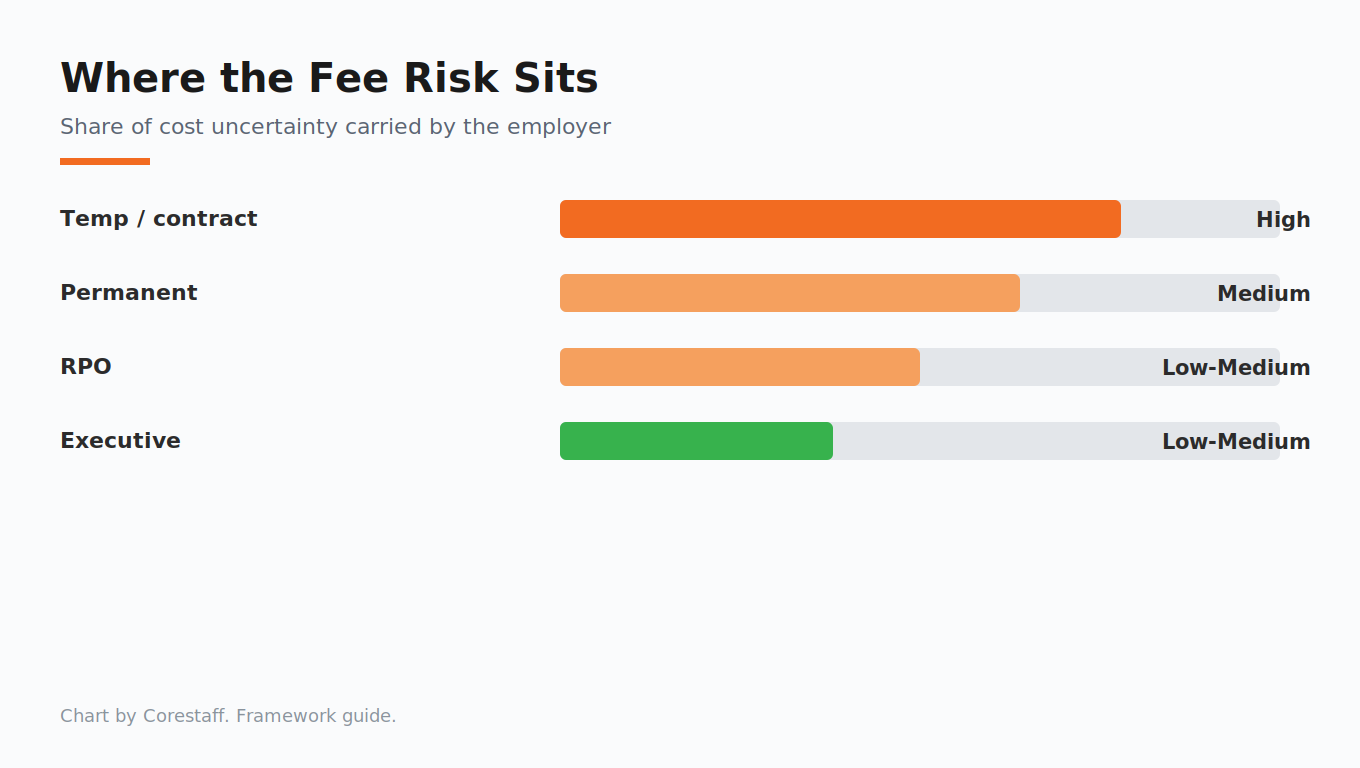
| Temporary and contract | An hourly or daily mark-up over the worker’s pay rate | Employer, who pays for hours worked |
| Permanent placement | A percentage of the placed candidate’s annual salary | Agency, until the guarantee window closes |
| RPO and managed hiring | A retainer or management fee for the function | Shared, governed by the SLA |
| Executive and retained search | Staged retainers across the search | Shared, with milestone deliverables |
Temporary and contract staffing
Contingent workers are billed as a mark-up on the worker’s pay rate, and everything of value sits inside that mark-up: employer CPF and levy obligations where relevant, insurance, leave accrual and the agency’s margin. Compare the all-in hourly rate, not the margin, because a lower mark-up applied to a higher pay rate is not cheaper. Ask what the rate includes for public holidays, no-shows and overtime, because those three items move the effective cost more than the headline margin.
Permanent placement
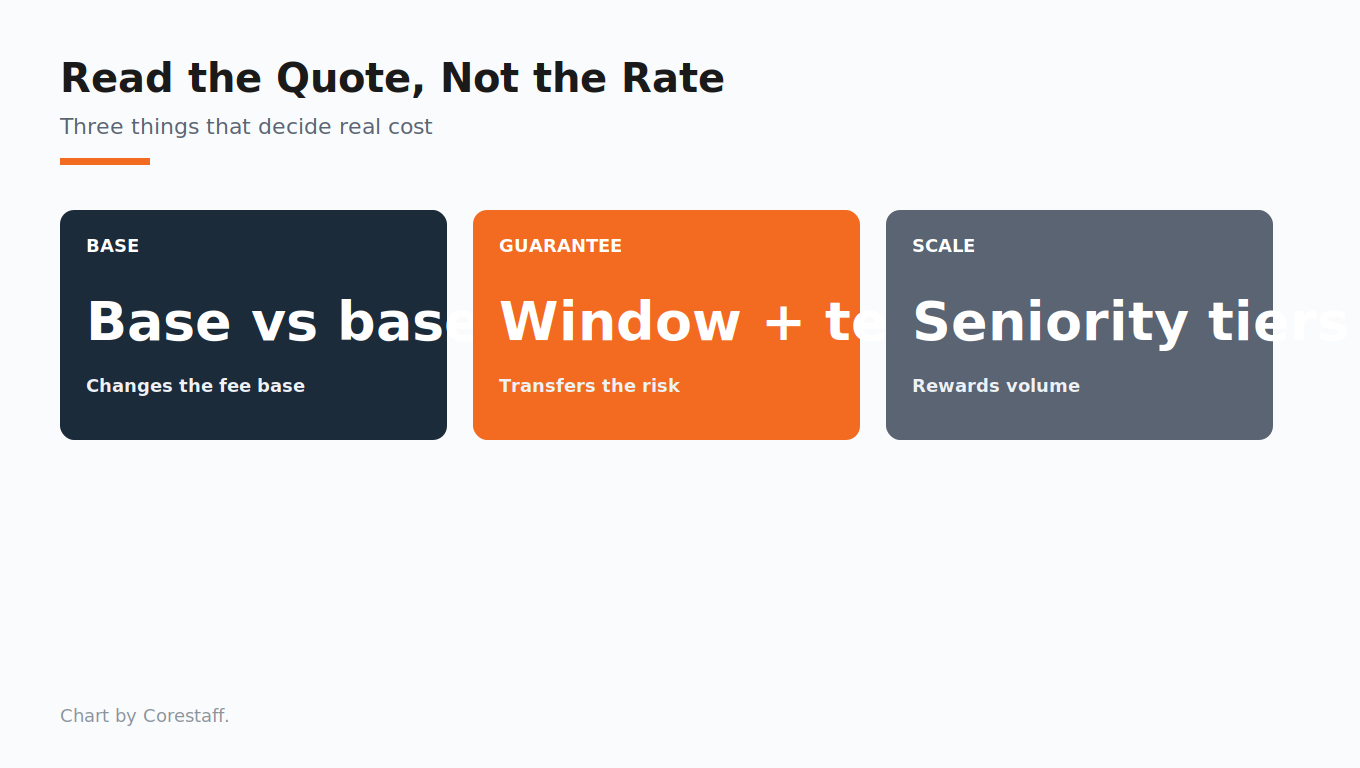
Permanent fees are quoted as a percentage of annual salary, typically inclusive of a guarantee period. Three questions decide the real cost: whether the percentage applies to base salary or to base plus fixed bonus, whether there is a sliding scale by seniority, and what the replacement guarantee actually covers. A fee quoted on total cash compensation can be materially higher than the same percentage on base, so make sure you are comparing like with like. Read our full guide to the recruitment SLA and replacement guarantee before you sign.
RPO and managed hiring
Recruitment process outsourcing suits employers with recurring volume, where the cost of managing many single placements starts to exceed the cost of managing a function. The fee is a retainer, and the value is in the SLA, not the rate. Insist on named deliverables: time-to-shortlist, quality-of-hire measures and replacement terms. If you are weighing this model against building an internal team, our RPO versus in-house cost analysis sets out the trade-offs.
Executive and retained search
Retained search is staged, because the work is research-heavy and the mandate is confidential. You are paying for a market map and a shortlist, not a database search. The fee structure should tie each stage to a deliverable, so the final instalment lands on placement, not on the start of the search. A supplier that asks for a third of the fee before doing any research is selling access, not search.
How to read a written quote
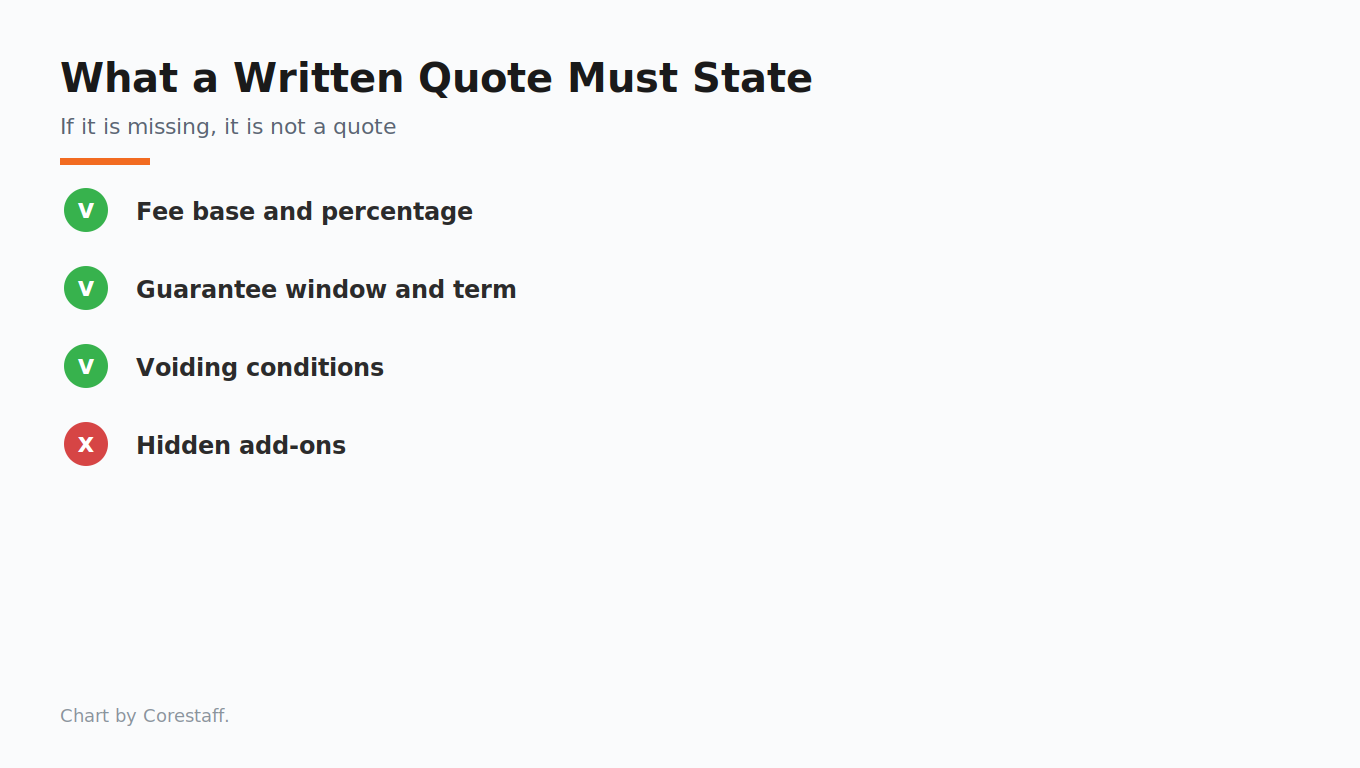
A written quote should let you compare suppliers without a follow-up call. Check four things.
- The charge basis. Is the percentage or mark-up applied to base, to base plus fixed bonus, or to total cash compensation?
- The guarantee. A stated replacement window, a stated replacement term, and the conditions that void it.
- The inclusions. Advertising, assessment, background screening and onboarding, or billed separately?
- The assumptions. An expected time-to-shortlist and a definition of a qualified candidate.
Get a written quote with the terms attached
Corestaff publishes clear fee bands across temp, perm, RPO and executive, and every quote states the guarantee window and replacement terms in writing.
Frequently asked questions
Is a lower percentage always cheaper?
No. The base the percentage applies to, and the guarantee that comes with it, matter more than the headline rate. A low percentage on total cash compensation can cost more than a higher percentage on base.
What should a permanent placement guarantee cover?
A defined replacement window, a stated replacement term, and clearly stated conditions under which the guarantee is void, such as a material change to the role after placement.
Why is retained search more expensive than contingency?
Because the agency is paid for research and market mapping delivered before a placement, rather than solely on a successful hire.
Should I use one agency or several?
For volume or specialist work, a single accountable partner with an SLA usually beats multiple contingency suppliers, who compete on speed rather than fit.
Related reading
Talk to Corestaff about this
Corestaff Pte Ltd is a Singapore employment agency, a trusted hiring partner since 2015, holding Employment Agency Licence 18C9027 under UEN 201633744E. If you want this article applied to your own workforce, our consultants will model it with you.
- Call: +65 6288 6866
- Email: recruit@corestaff.com.sg
- Visit: 175A Bencoolen Street, #11-05 Burlington Square, Singapore 189650
- Send a brief: Contact Corestaff · corestaff.com.sg