
Direct Answer
Reducing attrition in Singapore 24/7 manufacturing is a policy-alignment problem, not a wages problem. The employers who hold their workforce through 2026 and 2027 combine five specific levers: shift-structure clarity in the first 14 days; wage progression funded by PWCS at 30% co-funding through 2028; renewal certainty for S Pass and Work Permit staff; skills investment via SkillsFuture Workforce Development Grant (up to 70% of costs, capped SGD 150,000); and senior worker retention supported by the retirement age rising to 64 from July 2026.
What the Numbers Actually Say About Singapore Manufacturing Retention
Singapore’s manufacturing workforce is a mix of local PMEs, work-pass professionals, S Pass technicians, and Work Permit operators. Retention interventions differ sharply across these groups because the policy framework differs.
For locals: CPF and retirement age changes matter
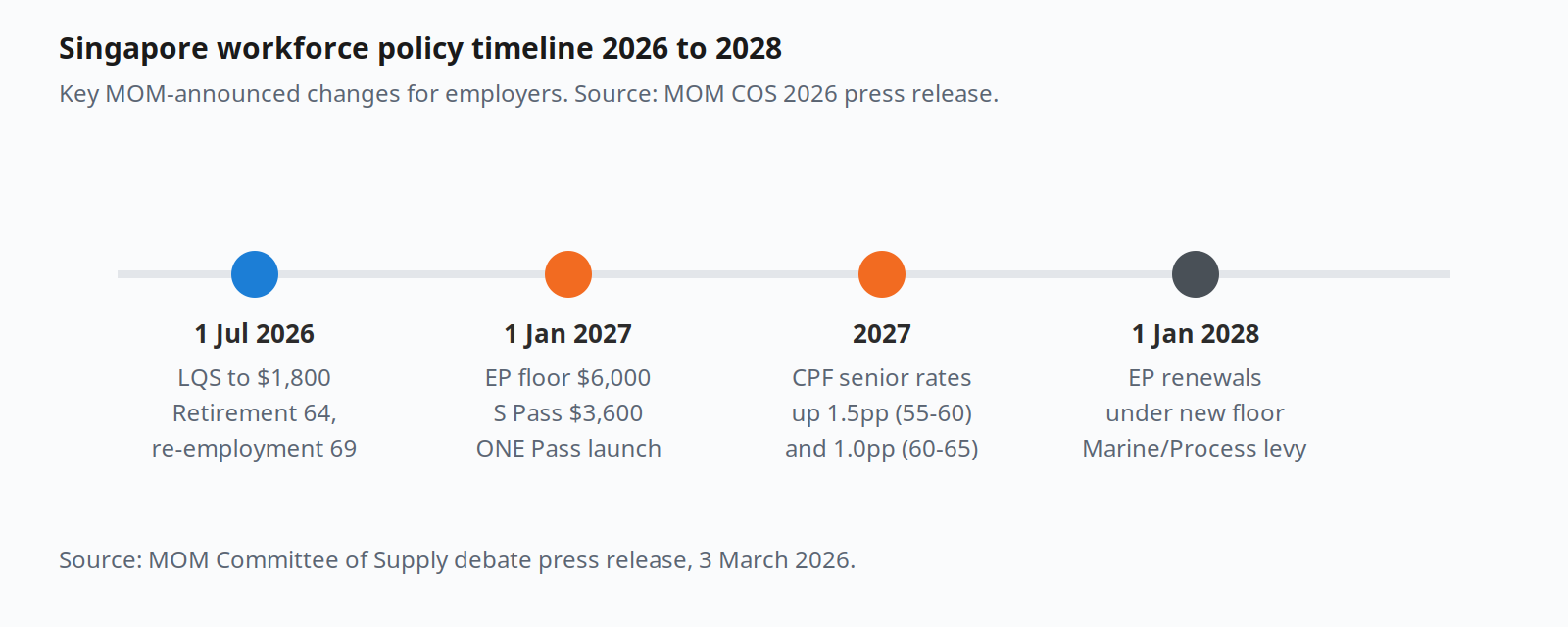
At MOM’s COS 2026 debate, the government announced retirement age rising to 64 and re-employment age to 69 from 1 July 2026. The Senior Employment Credit was extended to December 2027, with the top wage-support tier of 7% applying to workers aged 69+. CPF contribution rates for senior workers aged >55 to 60 rise by 1.5 percentage points, and for those aged >60 to 65 by 1 percentage point, from 2027.
For lower-wage locals: LQS and Progressive Wage Credit
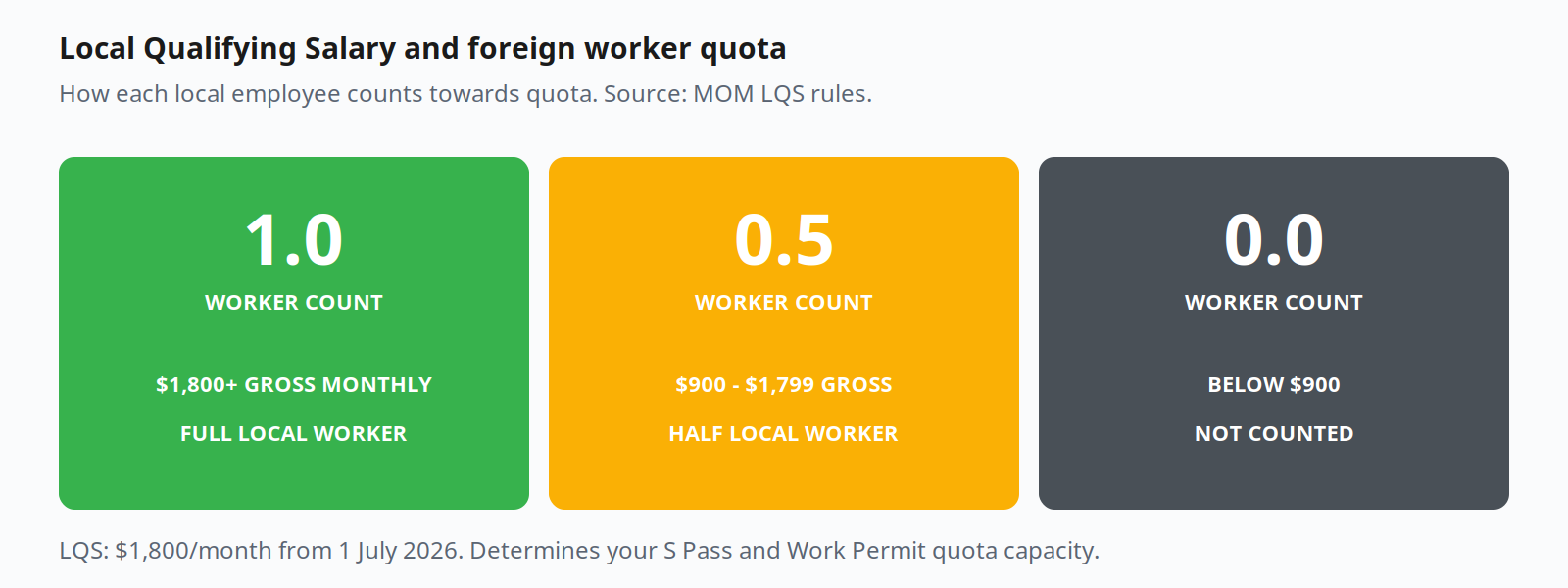
The LQS rose to SGD 1,800 from 1 July 2026. PWCS was extended to 2028 with co-funding at 30%.
For S Pass and Work Permit staff: pass duration and PCP structure
S Pass durations are up to 2 years for first-time candidates and up to 3 years for renewals. Employers must provide medical insurance and, for workers in dormitories or CMP sectors, purchase the Primary Care Plan.
📉 Attrition running above 20% in your 24/7 shift operations?
Corestaff runs retention diagnostics on Singapore manufacturing employers, mapping attrition drivers against wage structure, work-pass renewal timing, and shift design.
Five Retention Levers That Actually Work in 24/7 Manufacturing
| Lever | Target group | Government funding available? |
|---|---|---|
| 1. Shift structure clarity (first 14 days) | All new joiners | No (operational) |
| 2. Wage progression tied to PWCS | Lower-wage locals | Yes: PWCS 30% co-funding |
| 3. Renewal certainty for S Pass/WP staff | Foreign workers | No (policy communication) |
| 4. Skills investment via SkillsFuture | All existing staff | Yes: WDG(JR+) up to 70% |
| 5. Senior worker re-employment | Workers 55+ | Yes: SEC top tier 7% |

How to Sequence Interventions Across a Fiscal Year
Q1: Wage architecture review
Audit local base against the LQS of SGD 1,800 monthly (from 1 July 2026) and foreign base against the 2027 EP floor of SGD 6,000 and the 2027 S Pass floor of SGD 3,600.
Q2: Renewal criteria publication
Employees should know at month 18 or month 30 whether they are on track for renewal.
Q3: Skills investment
Deploy SkillsFuture Workforce Development Grant (Job Redesign+) projects.
Q4: Retention diagnostic and next-year plan
Formal attrition review by pass class, shift, and role family.
🔬 Not sure which lever gives you the fastest attrition drop?
We run 30-day retention audits and hand you a prioritised action plan.
The Compounding Effect of Doing All Five Right
Individual retention interventions typically drop attrition by 3-8 percentage points. Combined across all five levers, employers routinely see 15-25 percentage point drops within one fiscal year. Renewal uncertainty amplifies shift dissatisfaction; wage stagnation compounds with skills stagnation. Fixing one dimension pulls others down.
What Fails
- Wage-only interventions. Above a floor, wages do not fix attrition. Shift design, renewal clarity, and skills progression do.
- Uniform retention plans across pass classes. S Pass and Work Permit staff need different interventions than locals.
- Delayed onboarding. Waiting until week 4 for the first proper supervisor conversation is too late.
Frequently Asked Questions
What is the Progressive Wage Credit Scheme co-funding rate?
When does the LQS rise to SGD 1,800?
What is the Senior Employment Credit top tier?
What is the S Pass duration?
- MOM, COS 2026 press release
- MOM, Local Qualifying Salary
- MOM, S Pass key facts
- MOM, EP eligibility
How the CPF Transition Offset Reduces Employer Cost Through 2027
The CPF contribution rate increases for senior workers in 2027 might sound like a headwind for employers of an aging workforce, but MOM’s COS 2026 announcement pairs them with the CPF Transition Offset extended to December 2027, covering 50% of the employer CPF increase in 2027. Combined with the extended Senior Employment Credit (top tier 7% for workers 69+), the net-of-subsidy cost of retaining a 60-plus year-old worker in 2027 is often lower than the cost of hiring and training a replacement. Retention through re-employment becomes cheaper than replacement.
A Note on Attrition Measurement
Employers should measure attrition at three separate levels because the drivers differ:
- Local PMET attrition is typically career-progression driven; SkillsFuture-funded upskilling is the primary lever.
- S Pass attrition is typically renewal-uncertainty driven; publishing clear renewal criteria at day 30 is the primary lever.
- Work Permit attrition is typically shift-design driven; the first 14 days of onboarding determine month-three retention.
Combined attrition tracking obscures which lever is failing. Split the metric.
The Full 2027 CPF and Retirement Age Timeline for Employers
Three interlinked changes take effect in the 2026-2027 window that manufacturing employers must plan for:
1 July 2026: retirement and re-employment age rise
The retirement age rises to 64 and re-employment age to 69. Employees who reach the current retirement age of 63 after 30 June 2026 will be able to continue working under the new higher ceiling.
2027: CPF senior worker contribution rate increases
CPF employer and employee contribution rates for senior workers aged over 55 to 60 rise by 1.5 percentage points, and for those aged over 60 to 65 by 1 percentage point. The CPF Transition Offset covers 50% of the increase in employer CPF contributions in 2027.
December 2027: Senior Employment Credit expires (unless further extended)
The Senior Employment Credit was extended to December 2027 at the current announcement. Top tier of 7% wage support applies to workers aged 69+. Employers should plan retention interventions to compound before this expiry.
How to Structure a Retention Diagnostic in 24/7 Operations
A useful diagnostic breaks the workforce into six segments and runs attrition analysis on each separately:
- Local PMEs (career progression driven)
- Local operators earning above LQS (wage progression and shift design)
- Local operators earning below LQS (should not exist under quota rules; if they do, wage restructure)
- S Pass holders in first-time 2-year term (renewal clarity)
- S Pass holders on renewal (shift design and career conversion)
- Work Permit holders (living arrangements and PCP quality)
Combining these into a single attrition metric obscures the actual driver. Splitting them reveals which lever gives the fastest return.
Conclusion: What to Do Next
Attrition in Singapore 24/7 manufacturing is a policy-alignment problem. Every retention lever above is a government scheme employers can use today.
Reduce 24/7 manufacturing attrition with Corestaff
Corestaff runs recruitment sprints for Singapore employers across executive search, professional and mid-market hiring, and skilled-trade sourcing. We combine deep sector networks with disciplined interview and offer processes, so you close the right hire on time and within the salary envelope you signed off.
Book a Free Scoping Call →
Learn about Manufacturing Recruitment
Phone: +65 6288 6866 ·
Email: recruit@corestaff.com.sg
Address: 175A Bencoolen Street #11-05 Burlington Square, Singapore 189650
Web: www.corestaff.com.sg