
Direct Answer
Mass hiring in Singapore manufacturing (20 to 200 hires in a compressed window) works when you respect three government-set constraints: the LQS quota rule (SGD 1,800 monthly for a local to count as 1 full worker), the 2027 EP floor of SGD 6,000, and the S Pass floor rising to SGD 3,600. Employers who audit their LQS-adjusted local count before advertising, source local and foreign candidates in parallel, and use structured mass interviews close 80-plus hires in 6 to 8 weeks. Employers who copy generic playbooks lose weeks to rework and quota rejections.
The Local Qualifying Salary Is the Foundation of Every Manufacturing Quota Calculation
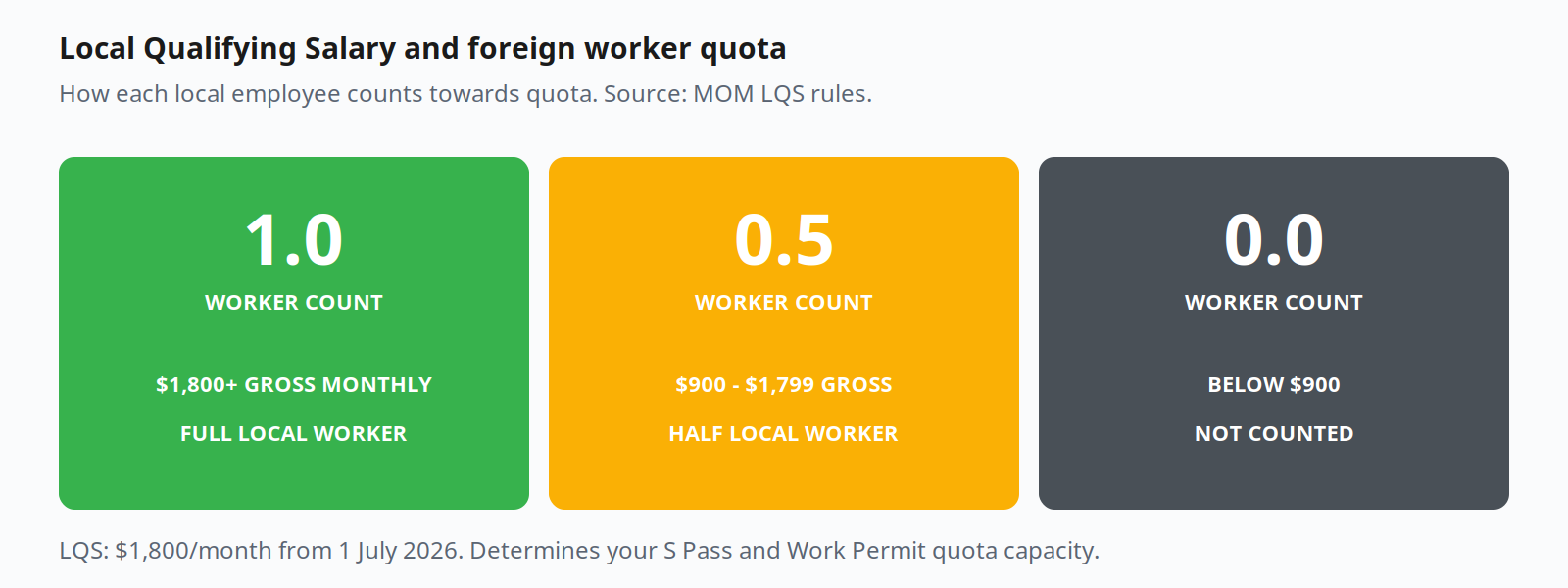
Under MOM’s Local Qualifying Salary (LQS) rule, only local workers earning at least SGD 1,800 gross per month count as one full local worker for quota purposes. Locals earning SGD 900 to below SGD 1,800 count as 0.5 workers. Anyone paid below SGD 900 does not count towards quota at all. That means the salary offered to your local base directly caps how many S Pass and Work Permit hires you can bring on.
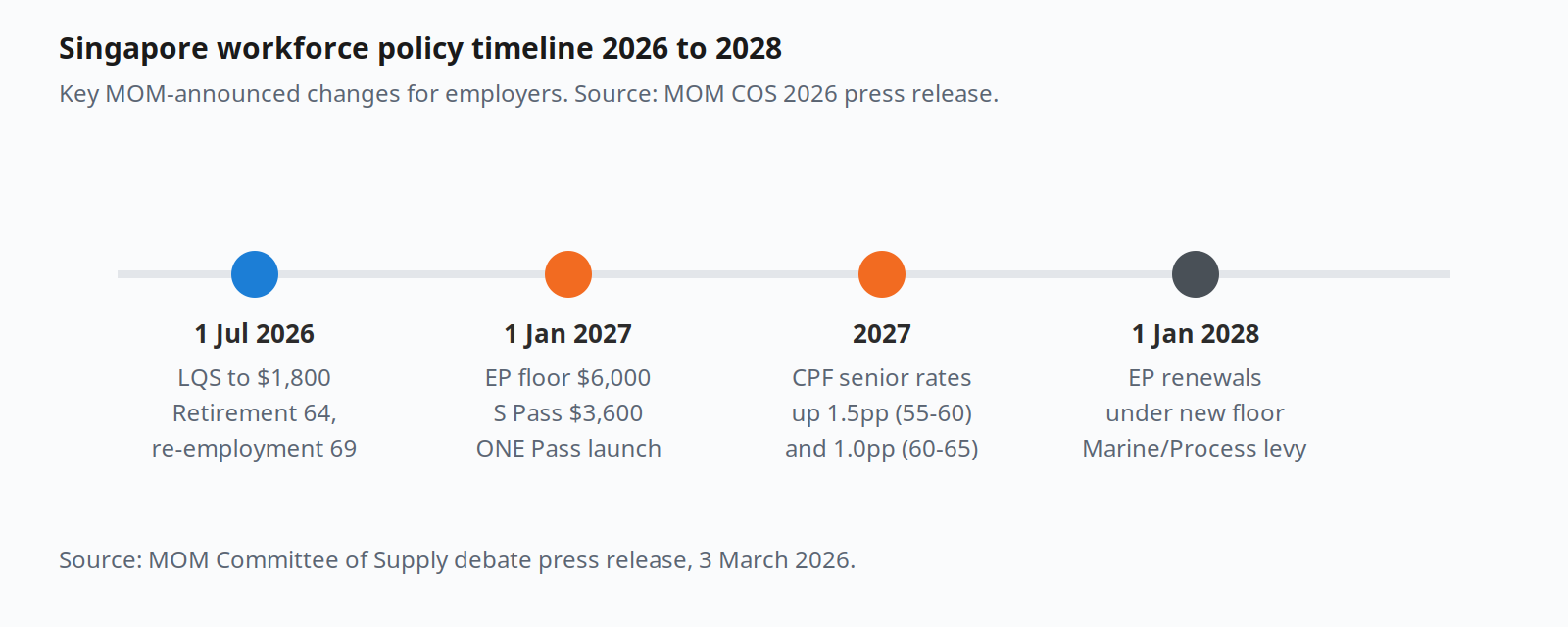
The LQS rose to SGD 1,800 from 1 July 2026, announced at MOM’s Committee of Supply debate on 3 March 2026. The Progressive Wage Credit Scheme was extended to 2028 at 30% co-funding, with the qualifying wage increase raised from SGD 100 to SGD 200 from 2027, so there is government support to run wage increases in a mass hiring context.
What Actually Breaks in Mass Hiring Without Structure
Volume without process becomes offer-declines and no-shows
Employers running a mass sprint without a structured interview funnel routinely see 20% to 40% no-show at day one. The candidate accepted a role elsewhere between offer and start date because the offer cycle was too slow.
Quota mistakes create rework and cost
Applying for S Pass or Work Permit hires against an incorrectly counted local base is a common error. MOM’s system will reject or delay applications, and employers often only find out after several rejections.
Retention is decided at week one, not week 12
Mass hire retention is largely a function of onboarding quality and shift structure clarity in the first 14 days.
🏭 Running a Singapore manufacturing mass hire in Q4 2026?
Corestaff has closed 80+ hire mass sprints in Singapore semiconductor and precision manufacturing, from workforce planning through onboarding. We map your LQS-adjusted quota, source S Pass and Work Permit candidates in parallel, and manage the full offer cycle.
How a Structured Mass Hiring Sprint Actually Runs
- Workforce plan against real quota. LQS-adjusted local count is confirmed. Any gap flagged before job advertising begins.
- Parallel sourcing. Local outreach and foreign-worker sourcing run at the same time, not sequentially.
- Structured mass interviews. Batch interviews with pre-set assessment criteria.
- Offer sequencing. Offers scheduled to keep in-principle approvals and PCP purchases aligned with intended start dates.
- Onboarding handoff. Day-one, day-seven, day-30 check-ins.
- Continuous replenishment. Passive candidate map keeps replacements close in weeks, not months.

The Employer-Side Compliance Checklist for Every Mass Hire
| Compliance item | Source of rule | When it applies |
|---|---|---|
| Fair Consideration Framework advertising | MOM EP eligibility | Before every new EP application |
| LQS-adjusted local worker count | MOM LQS | Before every S Pass and Work Permit application |
| S Pass Primary Care Plan (PCP) | MOM S Pass key facts | Dormitory or CMP-sector workers |
| Medical insurance | MOM S Pass | Every S Pass holder before pass issuance |
| Progressive Wage Model wages | MOM PWM/LQS | All locals covered by sectoral PWM |
Government Support Levers to Layer On
- SkillsFuture Workforce Development Grant (Job Redesign+). Up to 70% of project costs, capped at SGD 150,000 per company.
- Progressive Wage Credit Scheme (PWCS). Extended to 2028 at 30% co-funding.
- Senior Employment Credit. Extended to Dec 2027; top tier of 7% wage support for workers aged 69+.
Frequently Asked Questions
What is Singapore’s Local Qualifying Salary in 2026?
How does LQS affect S Pass and Work Permit quota?
How long does a Singapore mass hiring sprint take?
What is the Fair Consideration Framework?
- MOM, Local Qualifying Salary
- MOM, COS 2026 press release
- MOM, EP eligibility
- MOM, S Pass key facts
What the July 2026 LQS Increase Actually Changes
The MOM COS 2026 announcement raised the Local Qualifying Salary to SGD 1,800 monthly from 1 July 2026. For mass-hiring employers this is not just a wage floor; it directly determines how many S Pass and Work Permit hires you can bring on.
Consider a plant with 40 local operators earning between SGD 1,650 and SGD 1,800 monthly. Before 1 July 2026, all 40 counted as full local workers. After 1 July 2026, only those earning at least SGD 1,800 count as full workers; the rest drop to half. If the plant is heavily reliant on foreign workers, that shift could trim quota capacity by 15 to 25% without a single hiring decision being made. The employers who plan ahead are running wage restructures during Q2 2026, funded partly by the extended Progressive Wage Credit Scheme at 30% co-funding through 2028.
Sequencing Foreign Hires Against the 2027 EP Renewal Cliff
EP renewals expiring from 1 January 2028 fall under the new SGD 6,000 floor (SGD 6,600 for financial services). For employers running a mass sprint in H2 2026, this means every EP hire brought on now will hit the new renewal floor in 2028. Two implications for the sprint design:
- Offer letters should be written at the 2027 age-adjusted salary, not the current one. The delta is only SGD 400 to SGD 800 monthly, but ignoring it forces awkward salary uplifts at year 2.
- For roles under 24 months, contract engagement often works out cheaper than permanent EP hiring. See our overview of temp and contract staffing structures for the underlying economics.
The Non-Traditional Source Occupation List Expansion
From September 2026, MOM is expanding the Non-Traditional Source Occupation List (NTS-OL) by adding eight new occupations across social services, food services, and air transportation. For mass-hiring employers in these sectors, this opens sourcing from non-traditional markets for roles where local supply is limited. Sprint plans starting Q4 2026 should factor this expansion into candidate sourcing strategy.
Conclusion: What to Do Next
Mass hiring in Singapore manufacturing is not just a scale problem, it is a compliance and sequencing problem. Employers that respect LQS, sequence work-pass sourcing in parallel, and invest in structured onboarding close mass sprints in 6-8 weeks.
Run your next mass hire with Corestaff
Corestaff runs recruitment sprints for Singapore employers across executive search, professional and mid-market hiring, and skilled-trade sourcing. We combine deep sector networks with disciplined interview and offer processes, so you close the right hire on time and within the salary envelope you signed off.
Book a Free Scoping Call →
Learn about Manufacturing Recruitment
Phone: +65 6288 6866 ·
Email: recruit@corestaff.com.sg
Address: 175A Bencoolen Street #11-05 Burlington Square, Singapore 189650
Web: www.corestaff.com.sg