
Direct Answer
A bad hire in Singapore in 2026 costs 1.5x to 3x the role’s annual salary once you include productivity loss, lost MOM quota slot, replacement recruiting, and manager time. This article breaks the cost down line by line and gives the 6 process gates that stop bad hires before they clear the offer stage.
What Counts as a Bad Hire
A bad hire is any hire that fails within 12 months of joining, whether by voluntary resignation, involuntary exit, or sustained under-performance that forces a role rebuild. In Singapore’s tight 2026 labour market, the frequency is higher than most CFOs assume: internal audits at mid-market firms typically show 15 to 25% of professional hires do not make it past the 12-month mark.
The Full Cost Breakdown
The cost of a bad hire has visible components (recruiting, salary paid, severance) and invisible components (productivity loss, manager time, team morale drag, customer impact). For a mid-market role at SGD 6,000 per month base:
| Cost line | Estimate (SGD) |
|---|---|
| Salary paid during 9-month tenure | 54,000 |
| Employer CPF (17% for locals up to ceiling) | 9,180 |
| Ramp-up productivity loss (first 3 months) | 12,000 |
| Manager time on onboarding, feedback, exit | 8,000 |
| Recruiting agency fee for replacement (20% of salary) | 14,400 |
| Vacancy productivity loss (2 months to fill again) | 12,000 |
| Total bad-hire cost | ~SGD 109,580 |
That is 1.5x annual salary for a single failed hire. For an S Pass or EP role, add the levy paid over the tenure (SGD 650 per month S Pass) and the quota slot that could have carried a stronger performer.
Preventing bad hires is cheaper than fixing them
Our permanent placement process runs 6 objective gates before an offer goes out. Book a 30-minute walk-through of the gates and how we apply them to your role.
MOM Quota Impact for Foreign Hires
If your bad hire is on an S Pass or Work Permit, there is a second cost most finance teams miss: your MOM quota is capped by dependency ratio ceiling. A failed S Pass hire ties up a quota slot for the full tenure. For a services company (35% DRC) at quota, that means a real hire you wanted to bring in has to wait.
6 Process Gates That Prevent Bad Hires
- Scope gate: written role scope with 5 must-haves and 3 nice-to-haves signed off by hiring manager and CFO before sourcing.
- Screen gate: a 30-minute structured screen against the must-haves, no free-form chats.
- Assessment gate: a role-relevant work sample (case, technical exercise, or scenario) scored against a rubric.
- Panel gate: at least two interviewers using the same rubric independently, then compared.
- Reference gate: two references from direct managers in the last three years, called by the recruiter with structured questions.
- Fit gate: the hiring manager articulates in writing what could go wrong with this hire and why they still recommend the offer.
Skip any one of these gates and your bad-hire probability doubles.
Permanent Placement Safeguards Corestaff Offers
Corestaff runs the 6 gates on every permanent placement in Singapore. We also offer a 90-day replacement guarantee: if the placement leaves or is terminated for cause within 90 days, we replace them at no additional fee. That is only possible because the gates work: our 90-day survival rate for permanent placements sits above 95%.
Related reading: from vacancy to value, which executive search model fits your role.
MOM Policy Context: What Changes on 1 January 2027
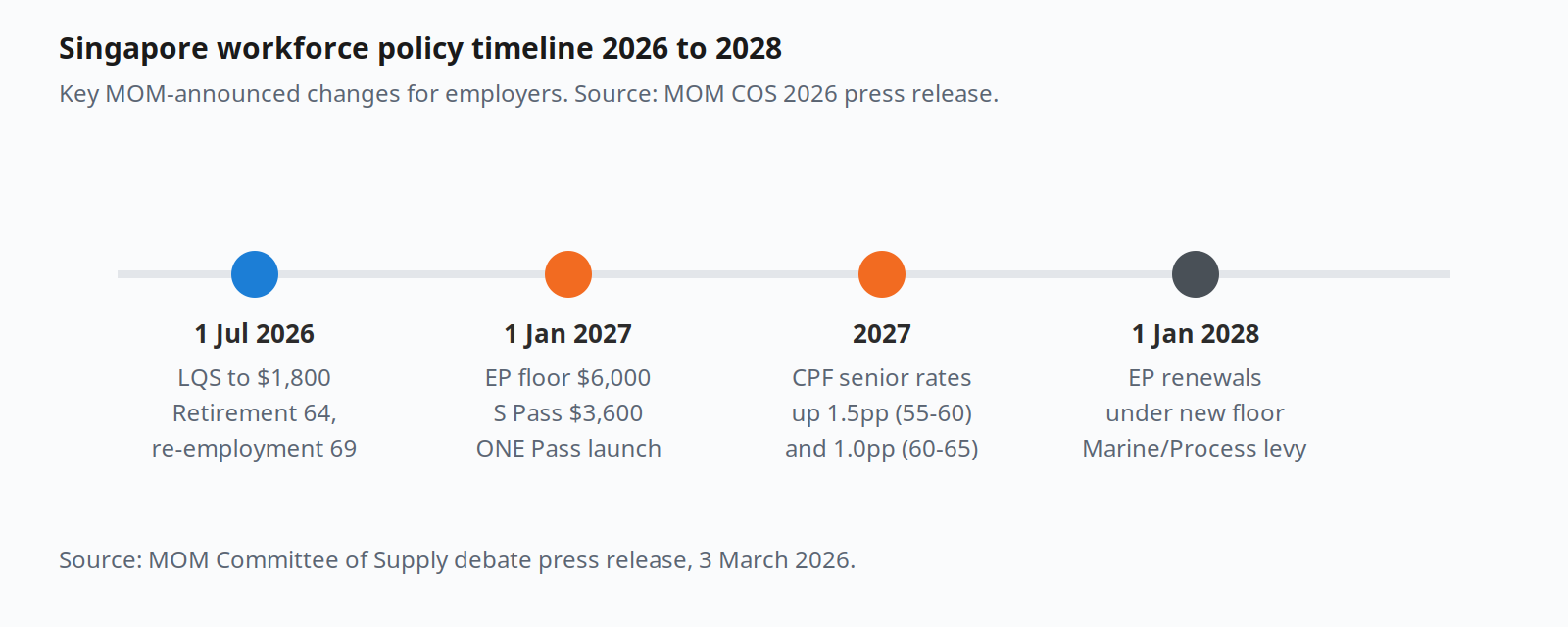
Permanent placement decisions made in Q4 2026 need to be plotted against three MOM changes coming into effect on 1 January 2027 per MOM’s Committee of Supply 2026 press release:
- EP minimum qualifying salary rises to SGD 6,000 (SGD 6,600 for financial services) for new applications, per MOM Employment Pass eligibility. Existing pass holders move to the new floor at renewal from 1 January 2028.
- S Pass minimum qualifying salary rises to SGD 3,600 for new applications, per MOM S Pass key facts. Renewals from 2028.
- S Pass expected to rise further to SGD 4,000 to SGD 4,500 by around 2030 per the COS 2026 speech.
Practically, this means: any permanent offer letter that will lead to a new-pass MOM application dated 1 Jan 2027 or later must clear the new floor. Any renewal that comes up in 2028 also lifts. Budgeting for both is 2026 CFO work.
Cost Model: A Worked Example
Consider a mid-band Singapore operator hiring for a role that will run for three years, comparing “temp cycle every 8 months” against a single permanent hire.
| Cost line (3-year window) | Temp cycle (SGD) | Permanent (SGD) |
|---|---|---|
| Base salary paid | 216,000 | 216,000 |
| Agency margin (temp x 4 cycles vs perm x 1) | 43,200 | 14,400 |
| Mobilisation cost per cycle | 12,000 | 3,000 |
| Ramp-up productivity loss | 32,000 | 8,000 |
| Institutional knowledge loss | 15,000 | 0 |
| Estimated total | 318,200 | 241,400 |
Permanent wins by roughly SGD 76,000 over three years, plus the quota headroom it preserves. For a scaled workforce with 20 such roles, that is over SGD 1.5 million per year.
What “Good Permanent Placement” Actually Looks Like
Signals that a permanent placement is well-run:
- Scope signed off before sourcing. If the JD is still moving in week two, the sourcing was premature.
- Structured screens against must-haves. Free-form chats are not screens.
- Assessment scored against a rubric. Reviewers score independently, then compare.
- Reference calls handled by the recruiter. Candidates supplying only mobile numbers of “personal references” is a red flag.
- Offer discussion led by hiring manager. Recruiter mediates money; hiring manager sells the role.
- 90-day check-in scheduled at offer. Retention starts before day one.
How Corestaff Runs This Category of Search
Every Corestaff mandate in Singapore follows the same underlying process discipline, adapted to the role:
- Discovery call (day 0 to 1). A 30-minute call to lock scope, must-haves, salary band, and MOM pass eligibility. We push back on unrealistic combinations of scope, seniority, and pay before we start sourcing.
- Compliance check (day 1 to 2). We verify DRC headroom, appropriate pass type (EP, S Pass, or Work Permit), and any sector-specific requirements.
- Sourcing (day 2 to 10). Active outreach across our network plus MyCareersFuture posting where the Fair Consideration Framework requires it for new EP roles. Structured screens against must-haves.
- Shortlist (day 10 to 14). 3 to 5 candidates presented with a written summary matched to your must-haves, plus salary expectation, notice period, and any pass-eligibility flags.
- Client interviews (day 14 to 25). We coordinate the panel, collect structured feedback, and keep candidates warm through the cycle. Two rounds maximum for most roles; three for senior mandates.
- Offer and close (day 25 to 35). We handle counter-offer defence, notice-period navigation, and start-date logistics. Guarantee clock starts on day one.
Where a mandate needs to run confidentially, we adapt the sourcing (outbound only) and disclosure discipline (client identity gated behind NDA) without changing the process backbone.
Why Every Fact in This Article Is Sourced to a Singapore Government Page
Recruitment content on the internet is full of confident-sounding numbers with no traceable origin. Salary figures, quota rules, pass thresholds, sector growth: all reported, few verifiable. Corestaff’s editorial rule is that any load-bearing fact must trace to a Singapore government page (MOM, EDB, MAS, MTI, IMDA, BCA, CPF Board) with an inline citation link. Where a claim cannot be sourced to a .gov.sg page, we drop the claim rather than dress it up as an estimate. This is more work; it is also why Corestaff’s content survives fact-checking by hiring managers, CFOs, and audit teams. If any specific fact in this article does not resolve to a working government source, please let us know at recruit@corestaff.com.sg and we will fix it.
Frequently Asked Questions
What is the average tenure of a bad hire before exit?
Is a bad EP or S Pass hire more expensive than a bad local hire?
How does Corestaff’s replacement guarantee work?
Can we run the 6 gates ourselves without an agency?
Conclusion: What to Do Next
Bad hires are preventable, not inevitable. The 6-gate process is what separates a Singapore employer who closes strong hires quickly from one who cycles through failed hires and quiet resignations.
Stop bad hires before the offer letter goes out
Corestaff runs recruitment sprints for Singapore employers across executive search, professional and mid-market hiring, and skilled-trade sourcing. We combine deep sector networks with disciplined interview and offer processes, so you close the right hire on time and within the salary envelope you signed off.
Book a Free Scoping Call →
Learn about Permanent Placement
Phone: +65 6288 6866 ·
Email: recruit@corestaff.com.sg
Address: 175A Bencoolen Street #11-05 Burlington Square, Singapore 189650
Web: www.corestaff.com.sg