
Direct Answer
Singapore’s Q4 2026 hiring window closes fast. With MTI the 2026 GDP forecast holding at 2.0 to 4.0% and manufacturing at +12.2%, and MOM’s 2027 EP and S Pass floors coming into effect from 1 January, employers who lock salary bands, MOM quota, and Q1 2027 pipeline by mid-November will start the year strong. Those who wait for the new year lose the first six weeks.
The Q4 2026 Hiring Picture
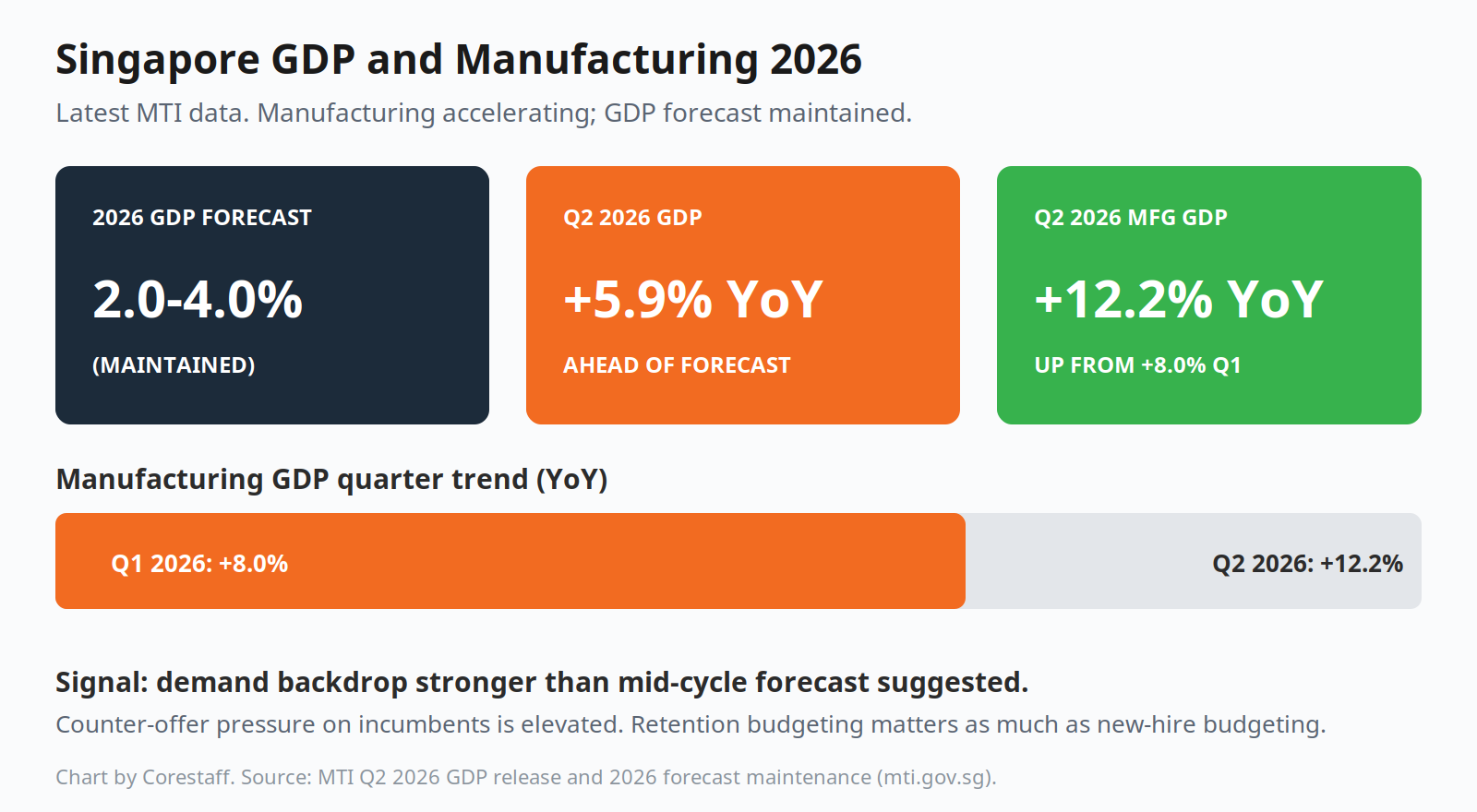
Per MTI, Singapore’s 2026 GDP growth forecast is maintained at 2.0 to 4.0%. Q2 2026 delivered +5.9% YoY, ahead of forecast, with manufacturing +12.2% and services holding steady. This is a solid demand backdrop for hiring; employers who slow down in Q4 typically do so on their own inertia, not market signals.
The 2027 Policy Clock
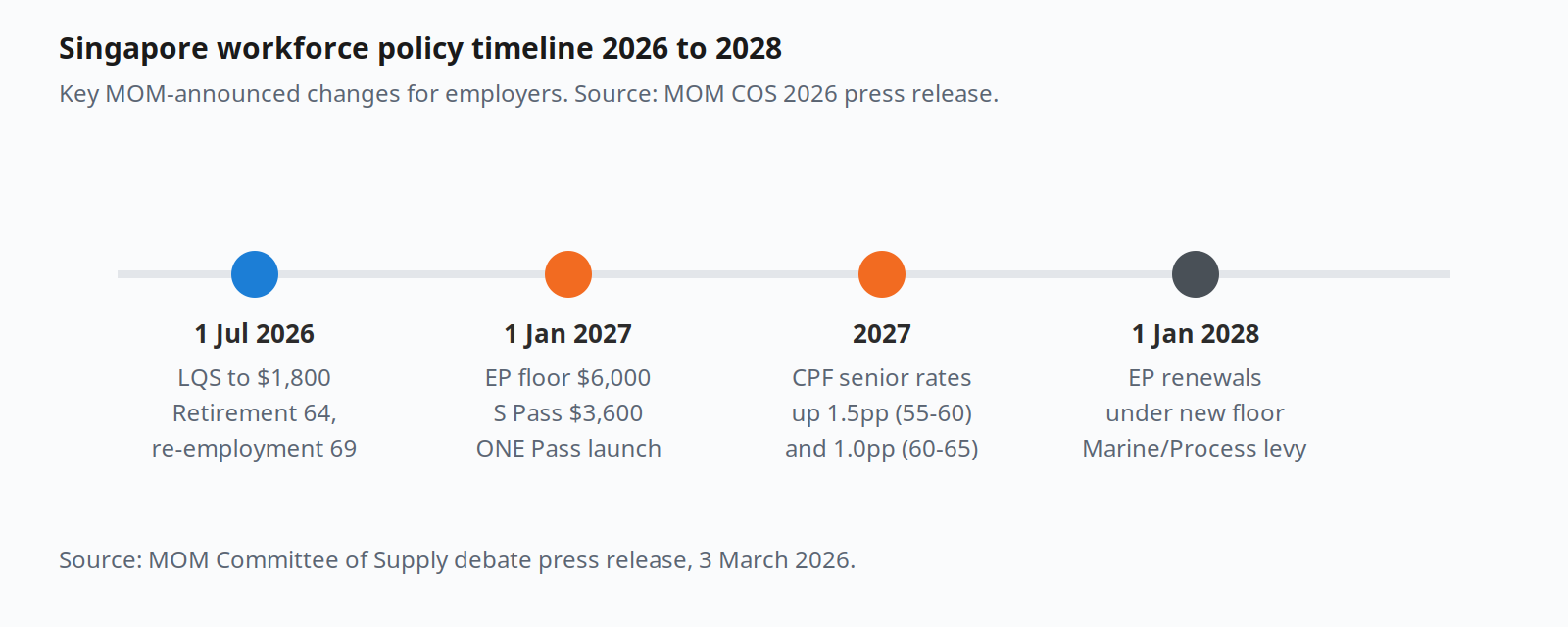
Four policy changes take effect on 1 January 2027 that shape Q4 2026 hiring decisions:
- EP minimum salary rises to SGD 6,000 (SGD 6,600 financial services) for new applications per MOM. Any new EP offer signed for a Jan 2027 start must clear the new floor.
- S Pass minimum salary rises to SGD 3,600 for new applications per MOM.
- CPF senior worker contribution rate increases per MOM COS 2026. Budget the on-cost impact for senior local hires.
- Any Budget 2026 measures with 1 Jan 2027 effective dates that touch employer cost or hiring.
Preparing your Q4 2026 hiring plan?
We run a 30-minute plan review against the 2027 policy clock, your DRC math, and salary-band updates. No obligation.
What to Lock In by Mid-November
- Salary bands. Publish your 2027 salary bands to hiring managers by mid-November. If you wait, offers go out inconsistently and you lose candidates to competitors.
- MOM quota headroom. Model DRC math for your Q1 2027 hires now, not in January.
- Pass conversions. If you have S Pass holders whose salaries are under the new SGD 3,600 floor, plan the salary uplift or role restructure now.
- Offer sequence. For roles with a foreign hire, target contract signing and MOM submission by early December to start 1 Feb 2027.
Q1 2027 Pipeline Planning
Q1 is a compressed hiring window in Singapore because of Chinese New Year (mid-late January to mid-February 2027). Effective hiring days are roughly 3 weeks shorter than Q1 2026 statistical days.
Plan implication: any Q1 2027 hire you need to onboard by end-February should be at signed-offer stage by mid-December 2026.
Sector-by-Sector Lens
- Manufacturing (semiconductor, precision, medtech): keeps hiring hard through Q4. +12.2% YoY sector growth means incumbents are aggressively retained by counter-offers.
- Construction: BCA 2026 demand at SGD 47 to 53 billion sustains skilled-trade and engineering demand into Q1 2027.
- Financial services / family office: post MAS SFO revised framework (15 June 2026), family offices continuing to hire ops and compliance roles. Confidential search for lead investment roles.
- Logistics: retail peak (CNY hampers, retail Q1) drives temp demand; permanent operations hiring is steady.
- Tech / AI: per IMDA, tech workforce hit 214,000 in 2024 with AI & Data roles fastest growing. Q4 hiring remains active.
Related reading: 2027 C-suite outlook, semiconductor hiring wave guide, construction hiring forecast, EP and S Pass employer playbook.
MTI Forecast Context
Per MTI, the 2026 GDP growth forecast was maintained at 2.0 to 4.0%. Downside risks have risen but the forecast has not been revised. Per MTI Q2 2026 GDP release, actual Q2 GDP was +5.9% YoY, ahead of forecast midpoint.
Manufacturing (+12.2% in Q2, up from +8.0% in Q1) is the outperforming sector. Services growth is steady. The signals for Q4 2026 hiring are net positive, not negative.
The Complete 2027 Policy Clock
Six MOM and CPF changes trigger on or from 1 January 2027, all of which shape 2026 hiring decisions:
- EP new-application floor rises to SGD 6,000 (financial services SGD 6,600) per MOM EP.
- S Pass new-application floor rises to SGD 3,600 per MOM S Pass.
- ONE Pass (AI and Tech) launches, replacing Tech.Pass, per MOM COS 2026.
- CPF senior worker contribution rate increases per MOM COS 2026.
- Shortage Occupation List refresh expected per MOM SOL.
- Renewals follow the new floors from 1 January 2028 (one year after new-application floors).
The Q1 2027 Hiring Window in Practice
Q1 in Singapore always compresses. Chinese New Year (mid-late January to mid-February 2027) removes roughly 3 effective weeks. Add year-end wind-down and the practical window from mid-December 2026 to end-February 2027 is short.
Employers who need a signed hire in office by 1 March 2027 should be at offer stage by mid-January and at active-shortlist stage by mid-December 2026. Executive search cycles run 10 to 16 weeks, so the C-suite kick-off for a Q1 2027 close needed to happen no later than early December 2026.
Related reading: EP and S Pass employer playbook, Singapore Budget 2026 for hiring managers.
How Corestaff Runs This Category of Search
Every Corestaff mandate in Singapore follows the same underlying process discipline, adapted to the role:
- Discovery call (day 0 to 1). A 30-minute call to lock scope, must-haves, salary band, and MOM pass eligibility. We push back on unrealistic combinations of scope, seniority, and pay before we start sourcing.
- Compliance check (day 1 to 2). We verify DRC headroom, appropriate pass type (EP, S Pass, or Work Permit), and any sector-specific requirements.
- Sourcing (day 2 to 10). Active outreach across our network plus MyCareersFuture posting where the Fair Consideration Framework requires it for new EP roles. Structured screens against must-haves.
- Shortlist (day 10 to 14). 3 to 5 candidates presented with a written summary matched to your must-haves, plus salary expectation, notice period, and any pass-eligibility flags.
- Client interviews (day 14 to 25). We coordinate the panel, collect structured feedback, and keep candidates warm through the cycle. Two rounds maximum for most roles; three for senior mandates.
- Offer and close (day 25 to 35). We handle counter-offer defence, notice-period navigation, and start-date logistics. Guarantee clock starts on day one.
Where a mandate needs to run confidentially, we adapt the sourcing (outbound only) and disclosure discipline (client identity gated behind NDA) without changing the process backbone.
Why Every Fact in This Article Is Sourced to a Singapore Government Page
Recruitment content on the internet is full of confident-sounding numbers with no traceable origin. Salary figures, quota rules, pass thresholds, sector growth: all reported, few verifiable. Corestaff’s editorial rule is that any load-bearing fact must trace to a Singapore government page (MOM, EDB, MAS, MTI, IMDA, BCA, CPF Board) with an inline citation link. Where a claim cannot be sourced to a .gov.sg page, we drop the claim rather than dress it up as an estimate. This is more work; it is also why Corestaff’s content survives fact-checking by hiring managers, CFOs, and audit teams. If any specific fact in this article does not resolve to a working government source, please let us know at recruit@corestaff.com.sg and we will fix it.
Frequently Asked Questions
When do the 2027 EP and S Pass changes actually bite?
Should we backdate offers to beat the new EP floor?
Does Singapore’s GDP forecast affect the hiring decision?
What is the absolute latest we can start a Q1 2027 executive search?
Conclusion: What to Do Next
The employers who prepare their 2027 salary bands, quota headroom, and pipeline before mid-November will start 2027 six weeks ahead. Those who don’t will spend Q1 catching up.
Q4 2026 is planning time, not slowdown time
Corestaff runs recruitment sprints for Singapore employers across executive search, professional and mid-market hiring, and skilled-trade sourcing. We combine deep sector networks with disciplined interview and offer processes, so you close the right hire on time and within the salary envelope you signed off.
Book a Free Scoping Call →
Learn about Permanent Placement
Phone: +65 6288 6866 ·
Email: recruit@corestaff.com.sg
Address: 175A Bencoolen Street #11-05 Burlington Square, Singapore 189650
Web: www.corestaff.com.sg