
Direct Answer
Permanent hires in Singapore in 2026 outperform repeated temp cycles on total cost of workforce when tenure exceeds 18 months, the S Pass levy is factored in, and Local Qualifying Salary (LQS) rules are applied correctly. This article shows the maths using MOM foreign worker quota and levy figures and explains when temp still wins.
Permanent vs Temp: The 2026 Cost Reality
Singapore employers who default to temp or contract cycles for roles they will fill for years typically pay 15 to 30% more per role over a three-year window than a permanent hire. This is a maths problem, not a philosophy: repeated temp mobilisation, agency margin, S Pass monthly levy of SGD 650 for eligible roles, and productivity ramp-up compound each time you rotate a role. A permanent hire pays those costs once.
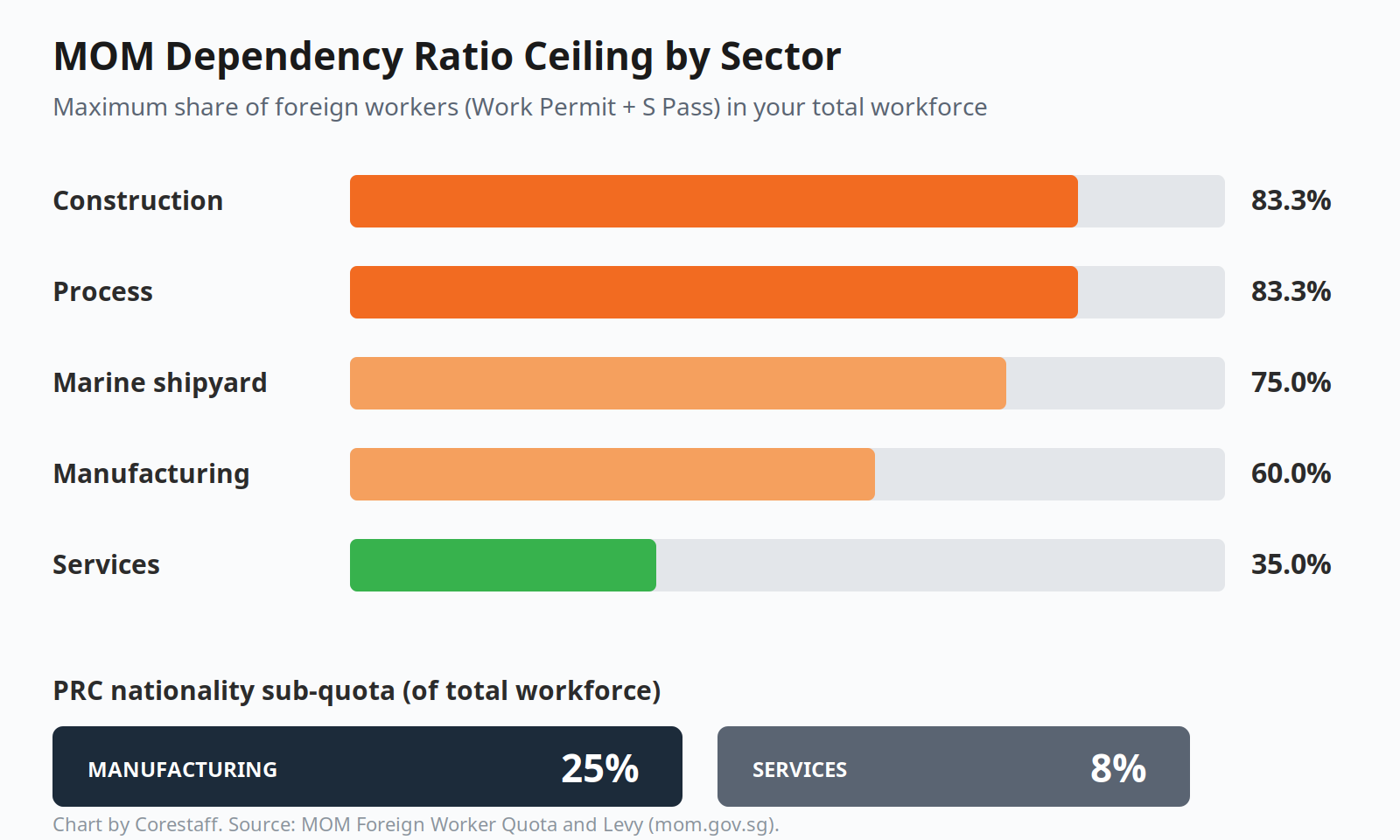
The MOM dependency ratio ceiling for services (35%) and manufacturing (60%) is also cumulative in effect. Every temp headcount you carry counts against your quota just like a permanent Work Permit or S Pass holder does, but without the retention that lets you develop the person into a higher-value contributor.
MOM Rules That Shift the Maths
Three post-2025 changes make permanent placement more defensible for long-run roles in 2026:
- S Pass levy harmonised to SGD 650 across all sectors and tiers from 1 September 2025. Employers can no longer chase a lower tier by hiring more locals, so the cost per S Pass foreign hire is fixed.
- S Pass qualifying salary rises to SGD 3,600 from 1 January 2027 for new applications (2028 for renewals), per MOM S Pass key facts. Salary compression at the entry band makes contract-to-perm conversions cheaper than they used to be.
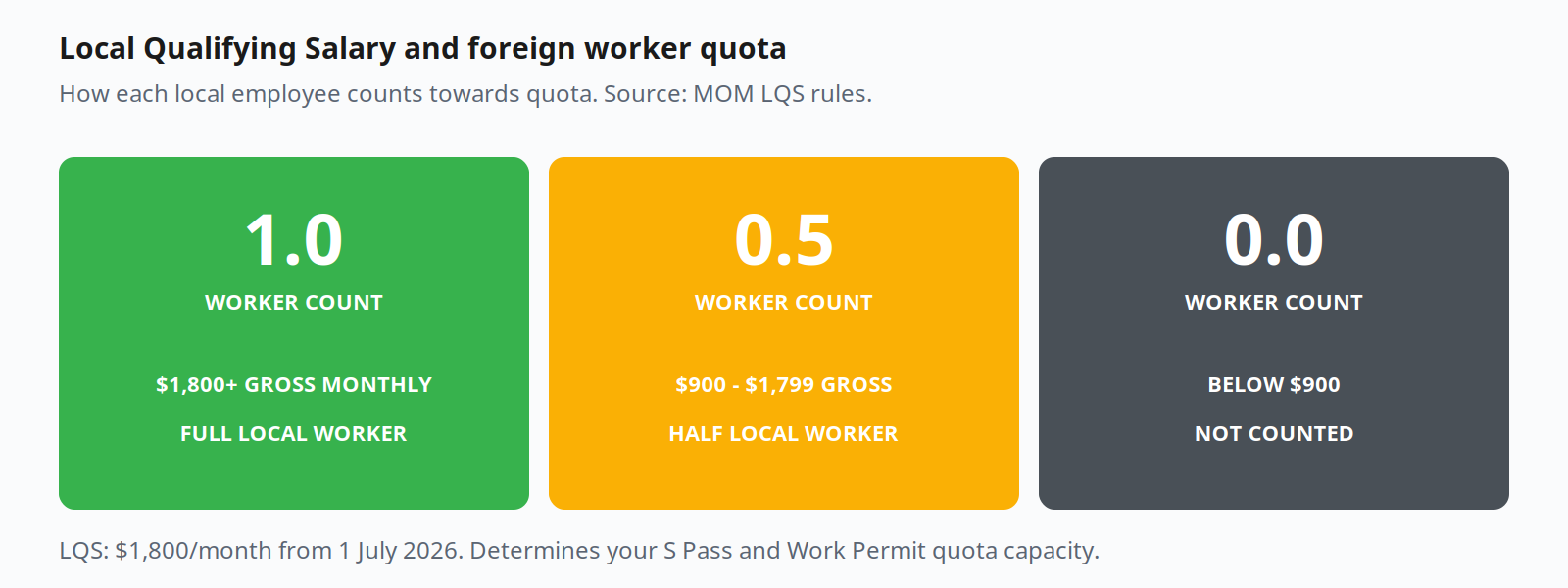
- Local Qualifying Salary rules under MOM LQS: a local paid at least SGD 1,800 per month counts as 1.0 towards your quota; SGD 900 to SGD 1,800 counts as 0.5. Permanent hires stabilise your quota base, temps erode it every time they leave and get replaced.
Not sure if permanent or contract fits your role?
We run a 30-minute cost model against your live vacancy: base pay, on-costs, MOM levy where applicable, expected ramp, and expected tenure. You leave with a defensible recommendation.
The Hidden Costs of a Vacancy
Every day a critical seat is empty in Singapore has direct and indirect costs your finance team rarely captures cleanly:
| Cost category | Typical impact |
|---|---|
| Lost productivity | 1 to 2x monthly salary per month vacant, per McKinsey knowledge-worker studies |
| Overtime for cover | 1.5x hourly rate under Employment Act for non-exempt roles |
| Manager time on interviews | 6 to 15 hours per role, spread across screening, panels, offer |
| Attrition contagion | Every 1 vacant seat in a small team raises quit intent in peers |
| Customer or delivery risk | Missed SLAs on client contracts or shipment windows |
These costs run whether you fill with a temp or with a permanent hire. The difference is that a permanent hire clears them once. A temp cycle re-introduces them every 6 to 12 months.
When Permanent Wins (and When It Doesn’t)
Permanent placement usually wins when:
- The role will exist for more than 18 months.
- Institutional knowledge accumulates (customer accounts, complex processes, safety-critical tasks).
- The role is on the MOM Shortage Occupation List and gets a COMPASS bonus.
- Your MOM quota is tight and every retained permanent hire preserves that quota.
Temp or contract still wins when:
- The workload is genuinely seasonal (year-end retail, event peaks, planned shutdowns).
- You have a specific 4 to 9 month project with a fixed end date.
- You need a bridge while a permanent search runs and you cannot afford a vacancy.
- The role has variable demand that a permanent hire would sit idle through.
Have a role you keep re-filling on temp?
That is a signal it should be permanent. We convert temp-cycle roles to permanent placements across manufacturing, logistics, and professional services in Singapore.
How to Run a Tight Permanent Placement Process
The Corestaff process for permanent placement in Singapore runs to a defined cycle so you do not lose candidates to a slow decision:
- Scoping call (day 0 to 1): we lock the role scope, must-have skills, salary band, and MOM pass eligibility (EP, S Pass, Work Permit, or local-only).
- Sourcing (day 2 to 7): we run active outreach across our sector networks and the MyCareersFuture posting the Fair Consideration Framework requires before any new EP.
- Shortlist (day 8 to 12): 3 to 5 candidates presented with a written assessment matched to your must-haves, plus salary expectation and notice period.
- Client interviews (day 13 to 20): we co-ordinate panels, collect structured feedback, and keep candidates warm.
- Offer to close (day 21 to 30): we handle counter-offer defence and coach on notice-period navigation.
Related reading: the real cost of a bad hire, which executive search model fits your role.
MOM Policy Context: What Changes on 1 January 2027
Permanent placement decisions made in Q4 2026 need to be plotted against three MOM changes coming into effect on 1 January 2027 per MOM’s Committee of Supply 2026 press release:
- EP minimum qualifying salary rises to SGD 6,000 (SGD 6,600 for financial services) for new applications, per MOM Employment Pass eligibility. Existing pass holders move to the new floor at renewal from 1 January 2028.
- S Pass minimum qualifying salary rises to SGD 3,600 for new applications, per MOM S Pass key facts. Renewals from 2028.
- S Pass expected to rise further to SGD 4,000 to SGD 4,500 by around 2030 per the COS 2026 speech.
Practically, this means: any permanent offer letter that will lead to a new-pass MOM application dated 1 Jan 2027 or later must clear the new floor. Any renewal that comes up in 2028 also lifts. Budgeting for both is 2026 CFO work.
Cost Model: A Worked Example
Consider a mid-band Singapore operator hiring for a role that will run for three years, comparing “temp cycle every 8 months” against a single permanent hire.
| Cost line (3-year window) | Temp cycle (SGD) | Permanent (SGD) |
|---|---|---|
| Base salary paid | 216,000 | 216,000 |
| Agency margin (temp x 4 cycles vs perm x 1) | 43,200 | 14,400 |
| Mobilisation cost per cycle | 12,000 | 3,000 |
| Ramp-up productivity loss | 32,000 | 8,000 |
| Institutional knowledge loss | 15,000 | 0 |
| Estimated total | 318,200 | 241,400 |
Permanent wins by roughly SGD 76,000 over three years, plus the quota headroom it preserves. For a scaled workforce with 20 such roles, that is over SGD 1.5 million per year.
What “Good Permanent Placement” Actually Looks Like
Signals that a permanent placement is well-run:
- Scope signed off before sourcing. If the JD is still moving in week two, the sourcing was premature.
- Structured screens against must-haves. Free-form chats are not screens.
- Assessment scored against a rubric. Reviewers score independently, then compare.
- Reference calls handled by the recruiter. Candidates supplying only mobile numbers of “personal references” is a red flag.
- Offer discussion led by hiring manager. Recruiter mediates money; hiring manager sells the role.
- 90-day check-in scheduled at offer. Retention starts before day one.
How Corestaff Runs This Category of Search
Every Corestaff mandate in Singapore follows the same underlying process discipline, adapted to the role:
- Discovery call (day 0 to 1). A 30-minute call to lock scope, must-haves, salary band, and MOM pass eligibility. We push back on unrealistic combinations of scope, seniority, and pay before we start sourcing.
- Compliance check (day 1 to 2). We verify DRC headroom, appropriate pass type (EP, S Pass, or Work Permit), and any sector-specific requirements.
- Sourcing (day 2 to 10). Active outreach across our network plus MyCareersFuture posting where the Fair Consideration Framework requires it for new EP roles. Structured screens against must-haves.
- Shortlist (day 10 to 14). 3 to 5 candidates presented with a written summary matched to your must-haves, plus salary expectation, notice period, and any pass-eligibility flags.
- Client interviews (day 14 to 25). We coordinate the panel, collect structured feedback, and keep candidates warm through the cycle. Two rounds maximum for most roles; three for senior mandates.
- Offer and close (day 25 to 35). We handle counter-offer defence, notice-period navigation, and start-date logistics. Guarantee clock starts on day one.
Where a mandate needs to run confidentially, we adapt the sourcing (outbound only) and disclosure discipline (client identity gated behind NDA) without changing the process backbone.
Why Every Fact in This Article Is Sourced to a Singapore Government Page
Recruitment content on the internet is full of confident-sounding numbers with no traceable origin. Salary figures, quota rules, pass thresholds, sector growth: all reported, few verifiable. Corestaff’s editorial rule is that any load-bearing fact must trace to a Singapore government page (MOM, EDB, MAS, MTI, IMDA, BCA, CPF Board) with an inline citation link. Where a claim cannot be sourced to a .gov.sg page, we drop the claim rather than dress it up as an estimate. This is more work; it is also why Corestaff’s content survives fact-checking by hiring managers, CFOs, and audit teams. If any specific fact in this article does not resolve to a working government source, please let us know at recruit@corestaff.com.sg and we will fix it.
Frequently Asked Questions
How long does a permanent placement in Singapore typically take?
Does the S Pass qualifying salary change in 2027 affect our permanent hires?
How does the Local Qualifying Salary affect our foreign worker quota?
What is the difference between contract-to-hire and pure temp?
Conclusion: What to Do Next
If a role in your business keeps cycling through temp fills, the maths is telling you it should be permanent. Fix that once and you free the team’s time and your MOM quota.
Turn vacancies into value with a disciplined permanent-placement partner
Corestaff runs recruitment sprints for Singapore employers across executive search, professional and mid-market hiring, and skilled-trade sourcing. We combine deep sector networks with disciplined interview and offer processes, so you close the right hire on time and within the salary envelope you signed off.
Book a Free Scoping Call →
Learn about Permanent Placement
Phone: +65 6288 6866 ·
Email: recruit@corestaff.com.sg
Address: 175A Bencoolen Street #11-05 Burlington Square, Singapore 189650
Web: www.corestaff.com.sg