
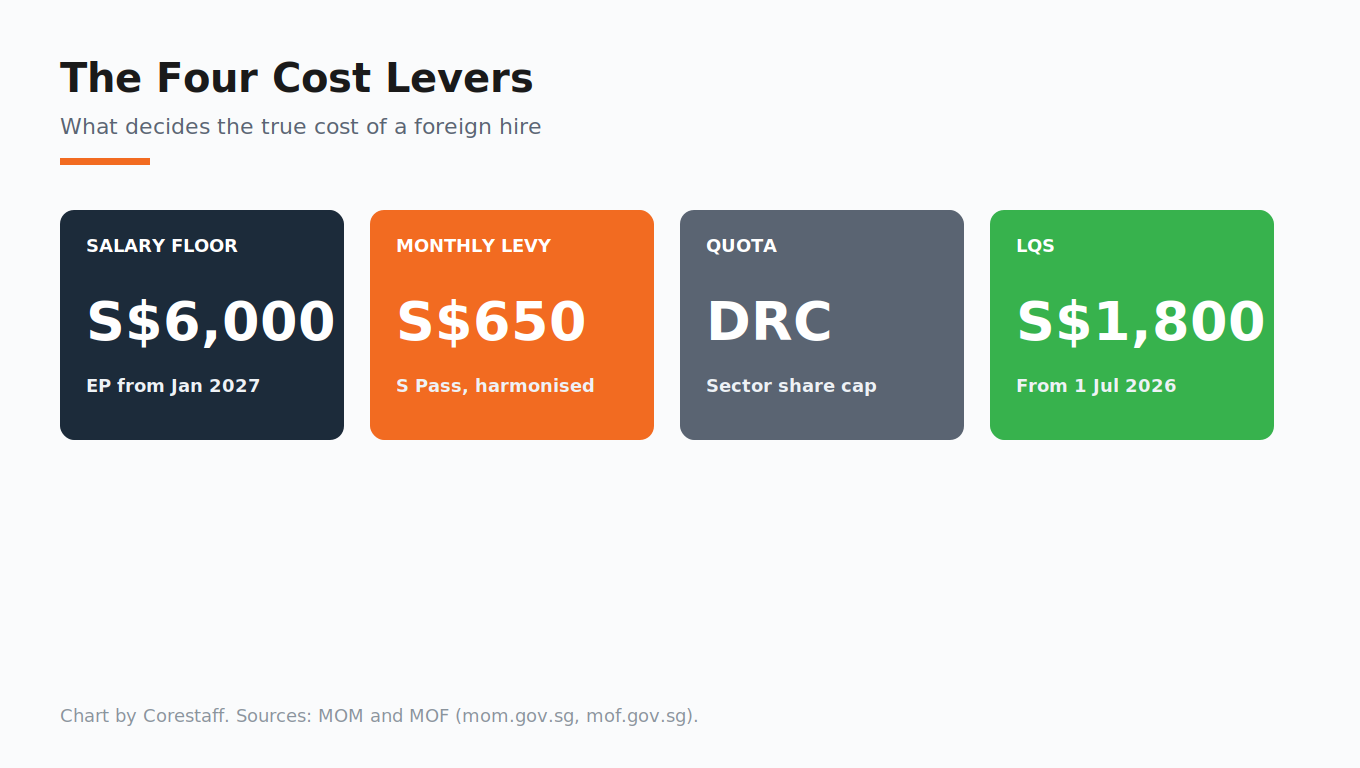
The advertised salary is the smallest line on the bill. For most employers, what a foreign hire really costs is decided by four moving parts: the salary floor, the monthly levy, the quota headroom you have left, and the Local Qualifying Salary you must pay your local staff to keep that headroom. Get one of them wrong and a hire that looked affordable on a spreadsheet becomes a renewal problem two years later.

This guide breaks down what a Work Permit, S Pass and Employment Pass cost in Singapore in 2026, sector by sector, and points you to the free calculator that models the whole roster. If you are new to foreign hiring, start with our Corestaff’s Singapore hiring services overview; if you already run a workforce, go straight to the numbers. If you would rather model this with a partner, Corestaff advises employers on pass mix and levy structure, and its construction and manufacturing recruitment teams hire directly against the ratios set out below.
The four levers that decide your real cost

Two employers can hire the same person on the same salary and pay materially different amounts. The difference sits in four places, and only one of them is the salary.
- Salary floor. The minimum you must pay the pass holder. It rises again on 1 January 2027, so a package that clears today’s floor may not clear the next one.
- Monthly levy. A per-worker charge on Work Permit and S Pass holders, tiered by sector, by your Dependency Ratio Ceiling usage, and by worker skill level.
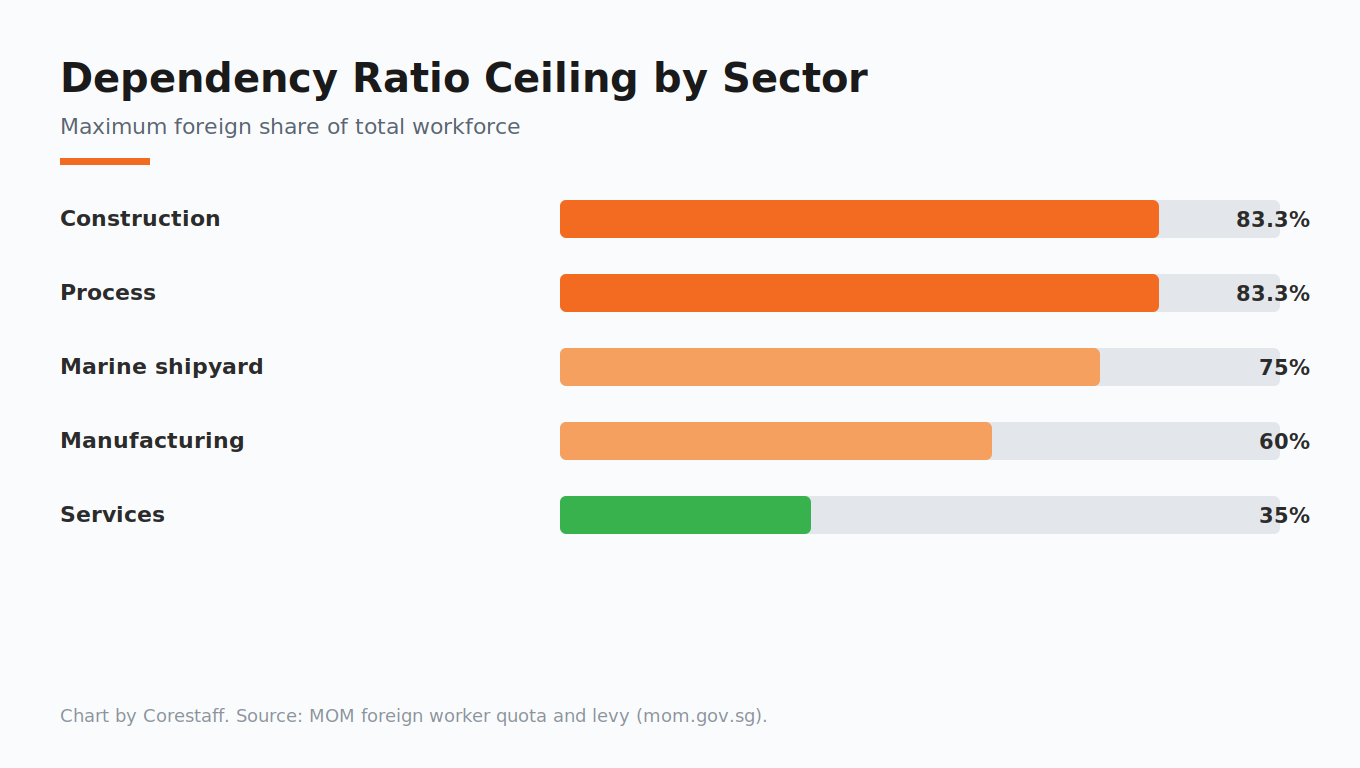
- Quota. The Dependency Ratio Ceiling caps foreign workers as a share of your local workforce. Near the ceiling, your next hire either costs more through a higher levy tier or cannot be made at all.
- Local Qualifying Salary. The pay floor that lets a local employee count towards your quota base. It rose to S$1,800 from 1 July 2026, up from S$1,600, and it quietly resets how much quota you have.
Work Permit levy: a tier, not a flat fee
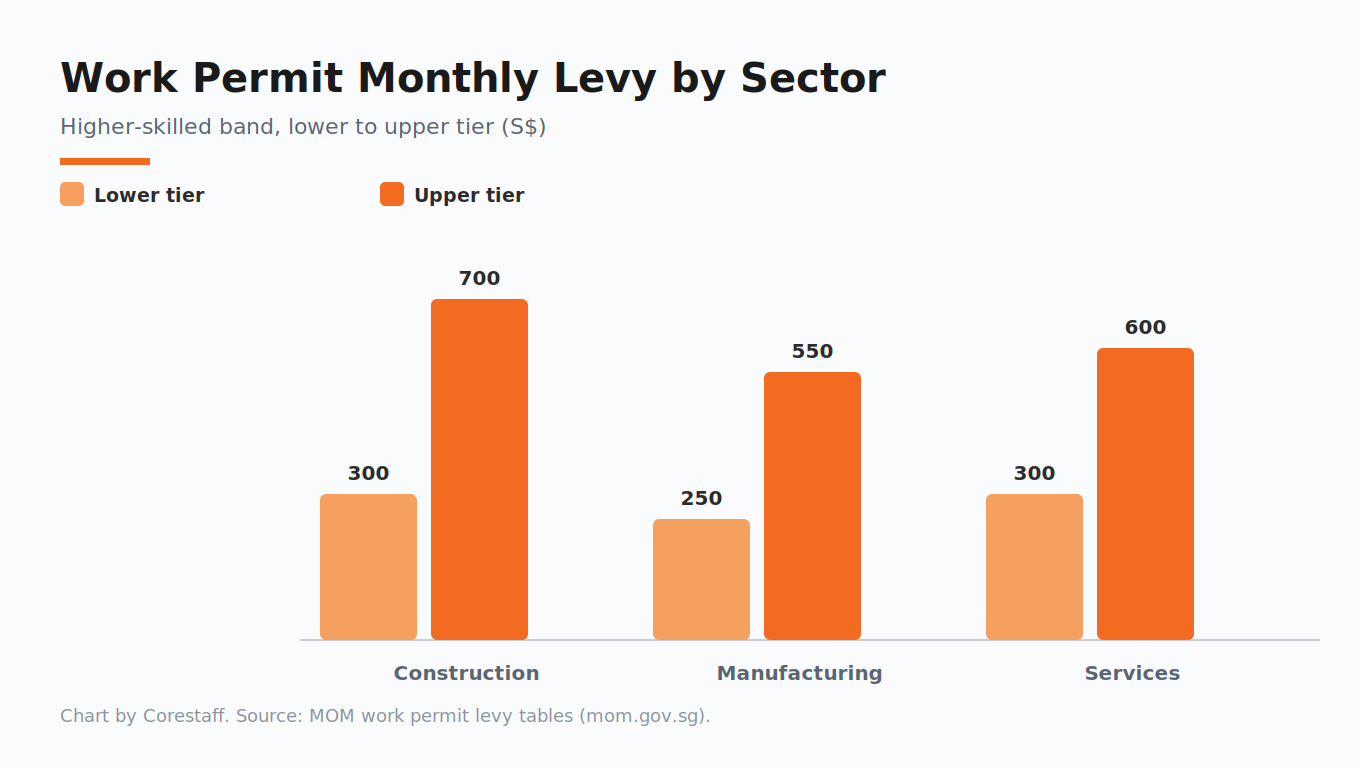
Work Permit charges are set by sector, by tier and by the source country of the worker. In Construction the monthly levy runs from S$300 for higher-skilled workers from Malaysia, North Asian sources and the PRC, up to S$900 for basic-skilled workers outside the permitted source list. Off-site construction work sits lower, at S$250 higher-skilled and S$370 basic-skilled.
The tier is tied to how much of your Dependency Ratio Ceiling you have used. Manufacturing charges S$250 to S$550 for higher-skilled workers as you pass through the 25, 50 and 60 per cent bands; Services runs S$300 to S$600 up to a 35 per cent ceiling.
| Sector (Work Permit, higher-skilled) | Monthly levy band |
|---|---|
| Construction, on-site (MY / NAS / PRC) | S$300 to S$700 by tier |
| Construction, off-site | S$250 higher-skilled / S$370 basic |
| Manufacturing (DRC to 60%) | S$250 to S$550 by tier |
| Services (DRC to 35%) | S$300 to S$600 by tier |
| Unskilled, any sector | S$900 flat |
Read that table as a budget warning, not a price list. Crossing from one band to the next is often triggered by a single extra hire, which is why roster-level modelling beats per-hire quotes every time.
The 10 per cent rule that blocks renewals
There is a second constraint that catches employers late. Before you can hire or renew a basic-skilled Work Permit holder, at least 10 per cent of your Work Permit workforce in that sector must already be higher-skilled. Miss the ratio and the renewal is refused outright rather than priced higher. A construction employer can be fully within quota and still unable to renew a basic-skilled worker.
The practical response is to plan the skilled mix, not just the headcount. Upskilling a share of your existing workers through the relevant trade tests does more for renewal certainty than any attempt to negotiate the levy.
S Pass: one flat levy and a tight sub-quota
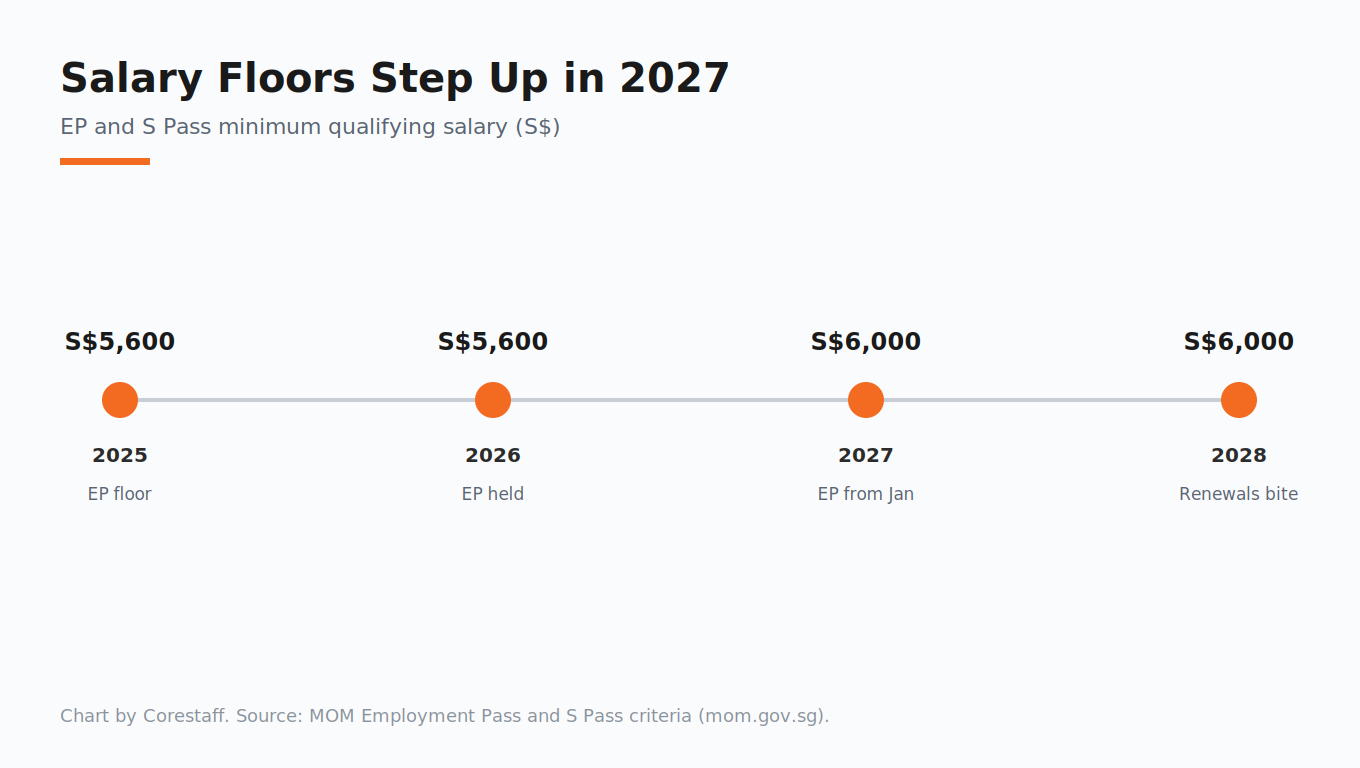
The S Pass levy has been a flat S$650 per month across all sectors and tiers since 1 September 2025, about S$21.37 a day. The real constraint is the sub-quota: 10 per cent of your local workforce in Services and 15 per cent everywhere else. Add a salary floor that moves from S$3,300 to S$3,600 for new applications on 1 January 2027, plus an age-graded scale that raises the required salary for older candidates, and the S Pass becomes a planning instrument rather than a cheaper alternative to the Employment Pass.
For a Services employer, the S Pass is usually the first pass to run out. Plan the sub-quota before you plan the salary, and read our guide to the 2027 work pass thresholds to see who on your current roster is exposed.
Employment Pass: no levy, but a rising floor
The EP carries no monthly levy and no quota, which is why employers reach for it. The trade is the salary floor and the COMPASS points test. The floor rises from S$5,600 to S$6,000 for new applications from 1 January 2027, and from S$6,200 to S$6,600 in financial services. COMPASS then decides whether the candidate qualifies at all, so the cost question becomes an eligibility question. Our COMPASS scoring explainer walks through the points.
A worked example: a 40-worker construction roster
Take a mid-sized contractor carrying 40 Work Permit holders, split 24 higher-skilled and 16 basic-skilled, all from permitted sources, sitting at half of the 83.3 per cent ceiling. The monthly levy alone can sit between roughly S$12,000 and S$20,000 depending on the mix, before salary, housing, insurance and the security bond. Move six workers from basic-skilled to higher-skilled and the same headcount costs less, while also protecting your renewal eligibility.
That is the counter-intuitive part of the 2026 rules: the cheapest roster is often the one with the highest skilled share, because the levy tier, the higher-skilled ratio and renewal certainty all move in the same direction. Employers who plan the mix pay less and sleep better than those who plan only the headcount.
Model your own roster in two minutes
Enter your sector, headcount and pass mix and the calculator returns your quota headroom, your levy tier and your annual bill, and flags every holder below the 2027 floors.
Frequently asked questions
Is the Work Permit levy the same for every employer in a sector?
No. It tiers by your Dependency Ratio Ceiling usage and by worker skill level, so two employers in the same sector can pay different rates for the same headcount.
Does the Employment Pass have a levy?
No. The Employment Pass carries no monthly levy and no quota, but it has a salary floor that rises on 1 January 2027.
Which is cheaper, an S Pass or an Employment Pass?
There is no universal answer. The S Pass has a levy but a lower floor and a sub-quota; the EP has no levy but a higher floor and the COMPASS test. The cheaper option depends on your local headcount and your quota headroom.
What is the Local Qualifying Salary used for?
It sets how much you must pay a local employee before that person counts towards your quota base. It rose to S$1,800 from 1 July 2026.
Related reading
Talk to Corestaff about this
Corestaff Pte Ltd is a Singapore employment agency, a trusted hiring partner since 2015, holding Employment Agency Licence 18C9027 under UEN 201633744E. If you want this article applied to your own workforce, our consultants will model it with you.
- Call: +65 6288 6866
- Email: recruit@corestaff.com.sg
- Visit: 175A Bencoolen Street, #11-05 Burlington Square, Singapore 189650
- Send a brief: Contact Corestaff · corestaff.com.sg