
Direct Answer
A bad executive hire in Singapore in 2026 costs 3x to 5x the role’s annual total comp once you count severance, opportunity cost, downstream hire failures, missed strategic outcomes, and organisational disruption. For a SGD 400,000 annual comp CFO, that is SGD 1.2M to SGD 2M of value at risk. Prevention is not optional.
What Goes Wrong at the Executive Level
Executive hires fail in three characteristic ways, and each has a distinct cost profile:
- Culture mismatch (60% of failures). The candidate’s technical strengths do not compensate for the operating style clash. Exit at month 6 to 12.
- Scope drift (25%). The role scope shifted after signing and the executive is now doing a different job than they signed up for. Exit at month 9 to 18.
- Under-performance on the specific strategic mandate (15%). The candidate could not deliver the outcome they were hired for. Exit at month 12 to 24.
The Full ROI Model for a Failed Executive Hire
Worked example: Group CFO at SGD 400,000 annual total comp, exits at month 12.
| Cost line | Estimate (SGD) |
|---|---|
| Total comp paid over 12 months | 400,000 |
| Employer CPF and other on-costs (locals) / severance package | 80,000 |
| Original search fee (retained, 30% of Y1 comp) | 120,000 |
| Replacement search fee (partial credit under guarantee if triggered) | 0 to 120,000 |
| Missed strategic outcomes (e.g. missed capital raise, delayed system rollout) | 300,000 to 800,000 |
| Direct-report disruption and voluntary turnover | 120,000 to 250,000 |
| Vacancy productivity loss (3 to 6 months to fill) | 100,000 to 200,000 |
| Total exposure | SGD 1.12M to SGD 2M |
That is 3x to 5x the executive’s annual total comp. And that assumes the guarantee triggers, which is not automatic.
Preventing a bad executive hire is cheaper than fixing one
Corestaff runs a 6-gate executive search process with a 90-day replacement guarantee. Book a walk-through of the gates and how they apply to your role.
The Hidden Costs Most Boards Miss
- Direct-report attrition contagion. A failed CFO or CTO usually loses 1 to 2 direct reports who lost faith in the leadership choice. Those replacements add another SGD 100k+ of costs.
- Peer credibility damage. A board that made the wrong appointment publicly loses standing for subsequent decisions.
- Strategic momentum loss. The strategic initiative the executive was hired to drive stops. Restarting takes 6+ months.
- Customer or investor perception. External stakeholders notice C-suite turnover and may adjust their engagement.
6 Prevention Gates for Executive Search
- Scope gate. Board-approved role scope with 5 must-haves and 3 no-go signals before sourcing.
- Screen gate. Structured behavioural + strategic screen against must-haves.
- Assessment gate. Role-relevant case study or strategic exercise scored against a rubric.
- Panel gate. Board or CEO plus 2 to 3 peers, independent scoring, then compared.
- Reference gate. Three references from direct managers and direct reports in the last five years, called by the search partner.
- Fit gate. Hiring principal (CEO or Chair) writes down what could go wrong with this hire before offer.
How Guarantee Periods Actually Work
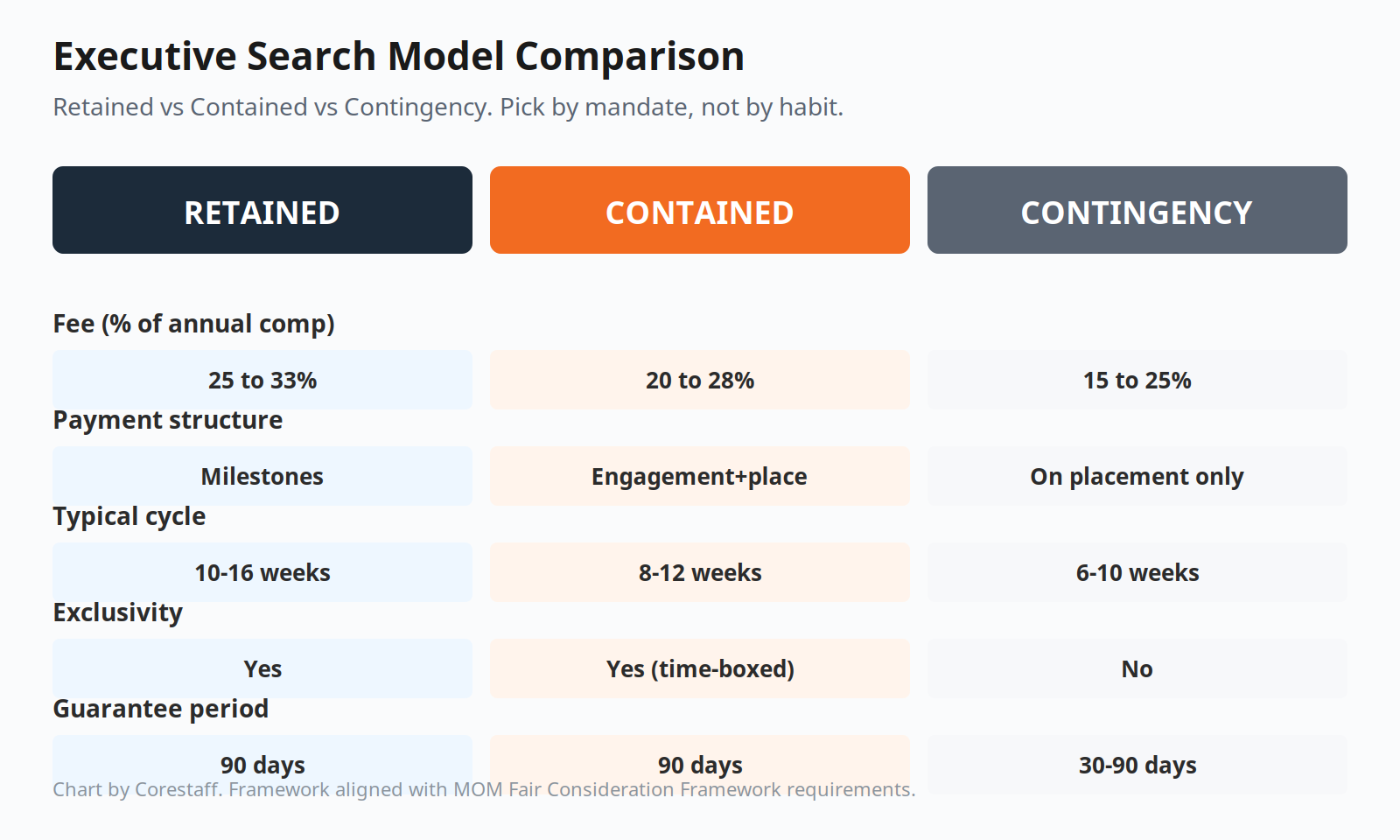
For retained executive search, most reputable firms offer a 90-day guarantee: if the executive leaves or is terminated for cause within 90 days of start date, the search partner replaces them at no additional fee. Corestaff’s replacement rate under the 6-gate discipline is below 5%.
Key questions for the guarantee: what triggers it (start date? day 91? termination for cause vs voluntary?), what does “replace” mean (same fee, same scope, same guarantee?), and what happens if the second placement also fails.
MAS-Regulated Roles: Extra Considerations
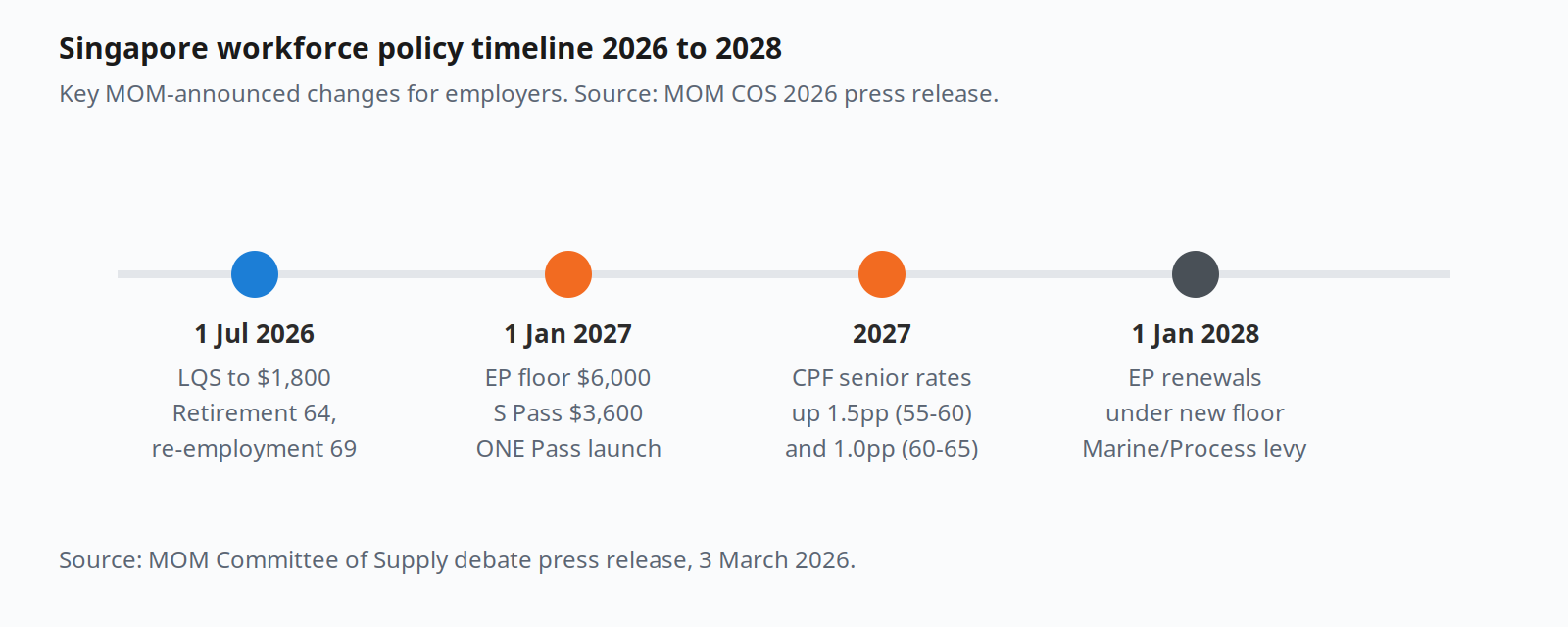
For MAS-regulated CFO, CRO, MLRO, or Head of Compliance hires, a failed appointment carries additional cost dimensions: potential regulatory scrutiny of governance, incident reporting, and even fitness-and-propriety questions. For SFOs under the revised MAS framework effective 15 June 2026, a failed lead investment or compliance hire also affects the framework’s notification and annual return requirements.
Related reading: confidential executive search, executive search model comparison, 2027 C-suite outlook, the real cost of a bad hire (non-executive).
MAS Regulated Context: What Confidentiality Actually Costs
Per MAS, the revised Single Family Office framework took effect on 15 June 2026. Existing SFOs have a transition period to 15 June 2027 to comply. Under the new framework, qualifying SFOs enjoy a structure-agnostic class exemption from licensing, provided they notify MAS, maintain an account with a MAS-licensed bank, and file an annual return.
What this means for executive search: family offices and MAS-regulated firms operate under heightened confidentiality by default. Any lead investment role, CRO, or MLRO hire will default to confidential search. The market’s tolerance for open C-suite postings in regulated finance is very low.
Section 13O and 13U Fund Tax Schemes
Per MAS, Sections 13O, 13OA, and 13U of the Income Tax Act 1947 provide fund tax incentives for family offices. Qualifying criteria must be maintained throughout the fund’s incentive period.
For hiring: an SFO managing a 13O or 13U fund typically employs an investment lead, a chief investment officer, or a portfolio manager, plus operations, tax, and compliance roles. The scale of the underlying fund drives headcount: a mid-size 13O fund typically staffs 4 to 8 people; a large 13U fund staffs 12 to 25.
Choosing the Right Search Model in Regulated Finance
Three signals point to retained (usually confidential) search rather than contingency for a MAS-regulated role:
- Incumbent is still in the seat. Any hint of open sourcing tips the market.
- Regulatory role. CRO, MLRO, and Head of Compliance hires get default confidentiality.
- Niche mandate. If the role has fewer than 30 qualified candidates in Singapore, retained is the only economically defensible model.
For open, mid-level MAS-regulated roles (compliance analyst, senior manager risk) with a broader candidate pool, contingency or contained can still work.
How Corestaff Runs This Category of Search
Every Corestaff mandate in Singapore follows the same underlying process discipline, adapted to the role:
- Discovery call (day 0 to 1). A 30-minute call to lock scope, must-haves, salary band, and MOM pass eligibility. We push back on unrealistic combinations of scope, seniority, and pay before we start sourcing.
- Compliance check (day 1 to 2). We verify DRC headroom, appropriate pass type (EP, S Pass, or Work Permit), and any sector-specific requirements.
- Sourcing (day 2 to 10). Active outreach across our network plus MyCareersFuture posting where the Fair Consideration Framework requires it for new EP roles. Structured screens against must-haves.
- Shortlist (day 10 to 14). 3 to 5 candidates presented with a written summary matched to your must-haves, plus salary expectation, notice period, and any pass-eligibility flags.
- Client interviews (day 14 to 25). We coordinate the panel, collect structured feedback, and keep candidates warm through the cycle. Two rounds maximum for most roles; three for senior mandates.
- Offer and close (day 25 to 35). We handle counter-offer defence, notice-period navigation, and start-date logistics. Guarantee clock starts on day one.
Where a mandate needs to run confidentially, we adapt the sourcing (outbound only) and disclosure discipline (client identity gated behind NDA) without changing the process backbone.
Why Every Fact in This Article Is Sourced to a Singapore Government Page
Recruitment content on the internet is full of confident-sounding numbers with no traceable origin. Salary figures, quota rules, pass thresholds, sector growth: all reported, few verifiable. Corestaff’s editorial rule is that any load-bearing fact must trace to a Singapore government page (MOM, EDB, MAS, MTI, IMDA, BCA, CPF Board) with an inline citation link. Where a claim cannot be sourced to a .gov.sg page, we drop the claim rather than dress it up as an estimate. This is more work; it is also why Corestaff’s content survives fact-checking by hiring managers, CFOs, and audit teams. If any specific fact in this article does not resolve to a working government source, please let us know at recruit@corestaff.com.sg and we will fix it.
Frequently Asked Questions
How is a bad executive hire different from a bad mid-level hire?
What triggers the 90-day guarantee?
Can we insure against a failed C-suite hire?
How does Corestaff calculate the ROI of a good executive hire?
Conclusion: What to Do Next
The 6-gate discipline plus a real guarantee is the difference between a board that gets its next 5 hires right and a board that cycles through failed appointments. Do the maths.
Bad executive hires are preventable, not survivable
Corestaff runs recruitment sprints for Singapore employers across executive search, professional and mid-market hiring, and skilled-trade sourcing. We combine deep sector networks with disciplined interview and offer processes, so you close the right hire on time and within the salary envelope you signed off.
Book a Free Scoping Call →
Learn about Executive Search
Phone: +65 6288 6866 ·
Email: recruit@corestaff.com.sg
Address: 175A Bencoolen Street #11-05 Burlington Square, Singapore 189650
Web: www.corestaff.com.sg