
Direct Answer
Singapore’s event calendar creates predictable, high-intensity logistics demand across F1, National Day, Chinese New Year, and Christmas peaks. The staffing model that actually works: pre-vetted local casual pools activated on trigger, sized to the event’s inbound volume, and structured to respect MOM DRC on the underlying operator.
The 2026 Event Calendar That Matters
Four Singapore event windows drive most temp logistics demand:
- Chinese New Year (January to February 2026): retail peak, hamper and gift box distribution, 2 to 3 week ramp.
- National Day (August 2026): merchandise and hospitality logistics around the parade and side events.
- F1 Singapore Grand Prix (September to October 2026): 10 days of intense inbound and event site logistics.
- Christmas and year-end retail (November to December 2026): e-commerce and physical retail peak, 6 to 8 week ramp.
Roles You Actually Need
| Role | Typical peak headcount (mid-size 3PL) |
|---|---|
| Warehouse pickers and packers | 30 to 100 |
| Inbound receivers | 6 to 20 |
| Sorting-line operators | 15 to 40 |
| Last-mile support (non-driver) | 10 to 30 |
| Event-site logistics crew | 20 to 60 for F1 / large events |
| Shift team leads | 3 to 8 |
Timelines and Activation Triggers
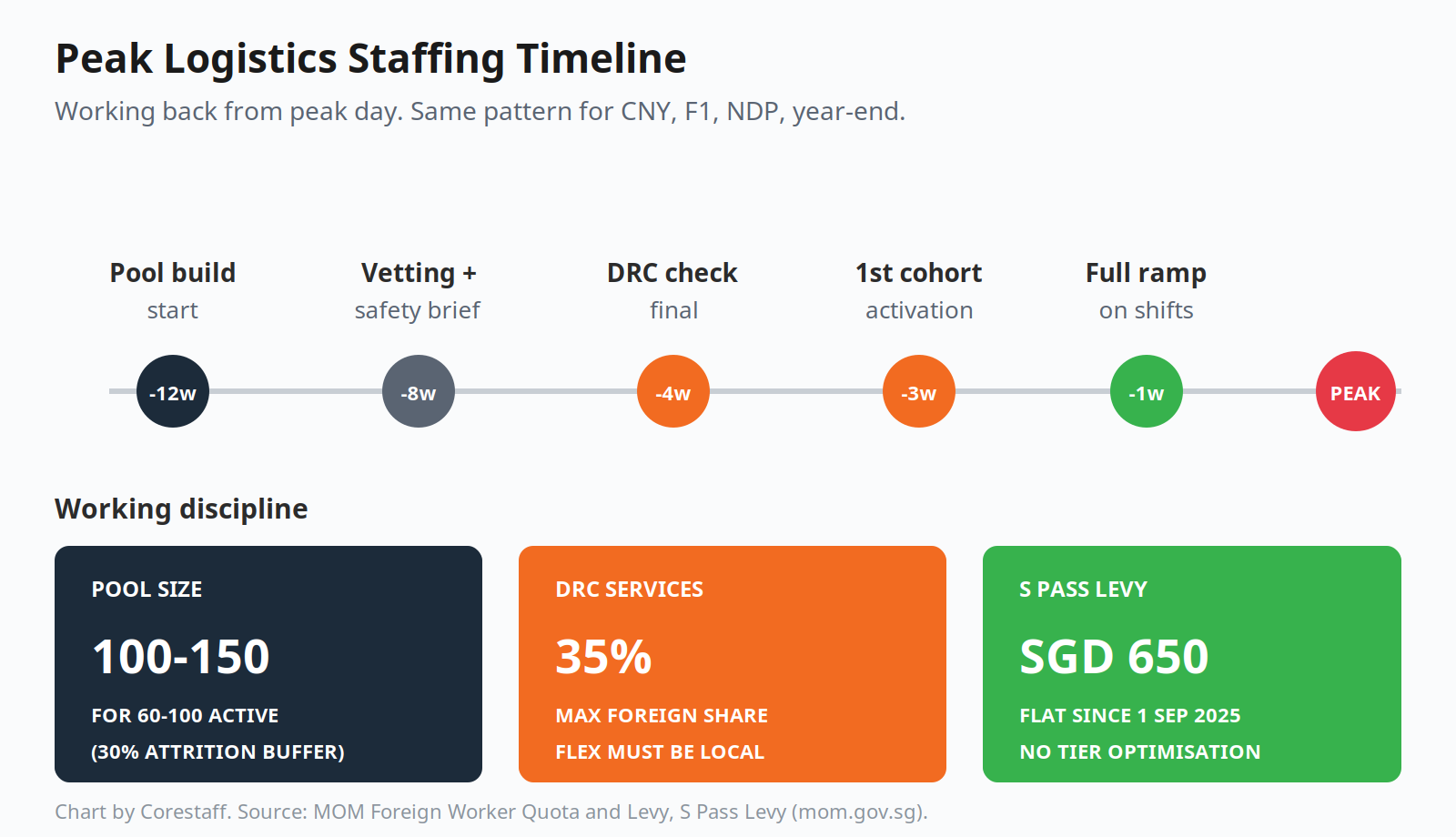
The activation window separates operators who hit their peak SLAs from operators who chase them:
- Pool building: starts 8 to 12 weeks before peak. Vetting, safety briefing, onboarding docs.
- First cohort activation: 3 weeks before peak, working steady-state shifts to break in.
- Full ramp: 1 week before peak, all cohorts on shift patterns.
- De-ramp: starts immediately post-peak; casual pool retained for next event window.
Peak season around the corner?
Corestaff pre-builds casual pools for logistics operators against the Singapore event calendar. If you have a peak coming, we can size the pool this week.
MOM Compliance Basics for Temp Logistics
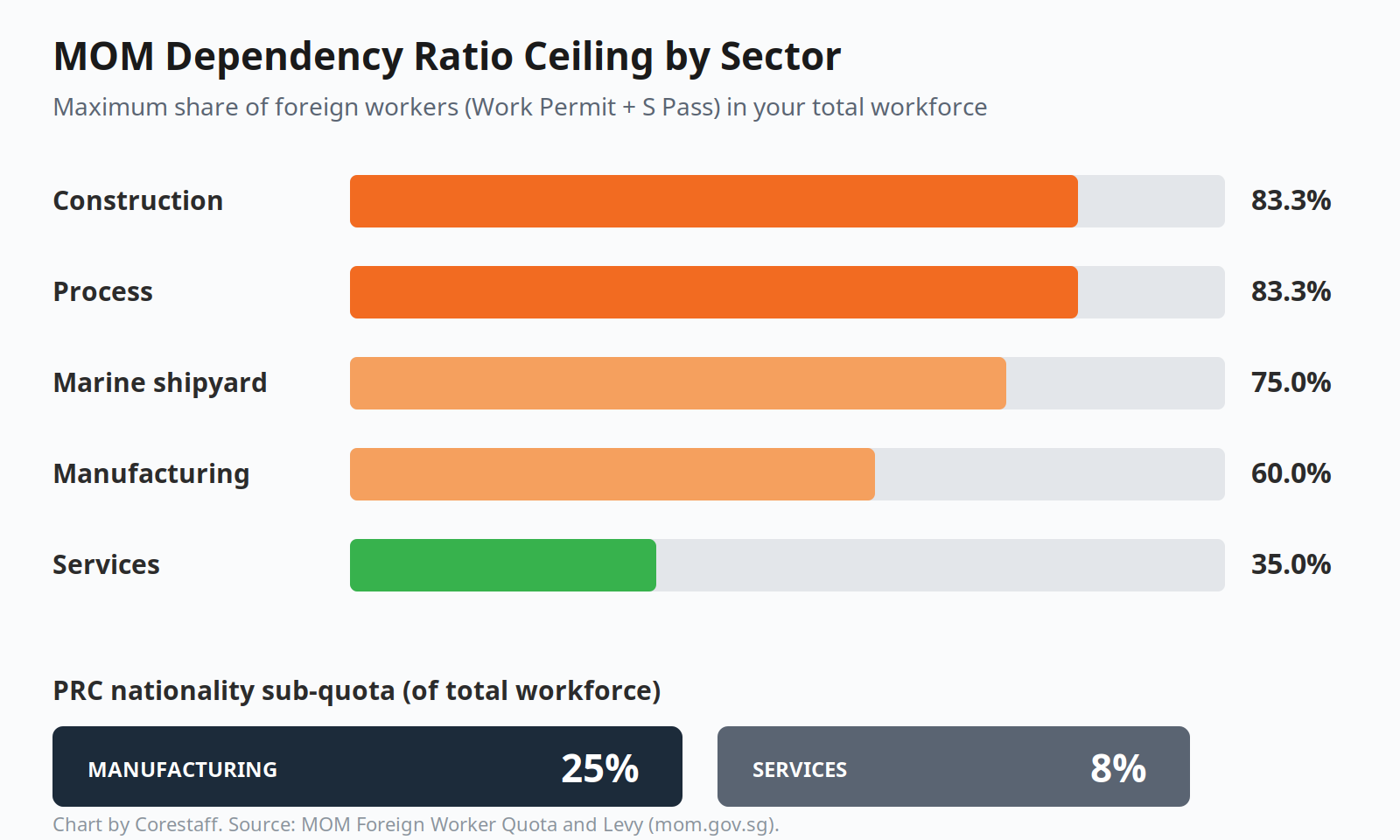
- Services DRC 35% per MOM. Applies to your total headcount including temp/contract foreign workers.
- S Pass levy SGD 650 per MOM from day of pass issuance.
- LQS: locals at SGD 900 to SGD 1,800 count as 0.5 towards quota base; SGD 1,800+ counts as 1.0.
- Employment Act overtime: 1.5x hourly for non-exempt workers, capped by working-hours limits.
Running a Peak Cleanly
- Forecast volume first, not headcount. Volume drives headcount; headcount does not drive volume.
- Pre-vet more people than you think you need (30% overage). Attrition on the day of activation is real.
- Use casual pool activation over overtime when the peak is more than 2 weeks. Overtime rates make sense for a 3 to 5 day event, not a 6-week retail peak.
- Track cost-per-parcel or cost-per-order, not just headcount cost. It is the only number that tells you whether your peak was profitable.
Related reading: Corestaff logistics recruitment, temporary and contract staffing, year-end hiring forecast.
MOM Compliance Checklist for Logistics Employers (2026)
Logistics operators in Singapore should run this checklist quarterly:
| Check | 2026 status |
|---|---|
| Services DRC 35% respected | Per MOM foreign worker quota |
| PRC sub-quota 8% respected | Per MOM quota rules |
| S Pass at SGD 3,300 today, budgeting for SGD 3,600 in 2027 | Per MOM S Pass |
| S Pass levy at SGD 650 flat | Per MOM S Pass levy, from 1 Sep 2025 |
| CPF contributions declared for all locals | Affects LQS quota base |
| Locals paid above LQS thresholds counted correctly | Per MOM LQS |
Peak Planning Mistakes That Cost Real Money
- Overtime pyramid. Stacking 1.5x Employment Act overtime on a fixed team through a 6-week peak costs more than adding pre-vetted casual pool headcount. Do the math each October.
- Late pool activation. A pool activated 3 days before peak has zero break-in time; expect 15 to 25% no-shows on day one.
- Mixing pass types blindly. A 30-person peak team of 20 locals + 10 S Pass may push you over DRC if steady state was already at 33%. Model first.
- No cost-per-parcel target. Without a cost-per-parcel target, headcount decisions are gut calls. Set it by lane and by shift before the peak.
Warehouse Safety and Productivity Signals
Two operational signals matter for retention and productivity on Singapore warehouses:
- Near-miss reporting rate. A rising near-miss rate is a leading indicator of an incident. Sites that reward reporting (not incidents) see fewer incidents.
- Shift-lead ratio. One qualified shift lead per 8 to 12 operatives is the sustainable ratio for retention. Above 15 and lead time on decisions dominates.
These are operational disciplines, not hiring problems, but they set the environment your hires walk into and determine whether they stay.
How Corestaff Runs This Category of Search
Every Corestaff mandate in Singapore follows the same underlying process discipline, adapted to the role:
- Discovery call (day 0 to 1). A 30-minute call to lock scope, must-haves, salary band, and MOM pass eligibility. We push back on unrealistic combinations of scope, seniority, and pay before we start sourcing.
- Compliance check (day 1 to 2). We verify DRC headroom, appropriate pass type (EP, S Pass, or Work Permit), and any sector-specific requirements.
- Sourcing (day 2 to 10). Active outreach across our network plus MyCareersFuture posting where the Fair Consideration Framework requires it for new EP roles. Structured screens against must-haves.
- Shortlist (day 10 to 14). 3 to 5 candidates presented with a written summary matched to your must-haves, plus salary expectation, notice period, and any pass-eligibility flags.
- Client interviews (day 14 to 25). We coordinate the panel, collect structured feedback, and keep candidates warm through the cycle. Two rounds maximum for most roles; three for senior mandates.
- Offer and close (day 25 to 35). We handle counter-offer defence, notice-period navigation, and start-date logistics. Guarantee clock starts on day one.
Where a mandate needs to run confidentially, we adapt the sourcing (outbound only) and disclosure discipline (client identity gated behind NDA) without changing the process backbone.
Why Every Fact in This Article Is Sourced to a Singapore Government Page
Recruitment content on the internet is full of confident-sounding numbers with no traceable origin. Salary figures, quota rules, pass thresholds, sector growth: all reported, few verifiable. Corestaff’s editorial rule is that any load-bearing fact must trace to a Singapore government page (MOM, EDB, MAS, MTI, IMDA, BCA, CPF Board) with an inline citation link. Where a claim cannot be sourced to a .gov.sg page, we drop the claim rather than dress it up as an estimate. This is more work; it is also why Corestaff’s content survives fact-checking by hiring managers, CFOs, and audit teams. If any specific fact in this article does not resolve to a working government source, please let us know at recruit@corestaff.com.sg and we will fix it.
Frequently Asked Questions
How early should we start pool building for F1 or National Day?
Can we use S Pass workers for temp event logistics?
What is Corestaff’s typical peak-pool size?
Is temp event work covered by Singapore’s Employment Act?
Conclusion: What to Do Next
Singapore’s event calendar is predictable. The logistics operators who treat it as a planning input, not a surprise, run their peaks profitably.
Own your peak season with a pre-built pool, not last-minute panic
Corestaff runs recruitment sprints for Singapore employers across executive search, professional and mid-market hiring, and skilled-trade sourcing. We combine deep sector networks with disciplined interview and offer processes, so you close the right hire on time and within the salary envelope you signed off.
Book a Free Scoping Call →
Learn about Temporary and Contract Staffing
Phone: +65 6288 6866 ·
Email: recruit@corestaff.com.sg
Address: 175A Bencoolen Street #11-05 Burlington Square, Singapore 189650
Web: www.corestaff.com.sg