

Direct answer: From 1 September 2026, the Ministry of Manpower (MOM) added eight new occupations to the Non-Traditional Sources (NTS) Occupation List. Singapore employers in air transportation, social services and food services can now hire Work Permit holders from nine approved Asian source countries for these roles. To hire under the list, your firm must hold the required sector licence in its own name, keep NTS Work Permit holders within a sub-Dependency Ratio Ceiling (DRC) of 8 percent, and pay each worker a fixed monthly salary of at least S$2,000.
What the NTS Occupation List is
The Non-Traditional Sources (NTS) Occupation List is a MOM scheme that lets firms in the Manufacturing and Services sectors hire Work Permit holders from a wider set of Asian countries and regions than the base Work Permit rules allow, but only for a restricted set of occupations. It exists to relieve structural shortages in roles that local hiring and mainstream foreign hiring do not fill, such as cooks in Indian restaurants, food processing workers and heavy vehicle drivers.
On 1 September 2026, MOM expanded the list with eight new occupations drawn from three sectors: air transportation, social services and food services. The expansion matters for two very different groups of employers. First, food and beverage firms that have been running kitchen and front-of-house roles on short-term local arrangements that never quite hold. Second, preschools and airlines, sectors that have not previously been able to use Work Permit hiring for these front-line roles at all.
The eight new occupations from 1 September 2026

MOM groups the eight new roles into three families. In the table below, each row is one occupation as MOM counts it.
| # | New occupation | Sector |
|---|---|---|
| 1 | Cabin attendants | Air transportation |
| 2 | Babysitters and infant caregivers (also called infant educator or childminder) | Social services |
| 3 | Child and after school care centre workers (also called educarer or early years educator) | Social services |
| 4 | Teacher aides (also called assistant infant educator or assistant early years educator) | Social services |
| 5 | Butchers, fishmongers and related food preparers | Food services |
| 6 | Food and drink stall assistants | Food services |
| 7 | Kitchen assistants | Food services |
| 8 | Waiters | Food services |
Two boundary notes worth knowing. The pre-existing food services occupations, such as cooks, remain on the list, so a restaurant can now build a complete kitchen and service team on Work Permit hires under NTS rules. And the food processing occupation continues to exclude supervisors, general foremen, tasters, graders, bakers, pastry cooks and confectionery makers.
The licence your firm needs for each role
Every NTS occupation is tied to a licence or certificate that your firm must hold in its own ACRA-registered name. MOM verifies this at application, so a licence held by a related company or a brand name that does not match your registered entity will not pass.
| Role | Your firm must hold |
|---|---|
| Cabin attendants | A Civil Aviation Authority of Singapore (CAAS) issued Singapore Air Operator Certificate (AOC), or a Foreign Operator’s Permit (FOP) while operating scheduled services to or from Singapore. |
| Childcare workers (all three roles) | A valid Early Childhood Development Centre (ECDC) licence, or appointment by the Early Childhood Development Agency (ECDA) under the ChildMinding Pilot for infants. |
| Food services workers (butchers, stall assistants, kitchen assistants, waiters) | A work pass account under the Services sector and a valid Singapore Food Agency (SFA) Food Shop or Supermarket licence, registered under the firm’s ACRA name. |
Source countries you can hire from
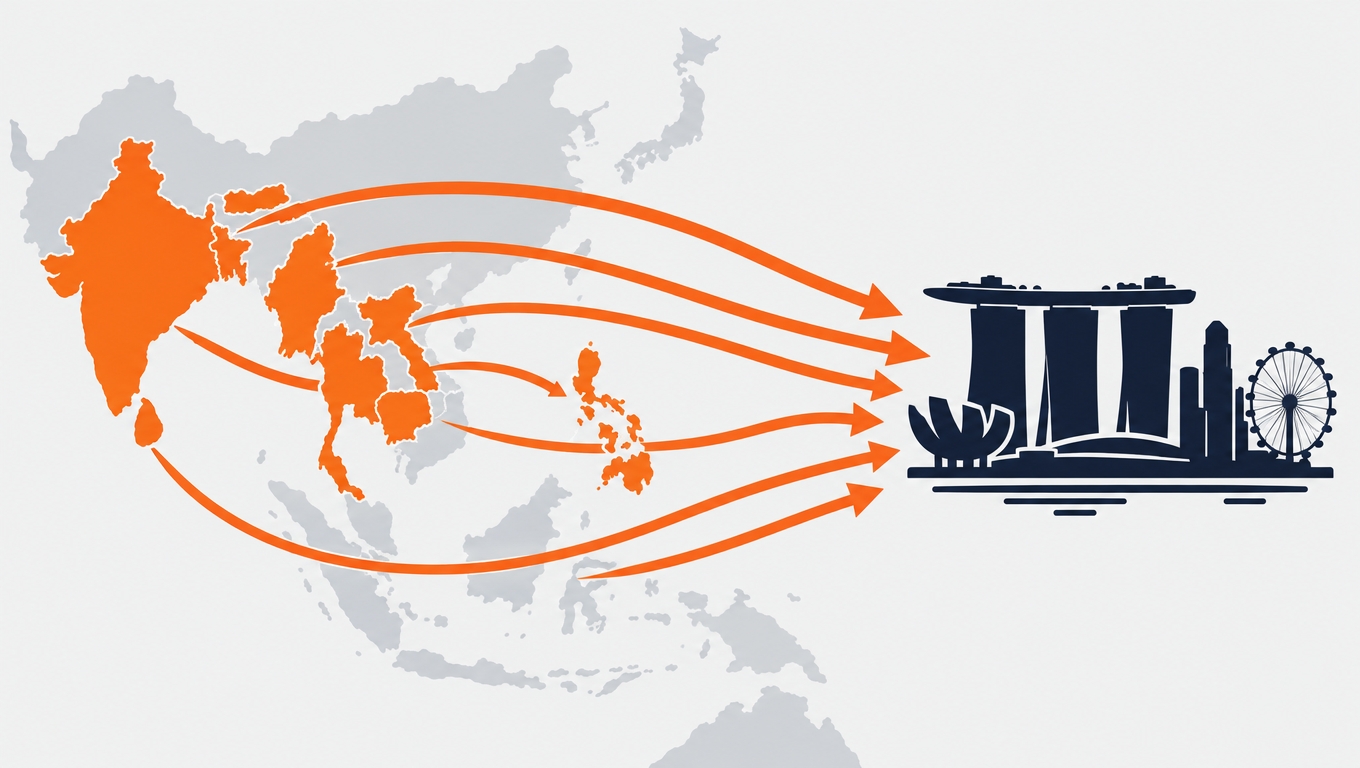
NTS hiring draws from a wider pool than the standard Work Permit scheme. Under the NTS Occupation List, firms may hire Work Permit holders from nine countries:
- Bangladesh
- Bhutan
- Cambodia
- India
- Laos
- Myanmar
- Philippines
- Sri Lanka
- Thailand
For Manufacturing and Services sector employers, the base NTS framework also continues to allow hiring from Malaysia, the People’s Republic of China and the North Asian sources (Hong Kong SAR passport holders, Macau, South Korea and Taiwan). If you already hire Malaysian or PRC workers, the new occupations are an extension of a channel you know; if you are opening a new source country, allow extra lead time for first-time recruitment in that market.
Three rules every NTS employer must follow
- Stay within the 8 percent sub-DRC. NTS Work Permit holders on the Occupation List count towards a sub-Dependency Ratio Ceiling of 8 percent, which sits on top of the conditions for your sector’s main quota. Firms already close to their sector DRC should model this constraint before committing to a hiring plan, because it is the limit that bites first.
- Pay at least S$2,000 fixed monthly salary. Each Work Permit holder performing an NTS Occupation List role must be paid a fixed monthly salary of at least S$2,000. Overtime and variable payments do not count towards the fixed component, so budget on the base salary alone.
- Keep the worker on the stated occupation. Work Permit holders may only perform the occupation stated on their Work Permit. A kitchen assistant cannot be redeployed into a different job family without a new application, so write the job scope you actually need at the point of application.
Normal levy rules apply on top of these, and the levy rate depends on your sector and the worker’s skill tier, which we break down in the next section.
What an NTS hire actually costs: quota and levy

Beyond the salary floor, two cost lines matter: the levy you pay monthly and the quota your headcount consumes. The Work Permit levy for the Services sector runs in three tiers by the share of your workforce:
| Services quota | Basic tier levy | Higher-skilled levy |
|---|---|---|
| Up to 10% of workforce | S$$450 | S$$300 |
| Above 10% to 25% | S$$600 | S$$400 |
| Above 25% to 35% | S$$800 | S$$600 |
In manufacturing, quota runs wider (a 60 percent DRC) and levies run lower:
| Manufacturing quota | Basic tier levy | Higher-skilled levy |
|---|---|---|
| Up to 25% of workforce | S$$370 | S$$250 |
| Above 25% to 50% | S$$470 | S$$350 |
| Above 50% to 60% | S$$650 | S$$550 |
To qualify for the higher-skilled levy tier, a worker must meet sector-specific criteria. In manufacturing, for example, that means a recognised qualification (such as an ITE Skills Evaluation certificate, Nitec or WSQ assessment), a fixed monthly salary of at least S$1,600, or at least four years of Work Permit experience in Singapore. Every S$150 to S$250 you save per worker per month between the basic and higher-skilled tier compounds quickly at scale, so processing qualifications properly at application stage is worth the effort.
For the full cost picture across passes, including levies, security bonds, insurance and medical cover, see our guide to Singapore work pass costs in 2026.
How this fits your Q4 2026 hiring plan
Q4 is budget season, and most Singapore employers are locking 2027 headcount and pass mix right now. Three forces interact with this expansion:
- Pass floors rise in January 2027. The EP minimum salary floor moves to S$6,000 (S$6,600 for financial services) and the S Pass floor to S$3,600 from January 2027. Roles that no longer fit those floors may fit the NTS list instead, at Work Permit cost levels. Our 2027 work pass thresholds guide shows which of your staff fall below the new floors.
- The market is cautious. Singapore’s Q4 2026 hiring outlook is +13 percent, the softest since Q4 2021, and 47 percent of employers plan to hold headcount steady. Firms still hiring are concentrating on roles with clear, urgent need, which is exactly the profile of the new NTS roles in F&B, childcare and air transport.
- Levy tiers change from 2028. If you are building a 2027 budget with foreign manpower in it, price both the current levy bands and the post-2028 structure so a two-year plan does not break mid-way.
Step by step: how to hire under the NTS list
The application mechanics are the same as any Work Permit hire, with the NTS licence and sub-DRC checks added. In practice the sequence runs:
- Confirm your firm holds the sector licence for the occupation, in its own ACRA-registered name.
- Check your sub-DRC headroom against your current workforce before you commit to a candidate.
- Source candidates from an approved NTS source country, with the right occupation match written into the contract.
- Submit the Work Permit application with the occupation stated precisely, then arrange in-principle approval, arrival and issuance.
Our step by step guide to hiring a foreign worker in Singapore covers the full process with timelines.
How Corestaff handles NTS hiring for you
Corestaff Pte Ltd is a licensed employment agency in Singapore. For NTS hiring we handle sourcing from the approved source countries, licence and eligibility checks against MOM requirements, the Work Permit application end to end, and onboarding. If your peak-season or expansion need is temporary rather than permanent
To find out whether your firm qualifies, and what a realistic time to first hire looks like for your sector, talk to our foreign worker recruitment agency in Singapore or request a foreign worker hiring quote.
Frequently asked questions
Which occupations were added to the NTS Occupation List on 1 September 2026?
Eight: cabin attendants; babysitters and infant caregivers; child and after school care centre workers; teacher aides; butchers, fishmongers and related food preparers; food and drink stall assistants; kitchen assistants; and waiters. They come from the air transportation, social services and food services sectors.
Which countries can NTS Work Permit holders come from?
Bangladesh, Bhutan, Cambodia, India, Laos, Myanmar, Philippines, Sri Lanka and Thailand. Firms in the Manufacturing and Services sectors can also hire from Malaysia, the People’s Republic of China and the North Asian sources (Hong Kong SAR, Macau, South Korea and Taiwan) under the same framework.
What salary must I pay an NTS Work Permit holder?
A fixed monthly salary of at least S$2,000. To qualify for the higher-skilled levy tier, a worker must also meet your sector’s own qualification, salary and experience criteria.
Does NTS hiring use my normal work permit quota?
No. NTS Occupation List hires are capped by a separate sub-Dependency Ratio Ceiling of 8 percent, on top of the conditions for your sector’s main quota (35 percent for services, 60 percent for manufacturing).
Can a preschool hire a foreign teacher aide under NTS?
Only if the firm holds a valid Early Childhood Development Centre licence or is appointed by the Early Childhood Development Agency under the ChildMinding Pilot, and the role stays within the childcare occupations on the list.
How long does an NTS work permit application take?
Once sourcing is complete and the licence checks pass, most straightforward applications are processed within one to two weeks. The longer lead time is usually candidate sourcing and document preparation, which is where a specialist agency saves the most time.
Sources (.gov.sg)
- MOM, Non-Traditional Sources (NTS) Occupation List
- MOM FAQ, Requirements to hire NTS workers in the new occupations from 1 September 2026
- MOM, Services sector Work Permit requirements (levy and quota)
- MOM, Manufacturing sector Work Permit requirements (levy and quota)
Last verified October 2026.