
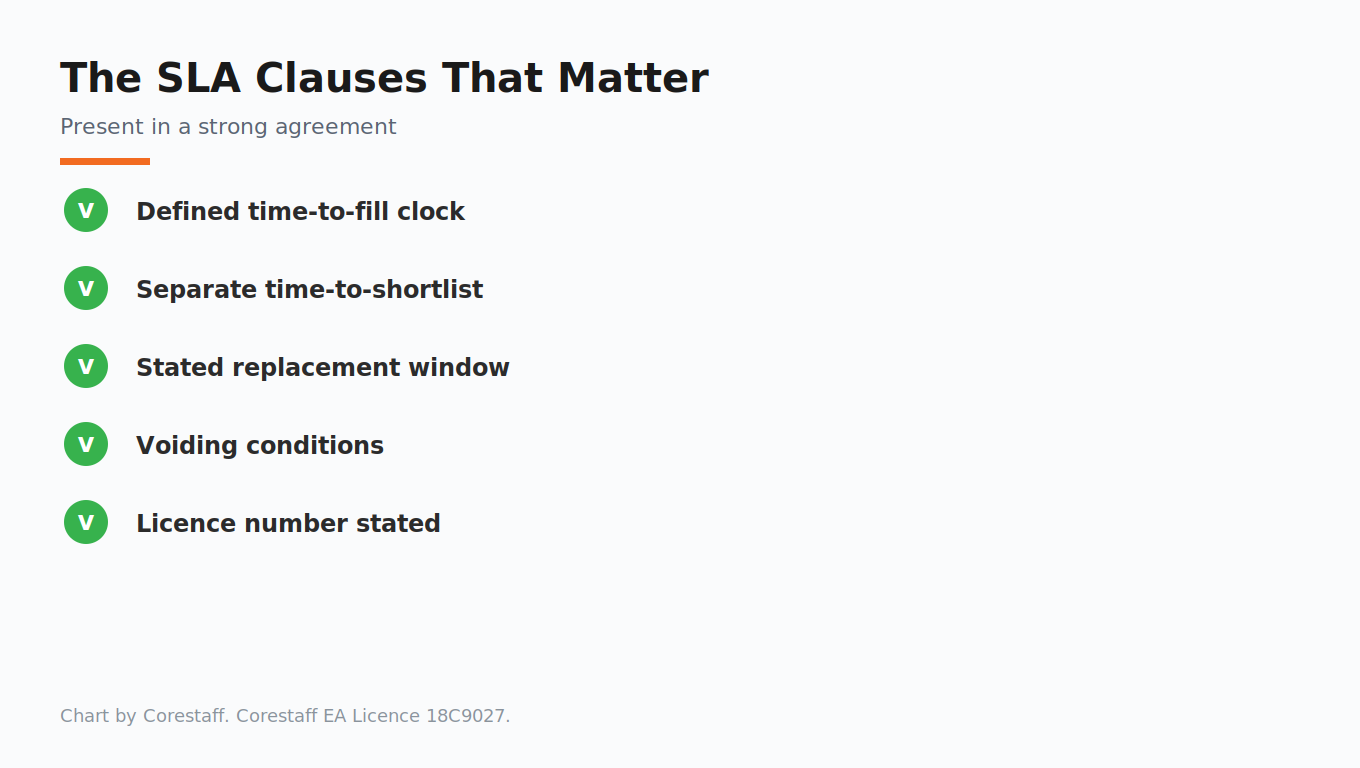
Employers shopping for an agency increasingly ask for proof rather than promise. The proof is a service level agreement with names, numbers and dates in it. Most agency guarantees look generous until you read what voids them, and the voiding conditions are usually the part that determines whether the protection ever pays out. This guide sets out the clauses worth negotiating, and the ones that quietly turn a guarantee into a gesture.

For the commercial context, pair this with our guide to recruitment agency fees in Singapore, and with Corestaff’s own published terms on the hiring guarantee page. Corestaff’s Singapore recruitment services put the same commitments in writing, and its outsourced recruitment engagements are governed by the SLA clauses described here.
Start with the clause that matters most: time-to-fill

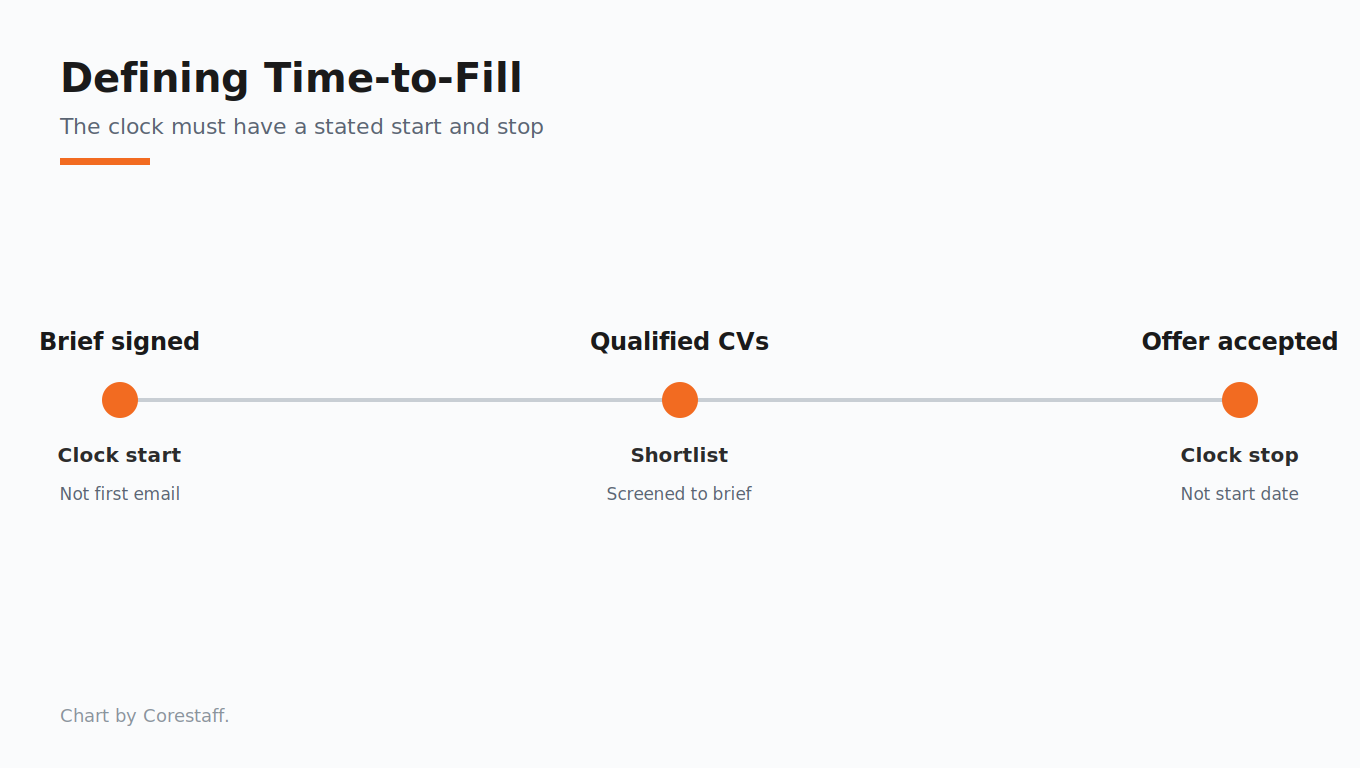
Time-to-fill is the most quoted and least standardised metric in recruitment. It can mean anything from the day the role is briefed to the day the candidate accepts, from first shortlist to signed contract, or from kickoff to start date. A supplier that reports a strong time-to-fill without defining it is reporting a number you cannot compare, and a number you cannot hold anyone to.
- Define the clock start. Brief received, or role signed off internally? The gap between the two is often two weeks you never counted.
- Define the clock stop. Offer accepted, or start date? A fast offer to a candidate with a long notice period is not a fast fill.
- Split the metric. Time-to-shortlist and time-to-fill measure different things, and both belong in the agreement.
- Name the exceptions. Client-side interview delays should pause the clock, and the agreement should say so, or the SLA is a one-way promise.
What a useful shortlist SLA looks like
A shortlist SLA commits to a number of qualified candidates within a defined window, where qualified is itself defined. A promise of five CVs is worthless if three are unsuitable. The stronger version commits to a number of candidates who meet the brief and have been screened against it, with the screening criteria attached. Insist on a definition of what disqualifies a candidate, because that is where a weak supplier leaves room to pad a shortlist with volume.
The replacement guarantee, and its fine print
| Clause | What to check |
|---|---|
| Guarantee window | How long after placement the replacement applies, counted from start date, not offer date |
| Replacement terms | Whether replacement is free, pro-rata, or capped to one attempt |
| Voiding conditions | Role changed, salary reduced, or reporting line altered after placement |
| Exclusions | Resignation versus termination, and redundancy carve-outs |
| Scope | Whether the guarantee covers the same role or any role at the same level |
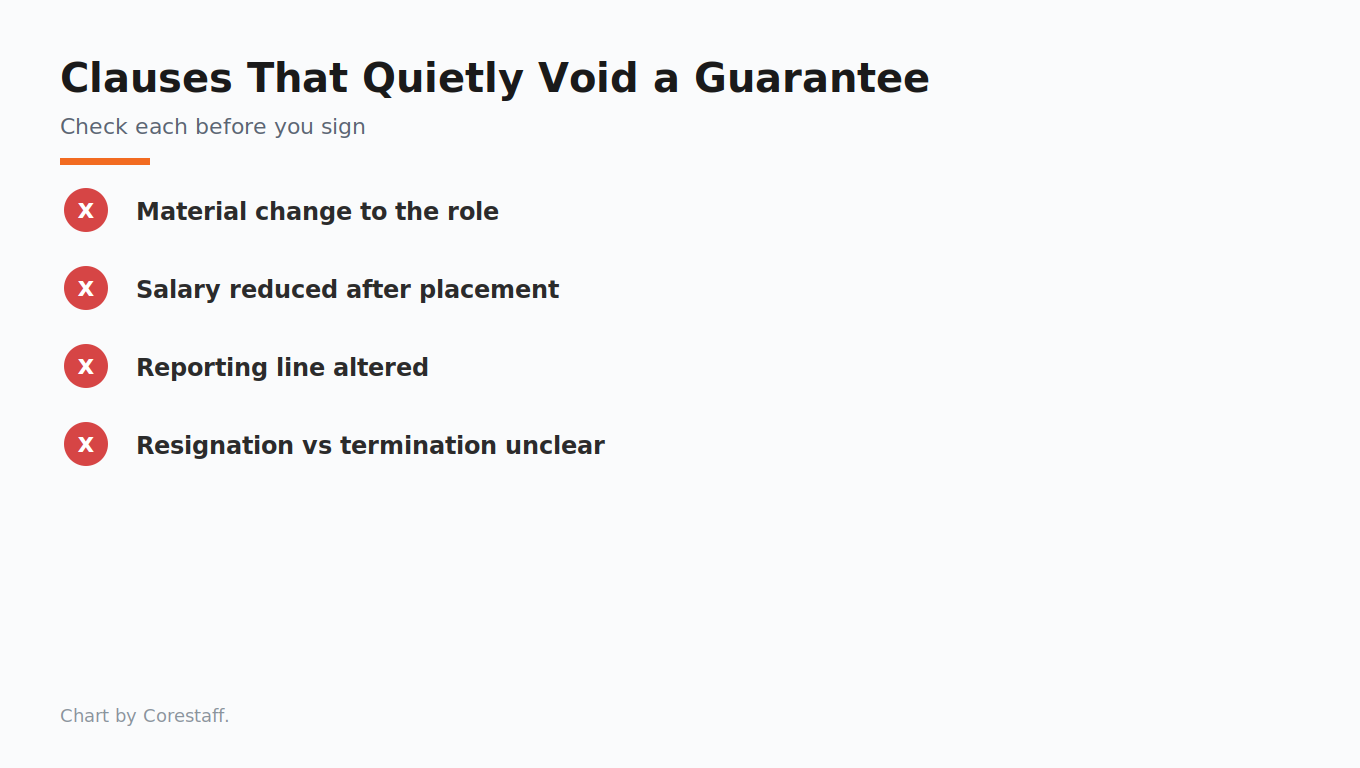
The single most common voiding condition is a material change to the role after placement. If you widen the scope, cut the salary or change the reporting line, the guarantee can fall away. That is not unreasonable, but it should be stated plainly, not buried in a schedule. A supplier confident in its screening will happily narrow the voiding conditions; one that will not is telling you where the risk actually sits.
Four clauses that quietly void a guarantee
- The role-changed clause. Any material change to scope, title or reporting line resets the guarantee.
- The same-role clause. Replacement is only offered for the identical role, which is rarely how hiring actually works.
- The one-attempt cap. A single replacement, regardless of whether that replacement also fails.
- The payment-in-full clause. The guarantee is void unless the invoice was settled within a short window.
Verify the licence before anything else
Any employment agency operating in Singapore must hold a valid licence from the Ministry of Manpower. Corestaff Pte Ltd holds Employment Agency Licence 18C9027, under UEN 201633744E. A licence number on a page is a claim you can check, and you should, before you sign an SLA with a new supplier. Licence status, not pitch quality, is the first filter.
How to compare two suppliers side by side
Line the two agreements up against the same six fields: clock start, clock stop, shortlist number and definition, guarantee window, replacement term, and voiding conditions. The supplier with the shorter list of voiding conditions and the clearer definitions is usually the better partner, even when its headline fee is higher. If you want a structured way to run that comparison, our fee comparison sets out the models alongside the terms that should accompany each.
See the terms in writing
Corestaff publishes its licence details, its time-to-fill commitments and its replacement terms on one page, so you can compare them against any other supplier before you sign.
Frequently asked questions
What is a normal replacement guarantee window?
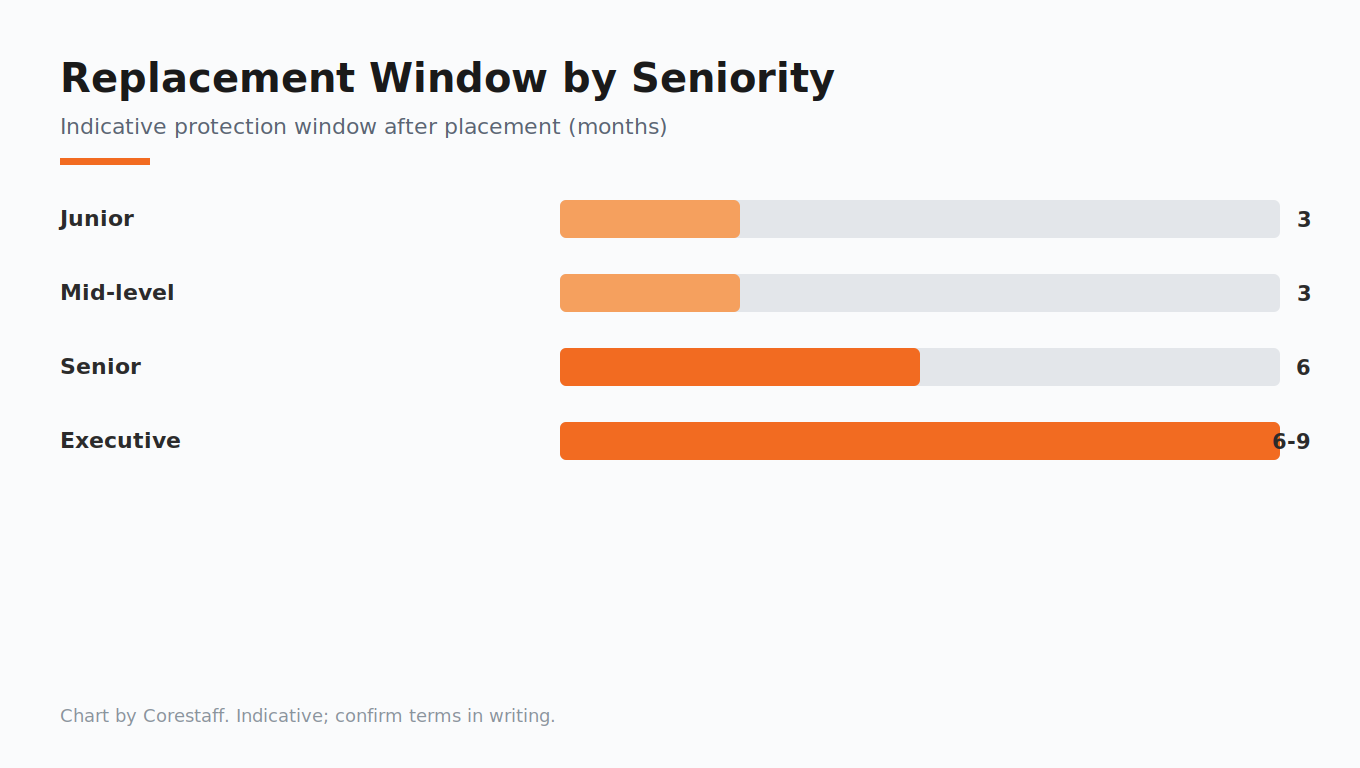
Windows vary by supplier and by role seniority. What matters is that the window, the replacement term and the voiding conditions are all stated in writing and counted from the start date.
Does changing the salary after placement void a guarantee?
It can. Many guarantees are voided by material changes to the role, so check the clause before you adjust a placed hire’s terms.
How do I verify an agency’s licence?
Check the employment agency licence number against the Ministry of Manpower register before signing, and confirm the legal entity name matches the one on your contract.
Should time-to-fill pause during client delays?
Yes. A well-drafted SLA pauses the clock for documented client-side delays, such as slow interview scheduling or feedback.
Related reading
Talk to Corestaff about this
Corestaff Pte Ltd is a Singapore employment agency, a trusted hiring partner since 2015, holding Employment Agency Licence 18C9027 under UEN 201633744E. If you want this article applied to your own workforce, our consultants will model it with you.
- Call: +65 6288 6866
- Email: recruit@corestaff.com.sg
- Visit: 175A Bencoolen Street, #11-05 Burlington Square, Singapore 189650
- Send a brief: Contact Corestaff · corestaff.com.sg