
Employers usually choose a recruitment agency by comparing quotes and trusting a relationship. That works until the hire goes wrong, and then the decision has no paper trail. A short RFP with a weighted scorecard fixes that without turning procurement into a project, and it usually gets better proposals because suppliers know exactly what will be judged.

This guide sets out the criteria that decide recruitment outcomes, and points to a toolkit that includes the RFP template, the weighted scorecard and the reference questions. If your starting point is the cost of the engagement rather than the choice of partner, begin with our recruitment agency fees guide. Corestaff sits on the other side of this process every week, so the criteria below are the ones its own clients score it against. Start with Singapore recruitment services from Corestaff, its executive search team, or the hiring guarantee it publishes.
The criteria that actually predict a good outcome

- Sector depth. Evidenced placements in your sector, not claimed familiarity with it.
- Time-to-shortlist. A defined commitment, with the clock start and stop named.
- Guarantee terms. A stated replacement window, term and voiding conditions.
- Compliance. A valid Employment Agency licence and a documented process.
- Fee transparency. Written bands across the models you will actually use.
Weight the criteria before you see the scores
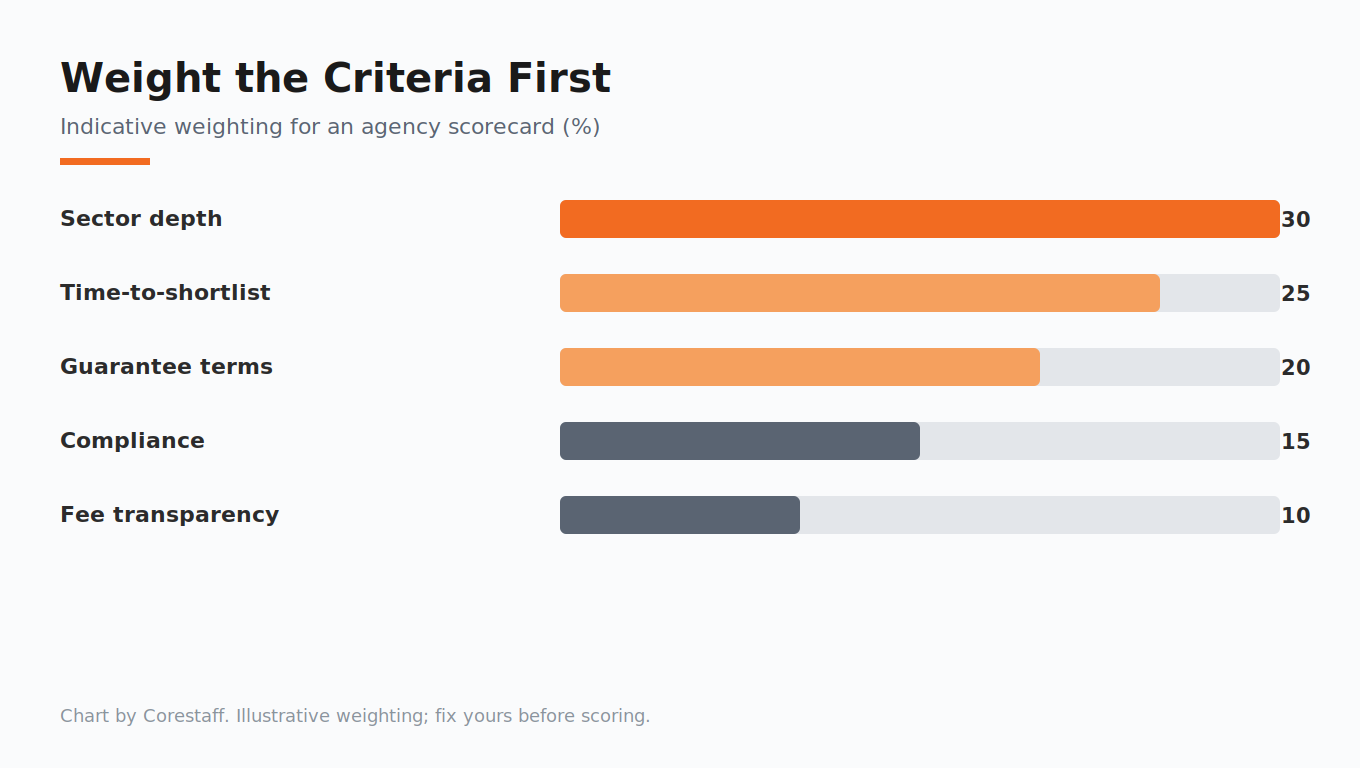
A scorecard only works if you fix the weights first. If sector depth matters more than price, weight it so, and record the weighting before proposals arrive. Otherwise the scorecard quietly becomes a way to justify the decision you already made, and suppliers who sense that will optimise for the pitch rather than the work.
| Criterion | Why it is weighted |
|---|---|
| Sector depth | Predicts shortlist quality more than any other factor |
| Time-to-shortlist | Decides whether the role is filled before the vacancy costs you |
| Guarantee terms | Transfers risk back to the agency where it belongs |
| Compliance | Protects you if a placement is challenged |
| Fee transparency | Prevents mid-engagement surprises |
Reference questions that reveal the real service
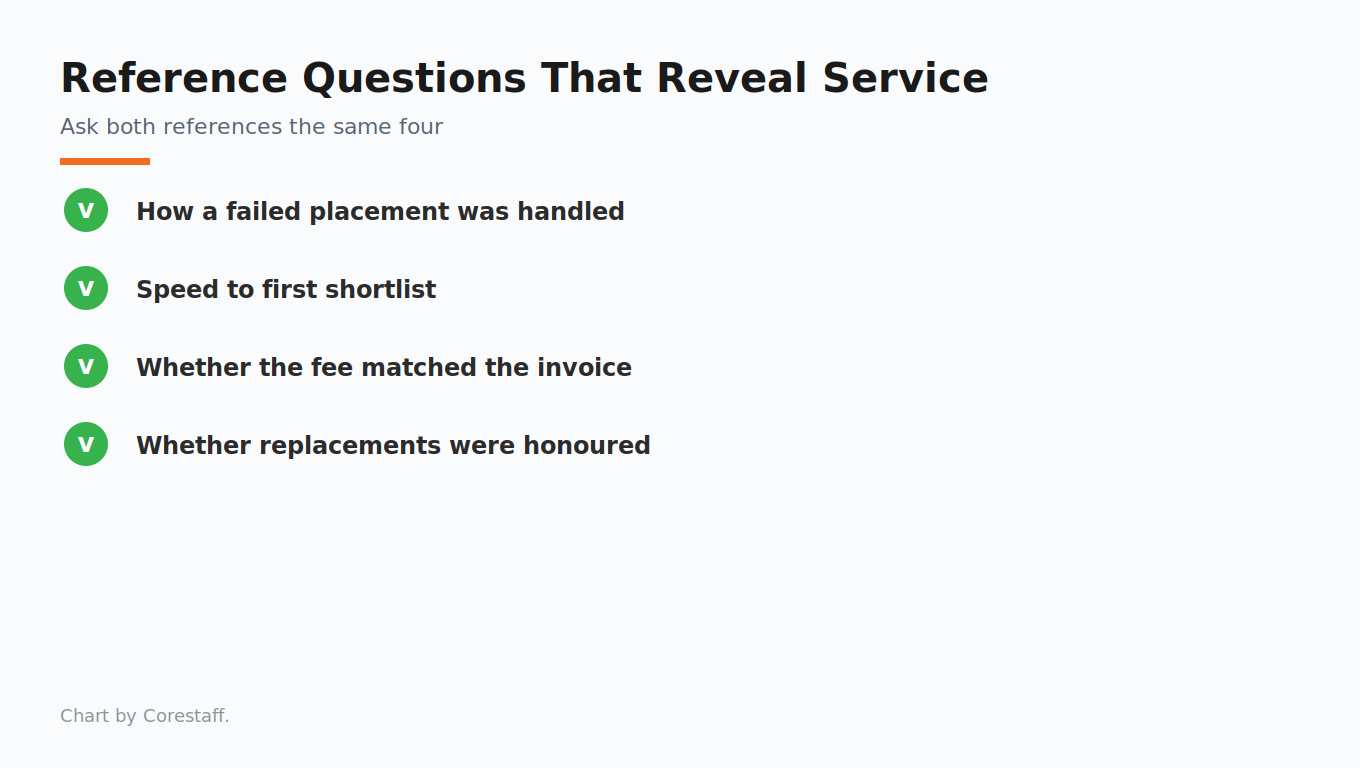
Two references, asked the same four questions, tell you more than any pitch. Ask how the agency handled a placement that did not work out, how quickly it produced the first shortlist, whether the fee quoted matched the fee invoiced, and whether the replacement terms were honoured without argument. A supplier whose references hesitate on the second and fourth questions is telling you where its process is thin.
Put the guarantee in the contract, not the brochure
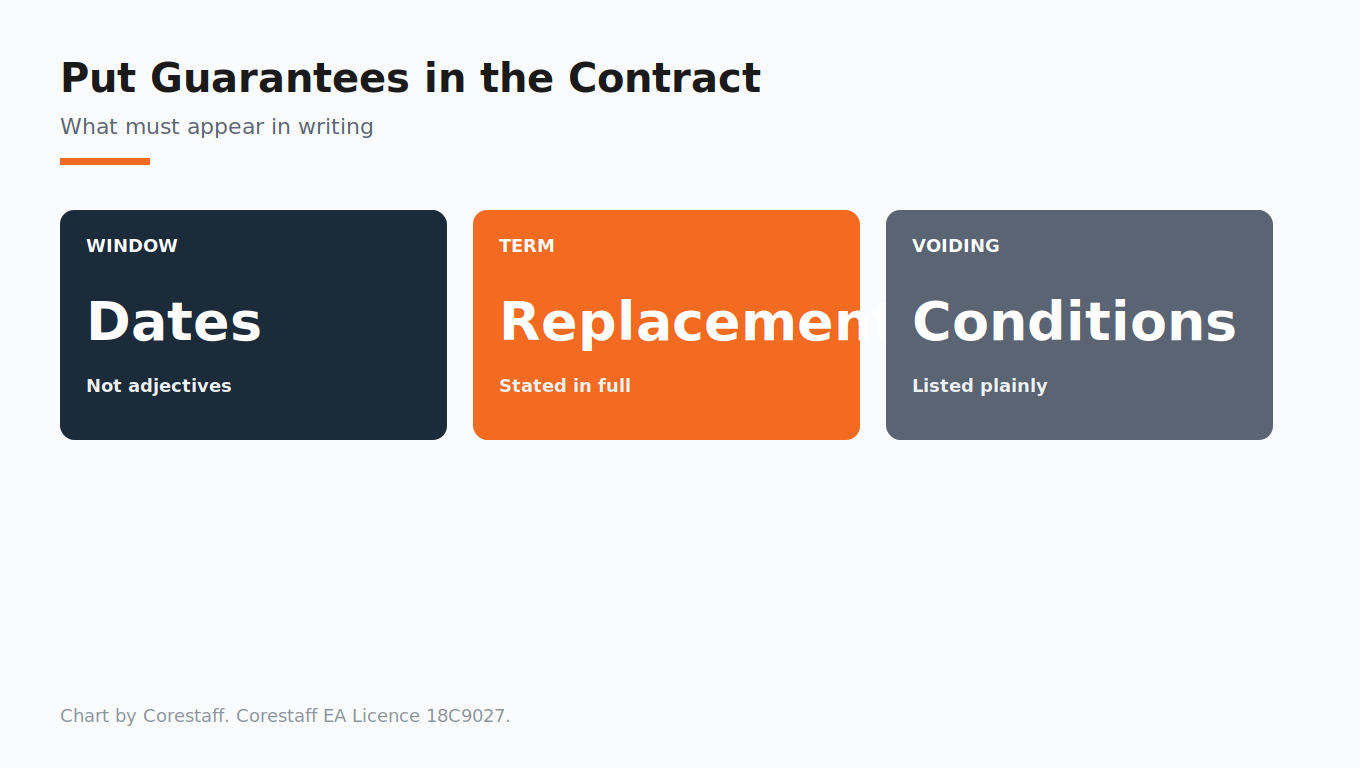
Whatever the pitch promises about replacements and time-to-fill should appear as contract language with dates and conditions. A guarantee described in a proposal and absent from the agreement is not a guarantee. Our hiring guarantee page sets out the terms we put in writing, and the fee comparison shows how those terms sit alongside each pricing model.
A four-step process from brief to contract
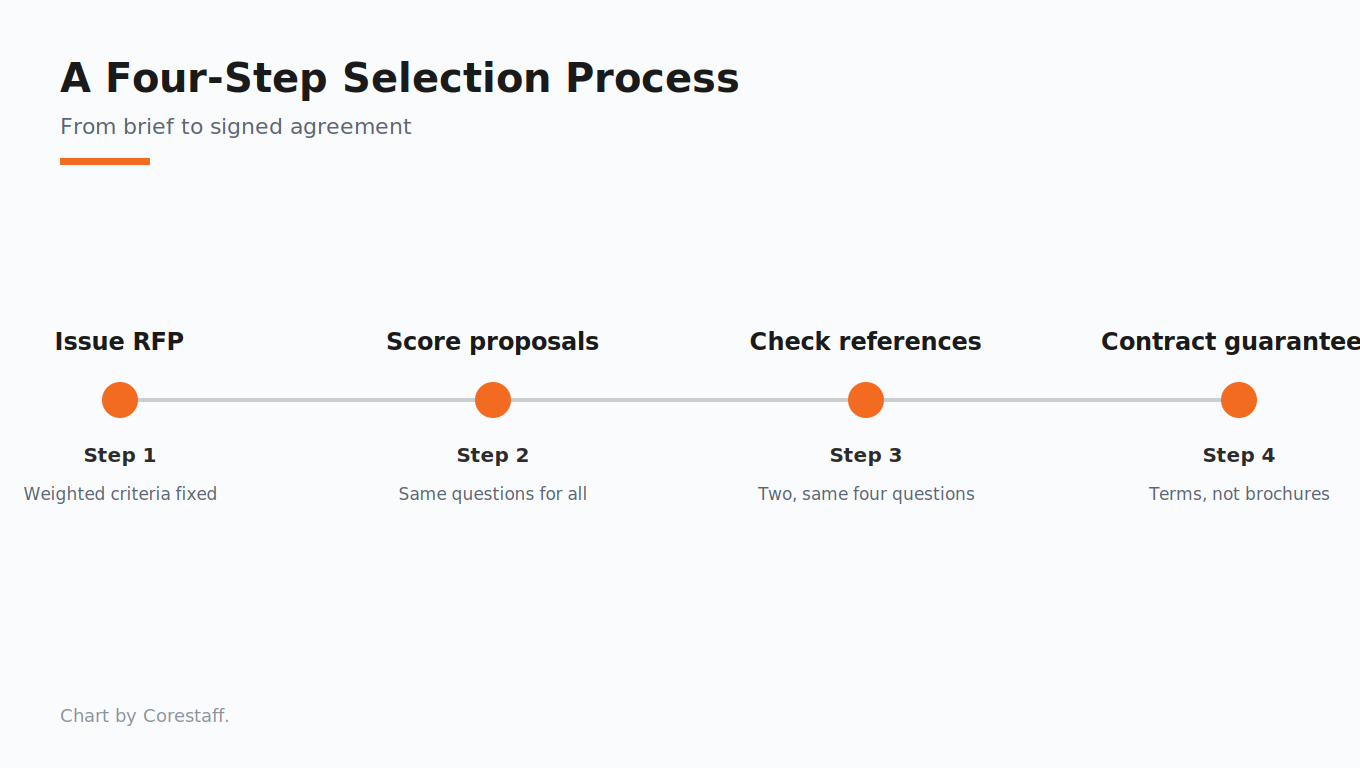
- Brief. Write the role outcome, the must-have skills and the deal-breakers in one page, and send the same page to every supplier.
- Score. Apply the pre-agreed weights to the written proposals, not to the presentations.
- Reference. Call two references per shortlisted supplier and ask the same four questions.
- Contract. Move the guarantee, the time-to-shortlist and the fee basis into the agreement before the first role goes live.
A worked selection: three suppliers, one scorecard
Three suppliers quote for the same warehouse supervisor role. Supplier A is cheapest at 12 per cent of annual salary but has placed twice in your sector in three years. Supplier B charges 18 per cent and has placed forty roles in your sector, with two references who both confirmed the replacement terms were honoured without argument. Supplier C charges a retainer and offers no named time-to-shortlist. On a weighted scorecard, where sector depth and guarantee terms carry more weight than fee, Supplier B wins despite being the most expensive on paper. The exercise is not about finding the cheapest supplier. It is about making visible why the cheapest supplier is often the most expensive one once the hire does not work out, and why a defensible decision is worth more than a discounted invoice.
Download the selection toolkit
The Agency Selection Toolkit includes the RFP template, the weighted scorecard, the reference question set and suggested guarantee clauses you can paste into a contract.
Frequently asked questions
How many agencies should I invite to an RFP?
Three to five is enough to compare on substance without creating an unmanageable evaluation load.
Should price be the heaviest weight?
Usually not. Sector depth and time-to-shortlist predict the outcome more reliably than the headline fee, so weight accordingly.
What should the RFP ask about guarantees?
Ask for the replacement window, the replacement term and the voiding conditions, and require them to appear in the final contract.
Do I need an RFP for a single senior role?
No. For a one-off senior hire, a short written brief with the guarantee terms is enough. Save the full RFP for an ongoing or multi-role engagement.
Related reading
Talk to Corestaff about this
Corestaff Pte Ltd is a Singapore employment agency, a trusted hiring partner since 2015, holding Employment Agency Licence 18C9027 under UEN 201633744E. If you want this article applied to your own workforce, our consultants will model it with you.
- Call: +65 6288 6866
- Email: recruit@corestaff.com.sg
- Visit: 175A Bencoolen Street, #11-05 Burlington Square, Singapore 189650
- Send a brief: Contact Corestaff · corestaff.com.sg