

Direct answer: Singapore’s Budget 2026 confirmed that Work Permit levy rates change from 2028. In the Services and Manufacturing sectors, levy Tiers 1 and 2 will merge into one tier, at S$600 basic-skilled and S$400 higher-skilled for Services, and S$470 basic-skilled and S$300 higher-skilled for Manufacturing. Marine Shipyard and Process sector levies rise by S$100 to S$150 per worker. Employers budgeting for 2027 and 2028 should model the merged rates now, because a Services firm whose workers sit in Tier 1 today will pay 33 percent more per worker from 2028, while Tier 2 employers see no change.
Where your levy stands in 2026
The levy you pay depends on your sector, your worker’s skill tier and how much of your quota you use. Rates are tiered so that firms hiring close to their quota ceiling pay more per worker. Here are the current monthly rates for the two sectors this guide covers:
Services sector (DRC 35 percent)
| Quota | Basic-skilled | Higher-skilled |
|---|---|---|
| Tier 1: up to 10% of workforce | S$$450 | S$$300 |
| Tier 2: above 10% to 25% | S$$600 | S$$400 |
| Tier 3: above 25% to 35% | S$$800 | S$$600 |
Manufacturing sector (DRC 60 percent)
| Quota | Basic-skilled | Higher-skilled |
|---|---|---|
| Tier 1: up to 25% of workforce | S$$370 | S$$250 |
| Tier 2: above 25% to 50% | S$$470 | S$$350 |
| Tier 3: above 50% to 60% | S$$650 | S$$550 |
Two structural notes. First, your quota position is calculated from your workforce composition, which is where the Local Qualifying Salary change covered below matters. Second, if you hire under the NTS Occupation List, your workers sit inside an 8 percent sub-DRC and must earn at least S$2,000 fixed monthly salary. Our guide to the eight new NTS occupations covers that route in detail.
What changes in 2028
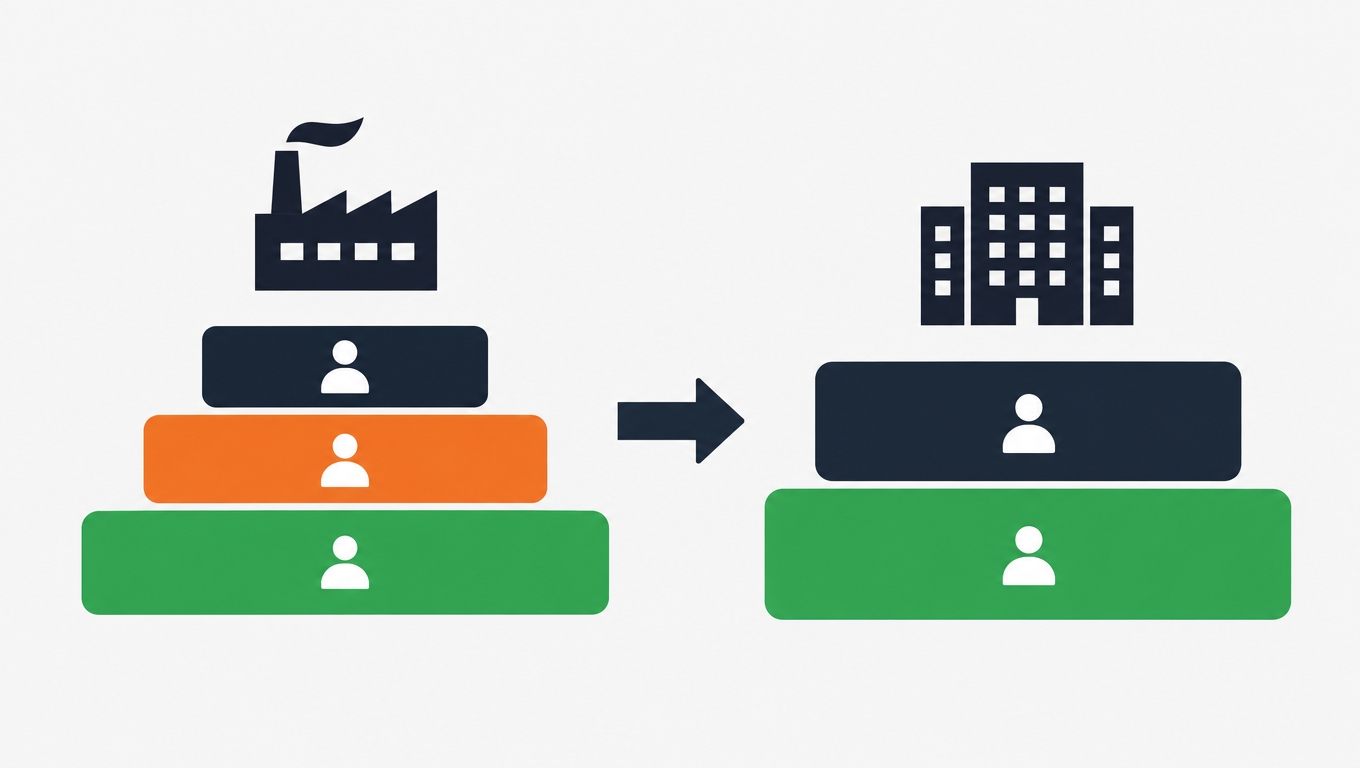
Budget 2026 simplified the levy framework for the two biggest Work Permit sectors. From 2028:
- Services: Tiers 1 and 2 merge into one tier at S$600 for basic-skilled and S$400 for higher-skilled workers. Tier 3 stays at S$800 and S$600.
- Manufacturing: Tiers 1 and 2 merge at S$470 basic-skilled and S$300 higher-skilled. Tier 3 stays at S$650 and S$550.
- Marine Shipyard: the basic-skilled levy rises by S$100, from S$500 to S$600.
- Process: the basic-skilled levy rises by S$150, from S$450 to S$600 for Malaysia, North Asian and PRC workers, and from S$650 to S$800 for Non-Traditional Sources workers. Higher-skilled rates in these two sectors are unchanged.
MOM has stated it will release the implementation timeline in due course, so the 2028 rates are confirmed but the exact effective month is not yet published.
Winners and losers by tier
The merged structure redistributes cost between low-quota and mid-quota employers. The table below shows what each position pays from 2028 versus today:
| Position in 2026 | Rate today | Rate 2028 | Change |
|---|---|---|---|
| Services T1, basic-skilled | S$$450 | S$$600 | +S$150 (+33%) |
| Services T1, higher-skilled | S$$300 | S$$400 | +S$100 (+33%) |
| Services T2, either skill | S$$600 / $400 | S$$600 / $400 | No change |
| Services T3, either skill | S$$800 / $600 | S$$800 / $600 | No change |
| Manufacturing T1, basic-skilled | S$$370 | S$$470 | +S$100 (+27%) |
| Manufacturing T1, higher-skilled | S$$250 | S$$300 | +S$50 (+20%) |
| Manufacturing T2, either skill | S$$470 / $350 | S$$470 / $350 | No change |
The practical reading: if your Services firm runs under 10 percent Work Permit density today, your per-worker levy rises by a third from 2028. If you sit between 10 and 25 percent, nothing changes. This is why the 2028 change is a planning problem, not a uniform cost shock. Firms below the mid-tier should either plan for the higher rate or deliberately structure their workforce mix to sit in the merged tier’s economics.
The quota change that arrives first: LQS from July 2026
Before the levy moves, a quieter change hits your quota maths. From 1 July 2026, the Local Qualifying Salary (LQS) rises from S$1,600 to S$1,800 per month. Every local employee earning below the LQS stops counting as a full local worker in your DRC calculation, which can shrink your Work Permit entitlement before a single levy dollar changes.
Audit your local payroll now: any Singaporean or PR employee earning between S$1,600 and S$1,799 needs a salary review or a headcount plan adjustment before July 2026, otherwise your quota base erodes silently.
Pass floors rising in 2027
The levy is only one line in the pass-mix budget. From 1 January 2027, the EP minimum qualifying salary rises to S$6,000 (S$6,600 for financial services) for new applications, and renewals follow from 1 January 2028. The S Pass floor moves to S$3,600 for all sectors and S$4,000 for financial services. Roles squeezed out of these passes either get re-benchmarked upward or shift to the Work Permit route, which is exactly where the how to hire under the new NTS list becomes relevant for food services, childcare and air transport roles.
Three budgeting moves to make in Q4

- Map every worker to their 2028 rate. List each Work Permit holder by sector, skill tier and current quota position, then price the merged 2028 rate. For most firms this is a one-afternoon spreadsheet exercise that removes the biggest unknown from the 2028 budget.
- Fix LQS exposure before July 2026. Identify local staff between S$1,600 and S$1,800 and decide whether to raise salaries or absorb the quota effect. This change lands before the levy does and is fully in your control.
- Re-benchmark pass mix against the 2027 floors. Roles sitting between the old and new EP and S Pass floors need a decision: raise pay, restructure the role, or move it to the Work Permit route. Deciding in Q4 2026 avoids renewals surprises through 2027 and 2028.
For the full per-hire cost picture beyond the levy, including security bonds, insurance and medical cover, see what each foreign hire costs beyond the levy, and for the salary floors specifically, our which of your staff fall below the new floors lists which staff fall below the new floors.
How Corestaff helps you plan the pass mix
Corestaff, the Singapore recruitment agency, builds levy and pass-mix projections into every foreign hiring plan, so the budget you approve in Q4 holds through 2028. Whether you need new hires under the current rules or a re-plan of your existing workforce, our our foreign worker recruitment services handles sourcing, pass applications and quota checks end to end. get a costed foreign hiring plan to get a costed plan for your headcount.
Frequently asked questions
When do the new Work Permit levy rates take effect?
The tier merger for the Services and Manufacturing sectors and the levy increases for the Marine Shipyard and Process sectors take effect in 2028. MOM has said it will release the detailed implementation timeline in due course, so plan your 2028 budget with the merged rates as the working assumption.
How much more levy will I pay from 2028?
It depends on which tier your workers sit in today. A Services employer with workers in Tier 1 pays S$150 more per basic-skilled worker per month (S$450 to S$600) and S$100 more per higher-skilled worker (S$300 to S$400). Tier 2 rates do not change, and Tier 3 is untouched. In Manufacturing, Tier 1 basic-skilled rises S$100 (S$370 to S$470) and higher-skilled rises S$50 (S$250 to S$300).
Does the levy change affect my quota?
No change to the Dependency Ratio Ceiling has been announced for Services (35 percent) or Manufacturing (60 percent). What does affect your quota from 1 July 2026 is the Local Qualifying Salary rise to S$1,800, because local employees who fall below it stop counting towards your workforce base.
What is the difference between basic-skilled and higher-skilled levy?
Higher-skilled (R1) workers pay a lower levy if they meet your sector’s qualifying criteria, such as a recognised qualification, a minimum fixed salary and relevant Work Permit experience. In Manufacturing, for example, that means an ITE or WSQ recognised qualification, at least S$1,600 fixed monthly salary, or four years of Work Permit experience in Singapore.
Should I rush hiring before 2028?
Not automatically. If your workers sit in Tier 2 today, the merged 2028 rate equals what you already pay. If they sit in Tier 1, model the increase across your headcount and compare it against the cost of a rushed hire. A structured approach usually beats a deadline-driven one.